Sequential vs Parallel Agent Execution
The fastest multi-agent workflow is not the one with the most parallel branches. It is the one that respects real dependencies while running genuinely independent work at the same time.
Sequential execution passes work through an ordered chain. Parallel execution fans work out to concurrent branches and fans results back into an aggregator. Most production systems need both.
This comparison explains the control-flow, context, cost, synchronization, and failure implications behind that choice.
TL;DR
- Use sequential execution when a step requires the output or decision of an earlier step.
- Use parallel execution when branches can start from stable inputs and do not need one another’s intermediate results.
- Parallelism can reduce elapsed time, but it usually increases coordination and aggregation work.
- A sequential agent chain is not necessarily a handoff, and parallel calls are not necessarily a multi-agent system.
- Hybrid fan-out/fan-in workflows are the normal production pattern.
The two execution shapes
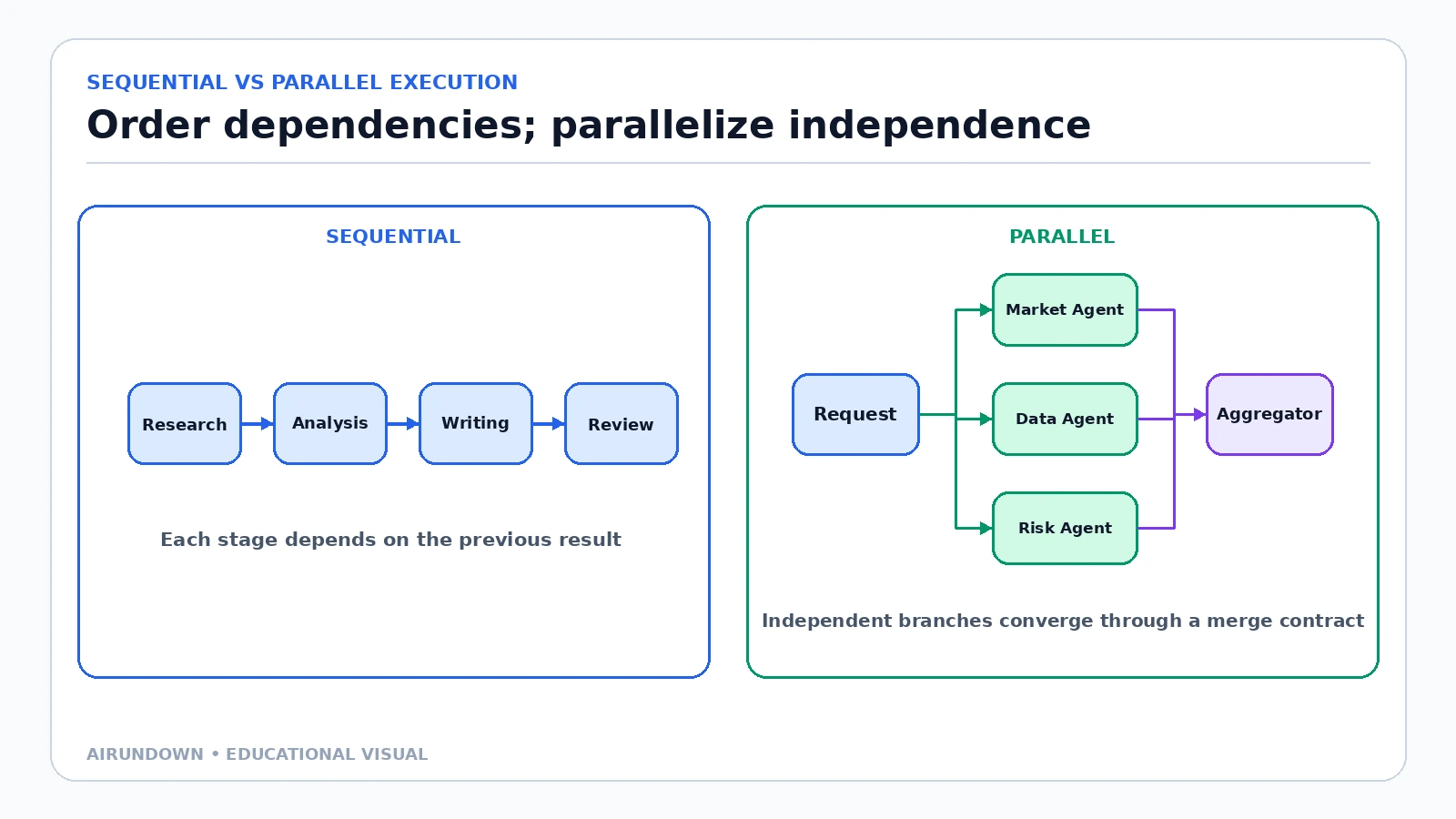
Sequential execution preserves dependencies; parallel execution reduces wall-clock time only when branches are sufficiently independent.
In a sequential workflow, one stage finishes before the next starts:
Research Agent → Analysis Agent → Writing Agent → Review Agent
The analysis agent needs the research result. The writer needs the analysis. The reviewer needs the draft. Order expresses data dependency, not merely preference.
In a parallel workflow, several branches start from a common input:
User Request → Market Agent + Data Agent + Risk Agent → Aggregator → Result
The specialists can work independently. The aggregator waits for the required branches, validates their outputs, resolves conflicts, and produces the combined result.
These are execution patterns inside a broader [agent workflow](/glossary/agent-workflow/). [Workflow orchestration](/glossary/workflow-orchestration/) determines when steps run, what state they receive, how failures are handled, and when the run advances.
Side-by-side comparison
| Dimension | Sequential execution | Parallel execution |
|---|---|---|
| Dependency handling | Natural fit for ordered dependencies | Requires branches to be independent or carefully isolated |
| Latency | Sum of stage durations on the critical path | Approaches the slowest required branch plus merge time |
| Complexity | Simpler control flow and debugging | Adds fan-out, synchronization, aggregation, and partial failure |
| State synchronization | Usually one writer at a time | Concurrent updates need ownership or merge rules |
| Failure handling | A failed stage blocks downstream stages | One branch may fail while others succeed; policy must define quorum or fallback |
| Cost | Easier to budget step by step | Concurrent calls may increase total model and tool use |
| Context transfer | Each stage can receive the previous result | Branches need a stable common brief and scoped local context |
| Best use cases | Transformations, reviews, dependent decisions | Independent research, multiple perspectives, validation, voting |
Parallel execution changes wall-clock time, not the amount of work. Three ten-second branches may finish in roughly the time of the slowest branch, but they still consume three branch executions plus aggregation.
Sequential execution in detail
Sequential execution is appropriate when later work would be invalid or wasteful before an earlier result exists.
Typical dependencies include:
- research before evidence-based analysis;
- extraction before normalization;
- a plan before implementation;
- implementation before testing;
- draft before review;
- approval before an external action.
The handoff between stages should be an explicit result contract. Instead of forwarding an entire conversation, the research stage might return:
- claims with source references;
- unresolved questions;
- confidence or coverage indicators;
- a concise summary;
- an artifact location.
The analysis agent receives what it needs, not every token the research agent saw.
Strengths
Sequential workflows are easy to trace because there is one main critical path. State updates are less likely to collide, and each stage can validate its input before starting.
They are also useful when deliberate gates matter. A human approval step is inherently sequential if execution must stop until approval arrives.
Weaknesses
Latency accumulates across stages. If the research stage takes 20 seconds, analysis 15, drafting 20, and review 10, the chain cannot finish in less than their combined critical path.
Errors also propagate. A flawed research output can cause confident but wrong analysis, which leads to a polished but unreliable draft. Each boundary therefore needs validation, not blind forwarding.
Parallel execution in detail
Parallel execution uses fan-out to create multiple runnable branches and fan-in to synchronize and merge them.
It works well in two broad situations:
- Sectioning: split one task into independent components, such as product, market, and risk analysis.
- Multiple perspectives or attempts: ask separate evaluators to inspect accuracy, safety, and completeness, or run independent attempts when diversity is useful.
Parallel branches should receive:
- the same stable goal or normalized input;
- a bounded subtask;
- permitted tools and data;
- a result schema;
- a deadline or timeout;
- a unique branch identifier.
Synchronization and aggregation
The aggregator needs a completion policy. It may wait for:
- all required branches;
- any successful branch;
- a minimum quorum;
- a deadline followed by partial synthesis;
- one primary result plus optional enrichments.
That policy changes reliability and latency. Waiting for every optional branch allows the slowest worker to hold the whole workflow. Finishing after the first answer may discard useful evidence.
Aggregation must also preserve provenance. If two agents disagree on a market figure, the aggregator should compare evidence and scope rather than average the numbers.
State synchronization
Parallel branches should not freely overwrite the same state fields. Safer designs use:
- one owner per field;
- append-only branch result collections;
- version checks;
- deterministic reducers;
- artifact references;
- a single aggregator that writes the combined result.
The [shared state and context article](/shared-state-and-context-in-multi-agent-systems/) covers these controls in detail.
Hybrid fan-out and fan-in
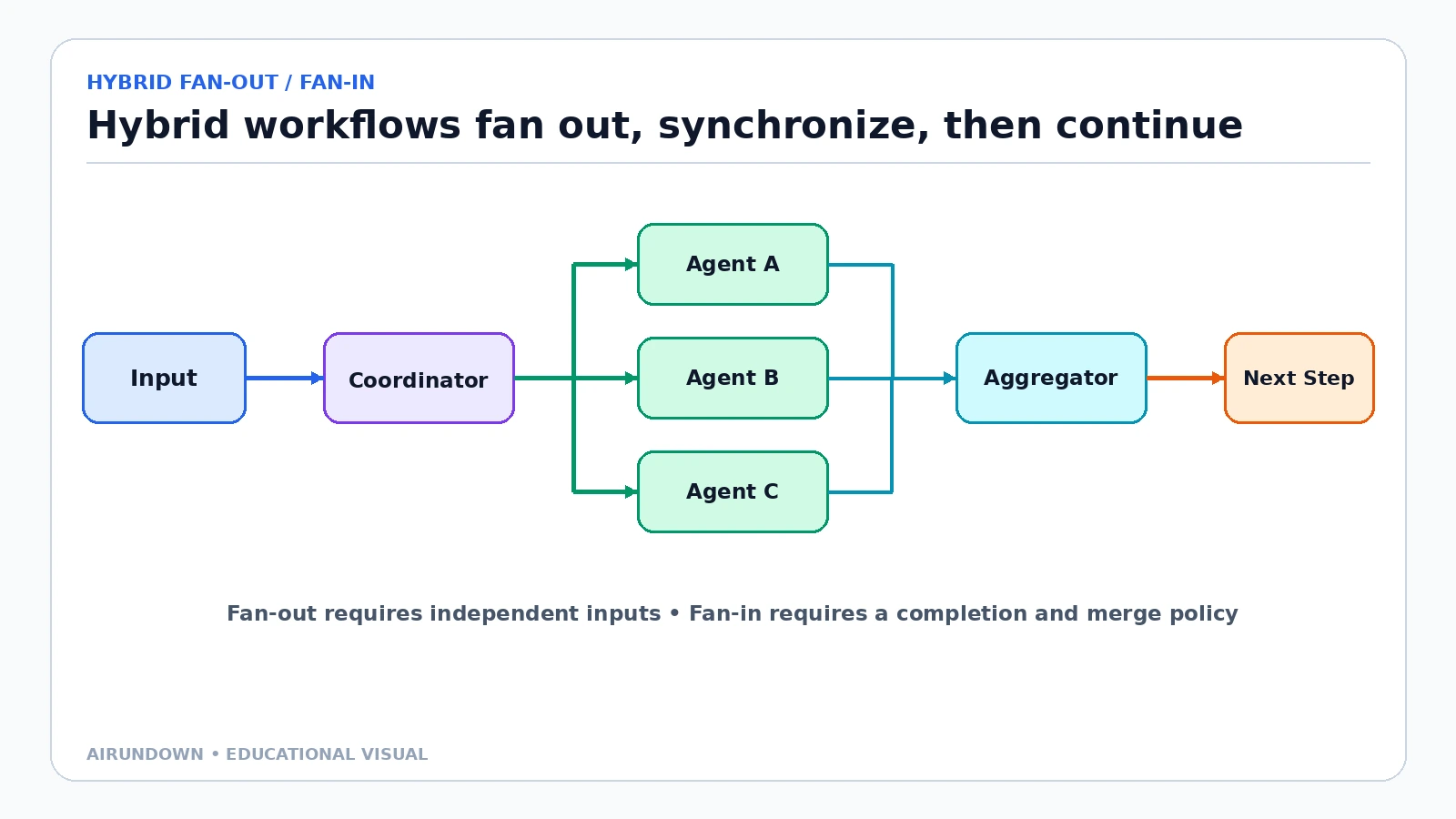
Most production workflows are hybrid: prepare once, fan out independent work, fan in through an explicit merge contract, then continue.
A practical workflow often looks like:
Step A → parallel B/C/D → aggregate → Step E
For a due-diligence report:
- A coordinator validates the request and creates a common company profile.
- Market, financial, and risk agents run concurrently.
- An aggregator checks required outputs, identifies contradictions, and produces an evidence map.
- A writing agent creates the report.
- A reviewer validates coverage and citations.
The initial preparation and final synthesis are sequential. The evidence-gathering branches are parallel.
The design principle is simple: parallelize across independent work, not through a dependency.
Context transfer and information boundaries
Sequential stages tend to accumulate context because every step can inherit previous results. Without compression, the final agent may receive a huge prompt containing raw sources, intermediate reasoning, drafts, and review notes.
Parallel branches have the opposite risk: inconsistency. If the shared brief is ambiguous or updated after fan-out, branches may work from different assumptions.
Use a versioned task brief. Give each branch only its slice plus necessary shared facts. Store large artifacts once and pass references. At fan-in, record which version each result used.
These practices improve both token efficiency and debuggability.
Failure handling
Sequential and parallel designs fail differently.
Sequential failures
If a stage fails, downstream stages usually cannot run. The orchestrator can retry the same stage, route to a fallback, request human input, or restore a checkpoint. Retrying the whole chain wastes completed work.
An [agent handoff](/glossary/agent-handoff/) can also fail if ownership transfers but the destination never accepts the task. The state should record pending, accepted, completed, or failed transfer—not merely “sent.”
Parallel failures
Parallel execution produces partial success. The system must decide whether a missing branch is:
- required and blocking;
- optional and skippable;
- retryable;
- replaceable by another worker;
- grounds for a partial result;
- grounds for human escalation.
Retrying only the failed branch is efficient, but the retried result must still correspond to the same input version. If upstream state changed, the entire fan-out may need re-evaluation.
Common confusions
Parallel execution vs multi-agent system
Parallelism is a scheduling choice. A program can make three concurrent calls to the same model with no persistent agent identity. Conversely, a multi-agent system may run entirely sequentially through handoffs.
Sequential agents vs agent handoff
Sequential order says when components run. A handoff says ownership transfers. An orchestrator can sequentially call four specialist agents while retaining control throughout. See [Handoffs, Delegation, and Sub-Agents](/agent-handoffs-delegation-sub-agents/) for the ownership distinction.
Parallel agents vs concurrent tool calls
An agent may concurrently call weather, inventory, and pricing tools. Those calls do not become agents merely because they run in parallel. A tool performs a bounded capability; an agent can pursue a goal and choose actions. [Tool calling](/glossary/tool-calling/) and [tool results](/glossary/tool-result/) define that boundary.
Execution order vs orchestration
Order is one orchestration concern. [Agent Workflows and Orchestration](/agent-workflows-and-orchestration/) also covers dependencies, state, retries, timeouts, checkpoints, branches, approvals, and stopping.
When not to parallelize
Avoid parallel branches when:
- one branch needs another’s result;
- all branches write the same mutable resource;
- the task is too small to justify setup and merge cost;
- API or infrastructure limits make concurrency unstable;
- the aggregator cannot reliably reconcile outputs;
- the same data must be read under a strict consistency point;
- speculative work would be expensive or risky.
Also avoid “fake parallelism,” where three agents independently rediscover the same background before producing nearly identical outputs. Better task decomposition gives each branch a distinct job.
A decision procedure
For each candidate pair of tasks, ask:
- Does task B require task A’s result?
- Can both use the same stable input version?
- Can their writes be isolated?
- Is there a clear result schema and merge policy?
- Is reduced elapsed time worth additional calls and failure handling?
If the first answer is yes, sequence them. If the next three are yes and latency matters, parallel execution is reasonable. If the answers vary, build a hybrid graph.
My take
Parallelism should be earned by dependency analysis. “Run more agents” is not a performance strategy.
The most reliable architecture keeps the critical path sequential, fans out only bounded independent work, and treats fan-in as a first-class validation step rather than a prompt that says “combine these.”
Sources
- Agent orchestration in the OpenAI Agents SDK documents code-led chaining and parallel execution for tasks without dependencies.
- Building Effective AI Agents distinguishes prompt chaining, parallel sectioning, voting, and dynamic orchestrator-worker decomposition.
- LangGraph workflows and agents shows parallel branches, routing, and orchestrator-worker patterns with shared results.
Continue learning
Review [Multi-Agent Coordination Patterns](/multi-agent-coordination-patterns/) for the larger team design, then use [Agent Graphs and State Machines](/agent-graphs-and-state-machines/) to make branches, synchronization, and terminal paths explicit.