AI Agent Cost Optimization
Control the cost of successful agent outcomes, not merely the price of one model call.
TL;DR
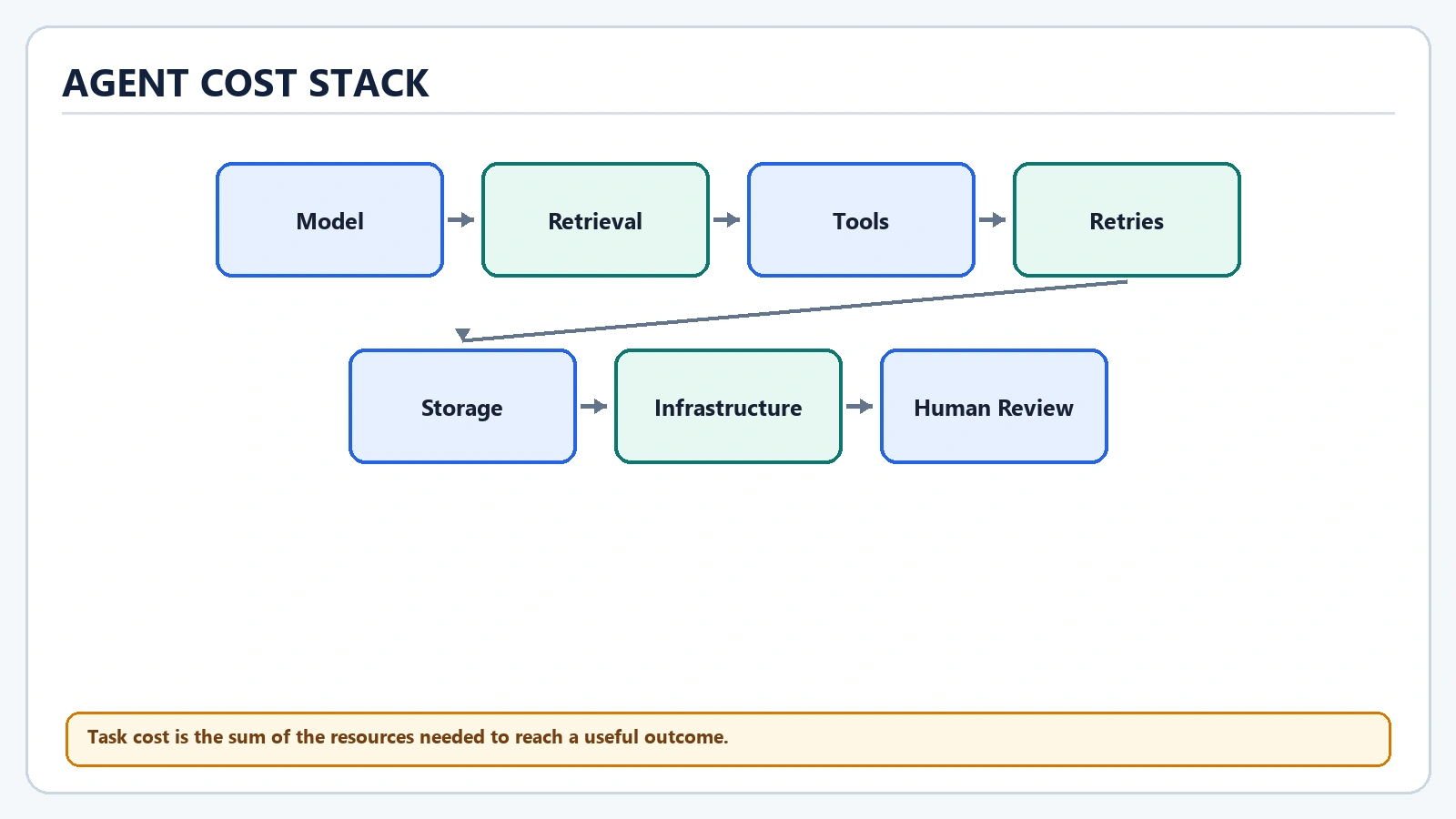
- The useful cost unit is the completed business task. Model tokens matter, but so do repeated reasoning, tools, search, embeddings, storage, infrastructure, observability, human review, failed runs, and duplicate multi-agent work. A cheap call can be part of an expensive failure loop.
- Start by making input and output tokens and repeated reasoning and reflection visible in the complete task path.
- Avoid the shortcut of always using the largest model; test the failure state before release.
- Judge the result with cost per successful task and success and evaluation score, not an isolated infrastructure number.
The production mental model
The useful cost unit is the completed business task. Model tokens matter, but so do repeated reasoning, tools, search, embeddings, storage, infrastructure, observability, human review, failed runs, and duplicate multi-agent work. A cheap call can be part of an expensive failure loop.
Keep five layers separate. Model optimization changes inference; agent optimization changes decisions and tool use; workflow optimization changes sequencing and recovery; infrastructure optimization changes capacity and execution; business optimization changes whether the result is worthwhile. For AI Agent Cost Optimization, the most revealing evidence is usually cost per successful task together with success and evaluation score. That pairing prevents a local improvement from disguising a worse task outcome.
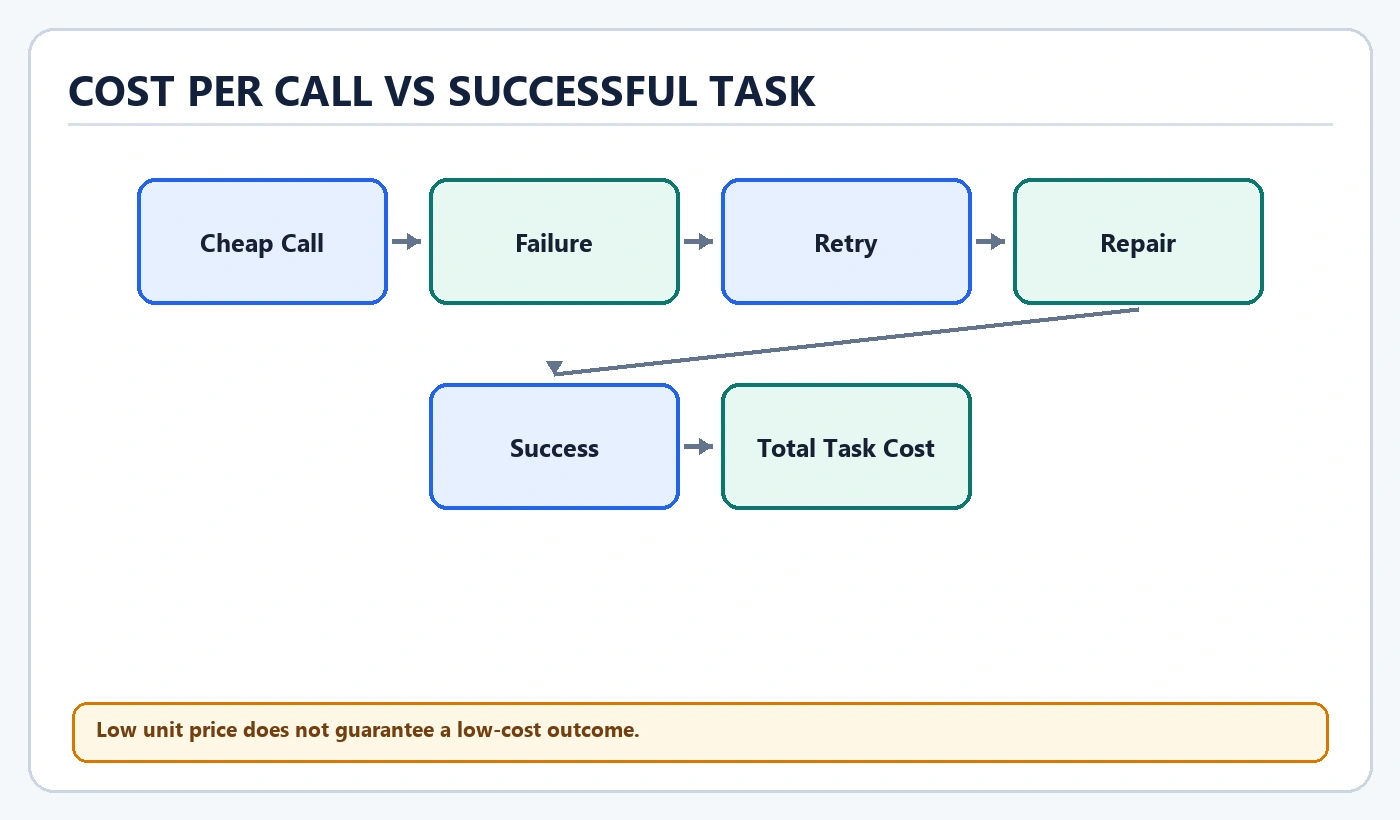
Low unit price does not guarantee a low-cost outcome.
A concrete example
Option A uses a low-cost model but makes eight attempts, repeats retrieval, generates invalid tool arguments, and needs human repair. Option B uses a more capable model twice and completes the task. Without real measurements neither option is automatically cheaper; cost per successful task combines unit prices, call counts, failure rates, and operational work.
The example is deliberately vendor-neutral. Exact provider limits, prices, model features, and service guarantees change; the durable design is to discover those values from the selected service, keep them in versioned configuration, and test the behavior that occurs when an assumption stops being true.
How the system works
- Input and output tokens. Trace it as part of the complete task so local improvements do not hide downstream cost or failure.
- Repeated reasoning and reflection. Give it an explicit owner, boundary, and failure result; implicit behavior becomes difficult to test.
- Paid tools, search, and apis. Measure it by workload class because read-only, interactive, background, and side-effecting tasks have different constraints.
- Embeddings, retrieval, and reranking. Keep the mechanism deterministic where it enforces identity, authority, durability, or resource limits.
- Storage and infrastructure. Trace it as part of the complete task so local improvements do not hide downstream cost or failure.
- Retries and failed executions. Give it an explicit owner, boundary, and failure result; implicit behavior becomes difficult to test.
- Multi-agent duplication. Measure it by workload class because read-only, interactive, background, and side-effecting tasks have different constraints.
- Telemetry and evaluation. Keep the mechanism deterministic where it enforces identity, authority, durability, or resource limits.
- Human review. Trace it as part of the complete task so local improvements do not hide downstream cost or failure.
- Opportunity cost of poor outcomes. Give it an explicit owner, boundary, and failure result; implicit behavior becomes difficult to test.
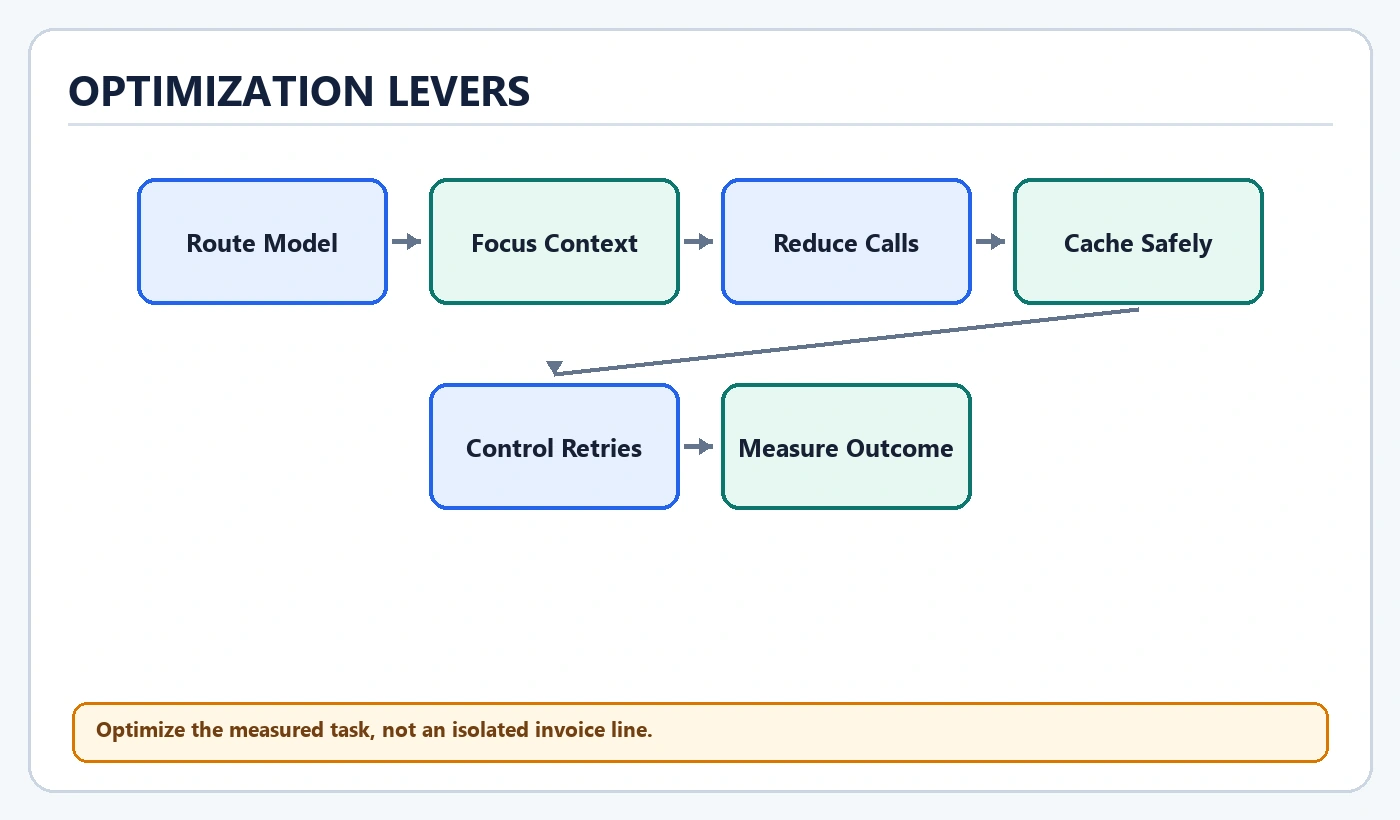
Optimize the measured task, not an isolated invoice line.
A practical implementation path
1. Define success and measure complete task cost
Write down the current baseline and the evidence that would disprove the change. For this step, inspect paid tools, search, and APIs, watch cost per successful task, and explicitly test always using the largest model. Record the assumption, owner, expected result, and safe terminal state so the team can distinguish a genuine improvement from work shifted elsewhere in the system.
2. Break cost down by model, workflow, tools, infrastructure, and review
Place this responsibility in the component that can enforce it consistently. For this step, inspect embeddings, retrieval, and reranking, watch success and evaluation score, and explicitly test always using the cheapest model. Record the assumption, owner, expected result, and safe terminal state so the team can distinguish a genuine improvement from work shifted elsewhere in the system.
3. Route each step to the least costly model that meets quality
Version the decision so a run can be reconstructed after dependencies change. For this step, inspect storage and infrastructure, watch model and tool calls per task, and explicitly test sending full history on every turn. Record the assumption, owner, expected result, and safe terminal state so the team can distinguish a genuine improvement from work shifted elsewhere in the system.
4. Reduce irrelevant context and constrain outputs
Exercise the denied, unavailable, stale, duplicate, and unknown-result paths as applicable. For this step, inspect retries and failed executions, watch retry and escalation rate, and explicitly test unnecessary self-reflection. Record the assumption, owner, expected result, and safe terminal state so the team can distinguish a genuine improvement from work shifted elsewhere in the system.
5. Remove redundant calls and deterministic model work
Use a production-representative trajectory; an empty endpoint test misses accumulated agent behavior. For this step, inspect multi-agent duplication, watch token use by context component, and explicitly test duplicate specialist work. Record the assumption, owner, expected result, and safe terminal state so the team can distinguish a genuine improvement from work shifted elsewhere in the system.
6. Cache reusable results with freshness and authorization controls
Keep identity, permission, and resource limits outside model discretion. For this step, inspect telemetry and evaluation, watch cost distribution by task class, and explicitly test unlimited retries. Record the assumption, owner, expected result, and safe terminal state so the team can distinguish a genuine improvement from work shifted elsewhere in the system.
7. Bound tokens, calls, elapsed time, and retries
Bound the work and define what happens when the bound is exhausted. For this step, inspect human review, watch cost per successful task, and explicitly test retrieving far more context than needed. Record the assumption, owner, expected result, and safe terminal state so the team can distinguish a genuine improvement from work shifted elsewhere in the system.
8. Evaluate changes against quality and completion rate
Attach telemetry to the task and compare the result with the previous version. For this step, inspect opportunity cost of poor outcomes, watch success and evaluation score, and explicitly test ignoring failed-task cost. Record the assumption, owner, expected result, and safe terminal state so the team can distinguish a genuine improvement from work shifted elsewhere in the system.
9. Segment costs by task class and tenant
Roll out gradually when the decision can affect live users or external systems. For this step, inspect input and output tokens, watch model and tool calls per task, and explicitly test always using the largest model. Record the assumption, owner, expected result, and safe terminal state so the team can distinguish a genuine improvement from work shifted elsewhere in the system.
10. Optimize the largest verified contributor first
Remove the mechanism if it adds burden without improving the intended outcome. For this step, inspect repeated reasoning and reflection, watch retry and escalation rate, and explicitly test always using the cheapest model. Record the assumption, owner, expected result, and safe terminal state so the team can distinguish a genuine improvement from work shifted elsewhere in the system.
Failure modes and anti-patterns
These mistakes are attractive because they appear to simplify the happy path. They move complexity into incidents, duplicate work, wrong outcomes, or unexplained bills:
- always using the largest model
- always using the cheapest model
- sending full history on every turn
- unnecessary self-reflection
- duplicate specialist work
- unlimited retries
- retrieving far more context than needed
- ignoring failed-task cost
Test each failure with the same seriousness as the successful path. Capture whether the system confirmed success, confirmed failure, returned a partial result, entered a degraded mode, or ended with an unknown external outcome. An unknown result must never be silently rewritten as success or treated as definitely safe to repeat.
Commonly confused concepts
| Concept | Meaning | Compared with | Meaning |
|---|---|---|---|
| Model cost | price of inference calls | Agent cost | cost of the complete execution |
| Token cost | usage-based model component | Infrastructure cost | runtime, storage, network, and operations |
| Cheap model | low unit price | Cheap task | low total cost at acceptable success and quality |
| Cost optimization | reduce outcome cost | Latency optimization | reduce elapsed time |
The distinctions matter because each mechanism promises something different. A queue does not create capacity; a timeout does not prove an operation failed; a larger context does not guarantee relevance; and an alternate path does not become safe merely because the primary path is unavailable.
What to measure
- cost per successful task
- success and evaluation score
- model and tool calls per task
- retry and escalation rate
- token use by context component
- cost distribution by task class
Segment these signals by task type, deployment version, route, dependency, and tenant where appropriate. Averages alone can hide slow or failing task classes. Prefer cost and latency attached to successful, quality-checked outcomes. Use traces for causal investigation, metrics for trends, logs for discrete evidence, and production evaluations for behavioral quality. Do not invent a universal threshold: derive action levels from the service objective, baseline, consequence, and time available to respond.
When the complexity is unnecessary
A local, read-only experiment with public data and no durable workflow may not need the full machinery described here. For AI Agent Cost Optimization, begin with the simplest observable path that can measure cost per successful task. Add complexity when input and output tokens, repeated reasoning and reflection, or the consequences of always using the largest model create a concrete need. Simplicity is valuable only while it preserves the required outcome and makes failure visible.
Builder checklist
- Define the task, success evidence, and terminal failure states.
- Map input and output tokens, repeated reasoning and reflection, and paid tools, search, and APIs onto owned components.
- Rehearse always using the largest model and always using the cheapest model before increasing exposure.
- Bound calls, tokens, retries, elapsed time, queueing, and external side effects.
- Verify important outcomes before reporting completion.
- Compare changes using production-representative evaluations.
- Monitor cost per successful task beside success and evaluation score.
- Maintain a clear fallback, escalation, or safe-stop path.
My Take
The strongest approach to AI Agent Cost Optimization is to make its boundary measurable before making it clever. My default is to expose input and output tokens, attach it to cost per successful task, and preserve a clear response to always using the largest model. That creates a system a team can improve deliberately instead of one that looks efficient only on its happy path.
Continue learning
- [Token Cost](/glossary/token-cost/)
- [Ai Agent Evaluation Explained](/ai-agent-evaluation-explained/)
- [Context And Token Cost Optimization](/context-and-token-cost-optimization/)
- [Model Routing For Ai Agents](/model-routing-for-ai-agents/)
- [Caching Strategies For Ai Agent Systems](/caching-strategies-for-ai-agent-systems/)
Sources
These stable primary references support the standards and distributed-systems concepts used above; no current vendor pricing or product limits are asserted.