Planning in AI Agents: From Goals to Adaptive Action
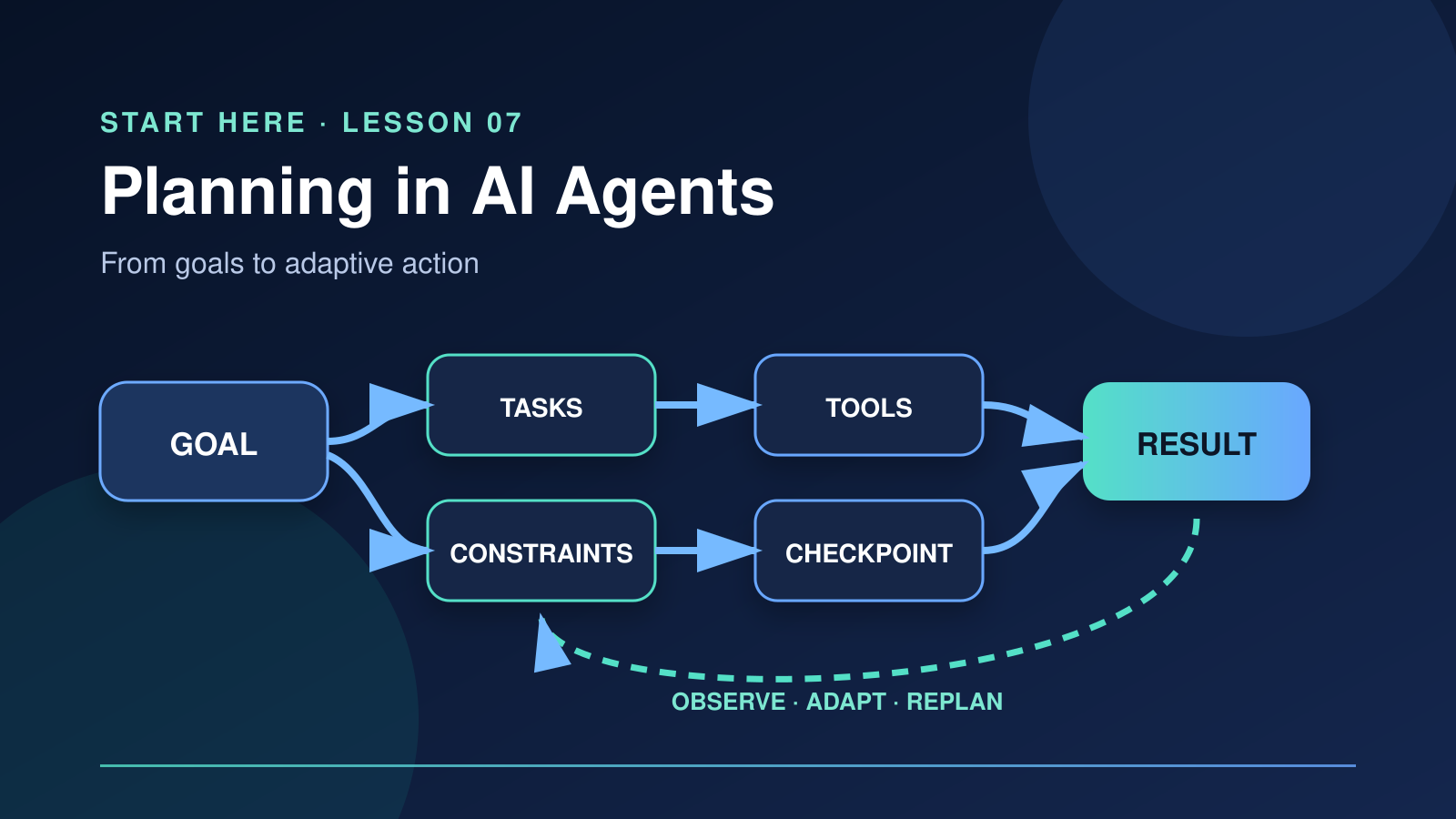
Planning is how an AI agent turns “what I want” into “what should happen next”—without assuming the first route will survive contact with reality.
If the goal is trivial, an agent may act immediately. If the goal spans multiple steps, tools, dependencies, or changing conditions, the agent needs a plan it can execute and revise.
This lesson builds that mental model from first principles.
TL;DR
- A plan is an ordered, constraint-aware route from the current state to a goal.
- Planning includes decomposition, sequencing, dependencies, priorities, tools, checkpoints, and stopping conditions.
- Reasoning helps the agent decide; planning organizes decisions across future steps.
- Fixed workflows prescribe a path in advance. Agent plans can be generated and revised at runtime.
- More planning is not always better. Use it when mistakes, dependencies, or changing conditions make direct action risky.
What planning means in an AI agent
An [AI agent](/what-is-an-ai-agent/) receives a goal, evaluates its situation, takes actions, observes results, and continues until it should stop. Planning is the part that organizes those actions across time.
A practical definition is:
Planning is the process of selecting and organizing future actions that can move an agent from its current state toward a goal while respecting dependencies, constraints, and available capabilities.
A useful plan answers seven questions:
- What outcome counts as success?
- What smaller results are needed first?
- In what order should they happen?
- Which steps depend on other steps?
- Which tools or actions can complete each step?
- How will the agent know whether it is making progress?
- When should it finish, retry, replan, or stop?
This extends the execution loop introduced in [How AI Agents Work](/how-ai-agents-work/). Instead of choosing only the next action, the agent maintains enough structure to coordinate several actions toward one outcome.
The practical planning loop
At a beginner level, agent planning can be understood as:
Goal → Break Into Tasks → Order Tasks → Choose Actions/Tools → Execute → Observe Progress → Replan if Needed → Finish
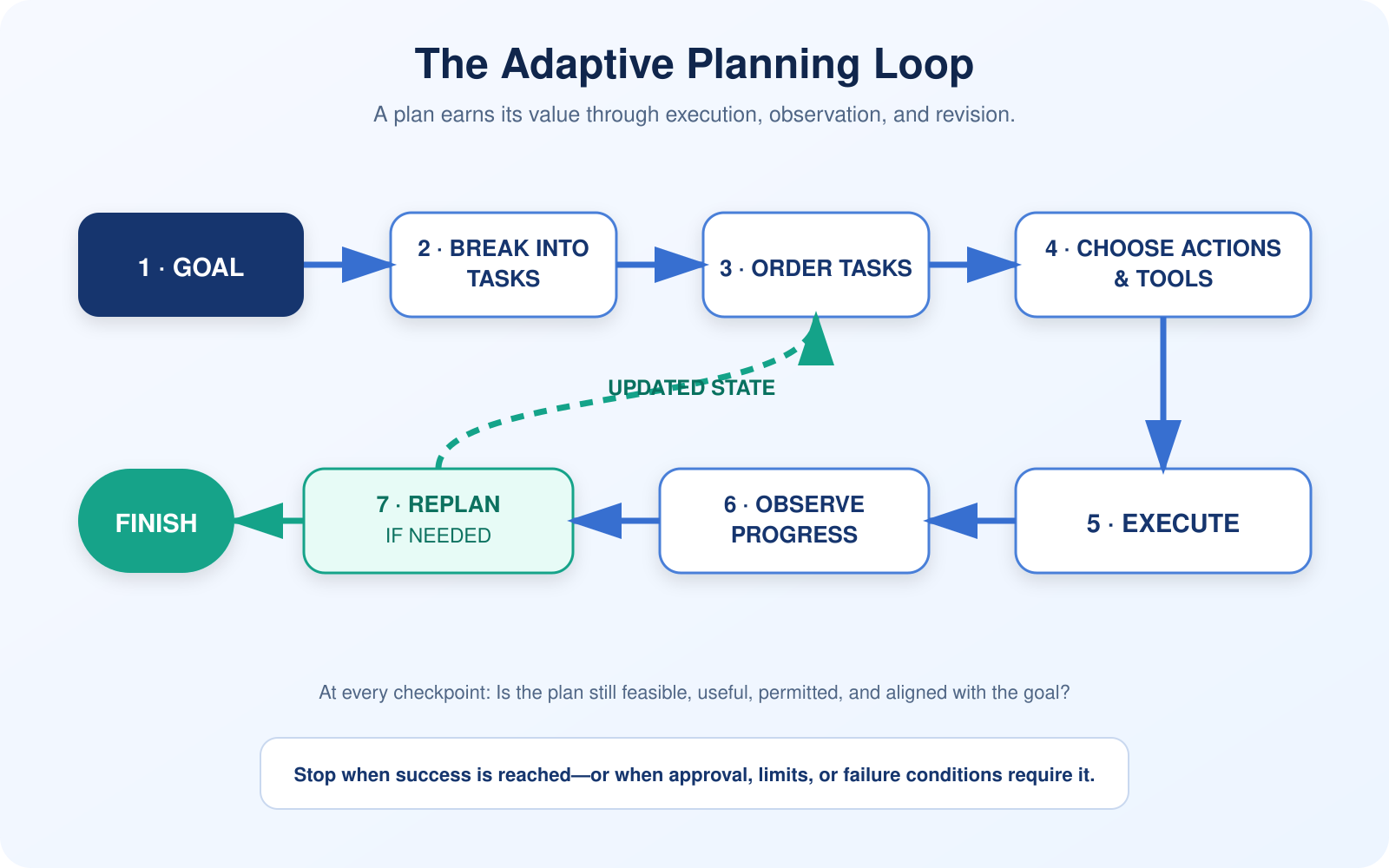
Each stage has a distinct job.
1. Goal
The goal defines the desired outcome. “Research electric vehicle trends” is a topic, not yet a precise finish line. A more useful goal is:
Produce a cited two-page briefing on 2026 electric vehicle market trends for a product strategy meeting.
The improved goal provides an artifact, scope, quality expectation, audience, and use.
2. Break into tasks
The agent converts the goal into smaller units of work. These might include:
- define the research questions;
- find credible sources;
- extract evidence;
- compare findings;
- draft the briefing;
- verify citations;
- format the final output.
This is task decomposition. Some tasks may also represent subgoals—intermediate outcomes that must be achieved, such as “obtain three independent sources for each major claim.”
3. Order tasks
The agent sequences the work. Ordering is not merely putting items in a list. It must account for:
- Dependencies: drafting depends on having evidence.
- Constraints: only approved sources may be used.
- Priorities: time-sensitive facts may need verification first.
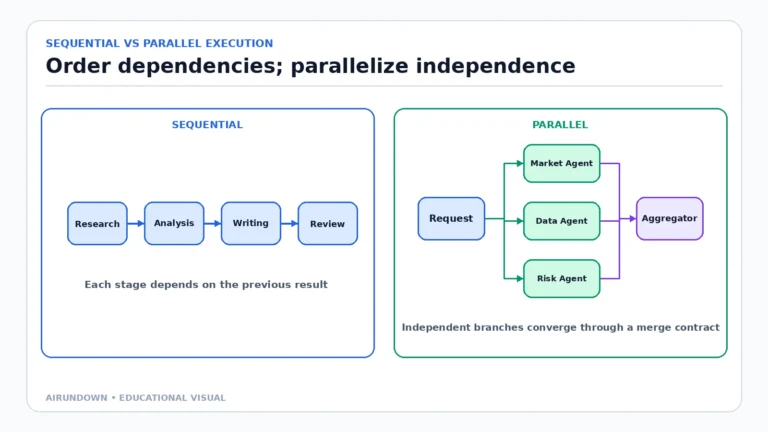
- Parallel work: independent research questions may be investigated at the same time.
- Risk: uncertain or expensive steps may be tested early.
4. Choose actions and tools
A plan becomes executable only when tasks map to capabilities. The agent may choose search for discovery, a database for records, code execution for calculation, or an external application for delivery.
This is tool-aware planning: the agent plans around what its tools can actually do, including their inputs, costs, permissions, and limits. [Tool Use in AI Agents](/tool-use-in-ai-agents/) explains how the agent selects, calls, and observes those tools.
5. Execute
The agent takes the next permitted action. Depending on the system, it may execute one task at a time, dispatch independent tasks in parallel, or hand a structured plan to a separate executor.
6. Observe progress
After each important action, the agent compares the result with the plan:
- Did the action succeed?
- What changed in the environment?
- Which tasks are now complete or blocked?
- Are the assumptions still valid?
- Is the remaining plan still feasible?
This is where checkpoints matter. A checkpoint is an intentional moment to inspect progress before committing more time, money, or irreversible action.
7. Replan if needed
New evidence can invalidate part of the plan. A source may be inaccessible. A required API may return an error. A cheaper flight may disappear. The user may change the deadline.
Dynamic replanning updates the remaining route using the new state. A capable agent preserves completed work, changes only what is necessary, and avoids blindly restarting.
8. Finish
The agent needs explicit stopping conditions. Common conditions include:
- the success criteria are satisfied;
- required checks have passed;
- the user must approve the next action;
- a budget, time, or retry limit has been reached;
- no feasible path remains;
- further work would add little value.
Without stopping conditions, an agent may keep searching, revising, or retrying forever.
The building blocks of an agent plan
Planning becomes clearer when the core concepts are separated.
Goal decomposition
Goal decomposition breaks a broad outcome into smaller outcomes.
For “launch a customer feedback survey,” subgoals might be:
- define what the team needs to learn;
- prepare a valid survey;
- identify the audience;
- distribute it;
- analyze responses.
Each subgoal describes a meaningful result, not just an activity.
Task decomposition
Task decomposition breaks work into executable units. The subgoal “prepare a valid survey” might become:
- draft questions;
- remove leading wording;
- test completion time;
- obtain stakeholder approval;
- create the final form.
Goal decomposition focuses on what intermediate outcomes are required. Task decomposition focuses on what work must be performed.
Sequencing and dependencies
A dependency exists when one task requires the output or completion of another.
Suppose an agent must book a business trip:
- it cannot compare suitable flights until it knows the dates;
- it should not pay before approval;
- it cannot add the itinerary to the calendar before booking is confirmed.
The agent may represent these as a simple ordered list or as a dependency graph. The important point is that “first” and “next” come from real prerequisites, not arbitrary ordering.
Constraints
Constraints define what the plan must respect. Examples include:
- maximum budget;
- deadline;
- approved tools;
- data-access rules;
- geographic or legal restrictions;
- required human approval;
- output format;
- quality thresholds.
A plan that reaches the goal by violating a constraint is not a valid plan.
Prioritization
When several tasks are possible, an agent needs a rule for choosing among them. It may prioritize by:
- dependency criticality;
- urgency;
- expected value;
- uncertainty reduction;
- cost;
- reversibility;
- risk;
- user preference.
A strong default is to resolve high-impact uncertainty early. There is little value in polishing a report before confirming that the necessary data exists.
Checkpoints
Checkpoints prevent long stretches of unchecked execution. Good checkpoint locations include:
- after requirements are clarified;
- before an expensive tool call;
- before an external or irreversible action;
- after a risky assumption is tested;
- before final delivery.
At a checkpoint, the agent may continue, revise the plan, ask for approval, or stop.
State-aware planning
The agent’s plan must reflect what is true now.
State can include completed tasks, retrieved facts, tool results, remaining budget, approvals, errors, and the current environment. The [anatomy of an AI agent](/anatomy-of-an-ai-agent/) includes state because planning against an outdated state produces invalid actions.
For example, once a hotel is booked, “book hotel” should be complete and its confirmation should become part of the current state. If the travel dates later change, the agent should identify which downstream tasks are affected instead of rebuilding everything.
The information needed to continue may be held in the current context or retrieved from [agent memory](/memory-in-ai-agents/), but neither is the plan itself.
Simple plan vs complex plan
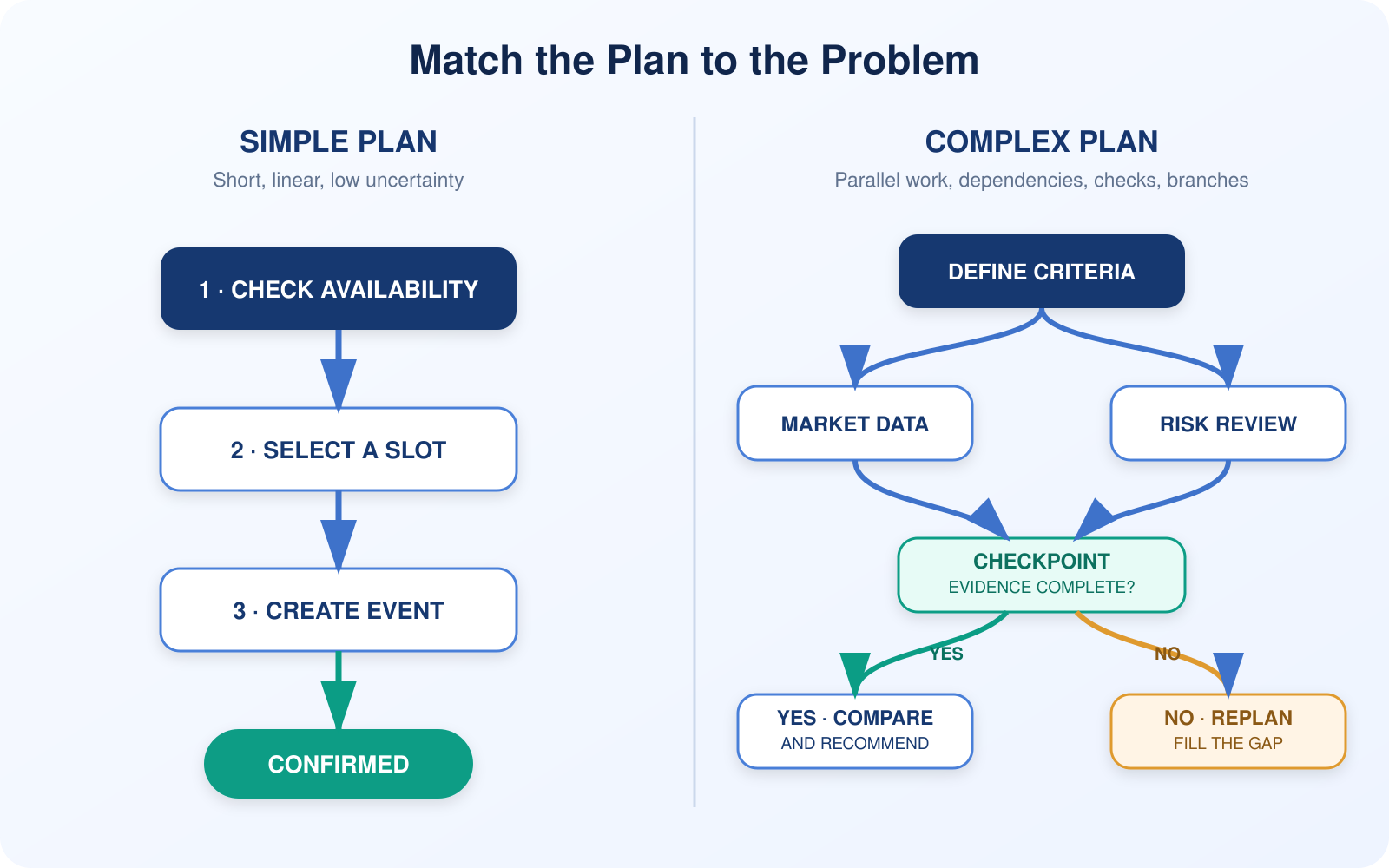
Simple example: schedule a meeting
Goal: schedule a 30-minute meeting with Maya next week.
A short plan might be:
- Read the user’s available times.
- Check Maya’s availability.
- Find overlapping 30-minute slots.
- Ask the user to choose if several valid slots remain.
- Create the event after approval.
- Confirm that the invitation was sent.
This plan is mostly linear. Its key constraints are duration, date range, availability, and approval. The completion condition is a confirmed calendar event.
Even here, replanning may be necessary. If Maya declines, the agent returns to the availability step rather than declaring the entire task a failure.
Complex example: prepare a product launch recommendation
Goal: recommend whether to launch a new AI support feature in three markets.
A more complex plan could contain these subgoals:
- Define the decision criteria
- adoption potential;
- support-cost reduction;
- language coverage;
- compliance risk;
- delivery effort.
- Collect evidence
- query product usage data;
- review support-ticket categories;
- research market and policy constraints;
- interview regional stakeholders.
- Validate readiness
- test model quality by language;
- estimate integration effort;
- identify required approvals.
- Compare the markets
- score each market against the same criteria;
- record uncertainty and missing evidence;
- run sensitivity checks.
- Create the recommendation
- propose launch order;
- state assumptions;
- describe risks and mitigations;
- define a pilot and success metrics.
- Checkpoint with the user
- review material uncertainties;
- obtain approval before finalizing the recommendation.
This plan contains parallel research, dependencies, constraints, tool choices, risk checks, and a human checkpoint. If one market lacks reliable language support, the agent should update the comparison and potentially recommend a limited pilot instead of continuing with the original launch sequence.
Planning vs related concepts
These ideas work together, but they are not interchangeable.
| Concept | Main question | Typical output |
|---|---|---|
| Reasoning | What does this information mean, and what should I decide? | A judgment or next-step decision |
| Planning | What sequence of actions can achieve the goal? | An ordered, constraint-aware route |
| Task decomposition | What smaller units make this work manageable? | Tasks or subgoals |
| Workflow execution | Which predefined step runs now? | Execution of a known process |
| Reflection | What went wrong or could be improved? | A critique, lesson, or correction |
Planning vs reasoning
[Reasoning in AI Agents](/reasoning-in-ai-agents/) is the broader decision process used to interpret a goal, compare alternatives, handle uncertainty, and choose what to do. Planning uses reasoning to organize actions across time.
An agent may reason without creating a multi-step plan—for example, deciding whether a message is urgent. It may also use reasoning repeatedly while executing a plan, especially when results are unexpected.
Planning vs workflow execution
Planning decides or revises the route. Workflow execution follows the route.
In some systems, one component acts as a planner and another as an executor. In others, the same agent alternates between planning and action. The architectural separation is optional; the functional distinction remains useful.
Plans vs fixed workflows
A fixed workflow defines its steps before the request runs:
Receive invoice → Extract fields → Validate → Route for approval → Archive
It may include conditions, but its allowed paths are designed in advance.
An agent-generated plan is constructed at runtime from the specific goal, state, and capabilities. It can add, remove, reorder, or replace steps when new information appears.
Use a fixed workflow when the process is stable, regulated, repetitive, and well understood. Use agentic planning when the path cannot be fully known in advance. Many reliable systems combine them: an agent plans within a controlled workflow that enforces permissions, approvals, and audit rules.
Planning vs task decomposition
Task decomposition is one part of planning. A list of tasks is not yet a complete plan.
A plan also needs ordering, dependencies, constraints, tool assignments, checkpoints, progress tracking, and stopping conditions.
Planning vs reflection
Planning looks forward: “What should I do?”
Reflection looks backward or inward: “Was that result good, why did it fail, and what should change?”
Reflection can trigger replanning, but replanning is the act of revising the future route. A system can replan from an external error without deep reflection, and it can reflect on quality without changing the plan.
How agents generate and execute plans
There is no single mandatory planning architecture. Common designs include:
Plan then execute
The agent generates a full initial plan, then executes it step by step. This is easy to inspect, but early assumptions can become stale.
Interleaved planning and action
The agent plans a short horizon, acts, observes, and decides again. This is adaptive and resembles the broader agent loop. The ReAct research pattern is a well-known example of interleaving reasoning, actions, and observations so plans can be updated as information arrives.
Planner-executor
A planner creates or revises tasks while an executor performs them. This separation can improve control and observability, but it adds coordination overhead and does not guarantee that the plan is valid.
External or symbolic planning
For domains with strict rules and well-defined states, an LLM can translate a goal into a formal planning problem and use a classical planner to search for a valid route. Research such as LLM+P illustrates why fluent language generation alone should not be assumed to produce feasible or optimal plans in constrained environments.
The architecture should match the problem. A five-step research task rarely needs a formal planner. A warehouse, scheduling, or robotics problem with hard preconditions may benefit from one.
When explicit planning helps
Planning adds value when:
- the goal requires several dependent steps;
- actions are expensive, slow, or difficult to reverse;
- multiple tools must be coordinated;
- important constraints must remain visible;
- the environment can change during execution;
- progress must be inspected or audited;
- a human needs to approve key decisions;
- failure at one step should change the remaining route.
The longer the horizon and the higher the cost of mistakes, the more useful explicit planning becomes.
When an agent does not need a plan
An agent may not need explicit planning when:
- one tool call can complete the task;
- the correct next action is obvious;
- the task is a simple transformation, such as reformatting text;
- a fixed workflow already captures the valid process;
- the environment provides immediate feedback after every small action;
- the cost of planning is greater than the cost of trying and correcting.
For example, checking today’s weather does not require a six-step plan. The agent can select the weather tool, provide the location, observe the result, and answer.
Overengineering simple tasks creates extra latency, token use, failure points, and false confidence. A plan should earn its complexity.
Common planning failures
Planning can make agent behavior more organized, but a written plan is not proof that the route will work.
Over-planning
The agent produces an elaborate plan for a simple task or spends more effort planning than executing.
Mitigation: match planning depth to task risk, horizon, and uncertainty. Start with the smallest useful plan.
Bad decomposition
Tasks are too vague, overlap, omit required work, or cannot be independently verified.
Mitigation: define each task by an observable result and check that the set of tasks covers the goal.
Impossible plans
The plan assumes unavailable data, nonexistent tools, missing permissions, or mutually incompatible constraints.
Mitigation: validate feasibility early. Check capabilities, preconditions, budget, and permissions before committing to the route.
Dependency mistakes
The agent performs work before its prerequisites are complete or overlooks how a changed step affects downstream tasks.
Mitigation: represent critical dependencies explicitly and recalculate affected tasks when state changes.
Failure to replan
The agent continues following the original plan after evidence shows it is invalid.
Mitigation: create checkpoints and define events that require replanning, such as tool errors, failed validation, changed requirements, or exhausted budgets.
Endless loops
The agent repeatedly retries, researches, critiques, or revises without converging.
Mitigation: set retry limits, time or cost budgets, minimum progress rules, and explicit terminal states.
Losing sight of the original goal
The agent optimizes a subtask while the final outcome becomes worse. It may collect more sources forever, polish an irrelevant section, or complete every listed task without answering the user’s actual question.
Mitigation: compare progress against the original success criteria at every major checkpoint. Completion is about achieving the goal, not merely checking boxes.
A practical builder checklist
Before allowing an agent to execute a plan, check:
- Goal: Is success observable?
- State: Does the plan use current information?
- Tasks: Are they specific and verifiable?
- Dependencies: Are prerequisites and downstream effects clear?
- Constraints: Are permissions, budgets, deadlines, and policies represented?
- Tools: Can the selected tools actually perform the actions?
- Checkpoints: Will risky assumptions be tested early?
- Replanning: What events invalidate the current route?
- Stopping: When must the agent finish, ask, escalate, or fail safely?
- Traceability: Can a human understand what has completed and why the plan changed?
My Take
The most useful agent plans are not the longest or most detailed. They are the ones that expose the few decisions that can change the outcome: dependencies, constraints, uncertainty, tool limits, approvals, and stopping rules.
For many applications, the right design is a small plan with frequent reality checks. Generate enough structure to coordinate the work, execute the next meaningful step, observe the result, and revise only when the state demands it.
Planning should reduce avoidable mistakes—not become a performance of intelligence.
What to learn next
Planning gives an agent a route. The next question is how the agent evaluates its own output and behavior. Continue to Reflection in AI Agents when that lesson is published.
You can also revisit the foundations:
- [What Is an AI Agent?](/what-is-an-ai-agent/)
- [How AI Agents Work](/how-ai-agents-work/)
- [Anatomy of an AI Agent](/anatomy-of-an-ai-agent/)
- [Reasoning in AI Agents](/reasoning-in-ai-agents/)
- [Tool Use in AI Agents](/tool-use-in-ai-agents/)
- [Memory in AI Agents](/memory-in-ai-agents/)
Sources
- Yao et al., “ReAct: Synergizing Reasoning and Acting in Language Models”, 2022/2023.
- Wang et al., “Plan-and-Solve Prompting: Improving Zero-Shot Chain-of-Thought Reasoning by Large Language Models”, ACL 2023.
- Liu et al., “LLM+P: Empowering Large Language Models with Optimal Planning Proficiency”, 2023.