RAG vs Agent Memory
RAG helps an agent look something up. Memory helps it carry something forward. Both may retrieve vectors, but they preserve different kinds of meaning.
TL;DR
- RAG usually retrieves external knowledge relevant to the current request.
- Agent memory stores information from prior interactions, observations, decisions, or experience for later use.
- Semantic memory and RAG can overlap because both retrieve factual content.
- A shared vector database does not make the concepts identical.
- The correct distinction comes from purpose, origin, ownership, lifecycle, and how the information may be used.
The core difference
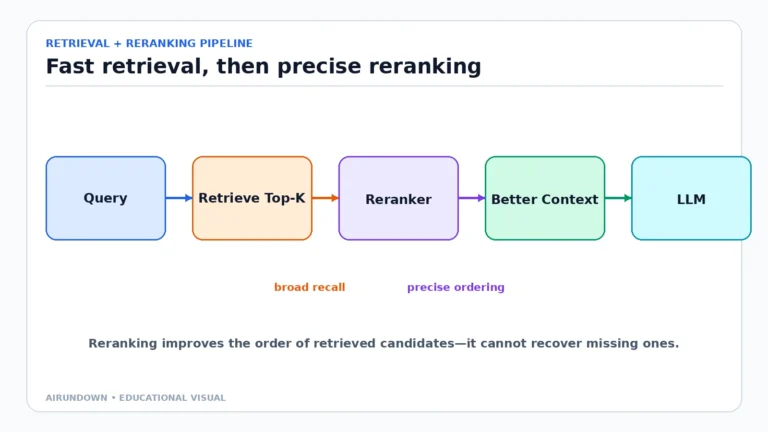
[RAG](/glossary/retrieval-augmented-generation/) is an architecture for retrieving external information and adding it to the model’s current context.
[Agent memory](/glossary/agent-memory/) is a system for retaining and recalling information across steps, interactions, or tasks.
RAG asks:
What external knowledge is relevant to this question?
Memory asks:
What from the agent’s past should influence what happens now?
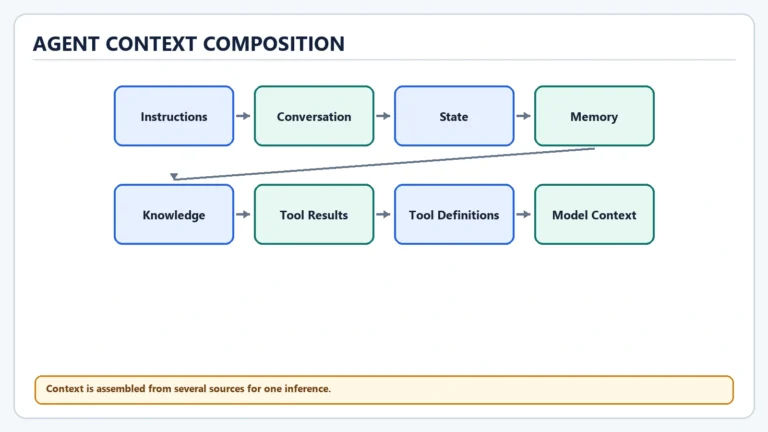
Both answers can become [context](/glossary/context/) for the next model call. That shared destination is why they are frequently confused.
What counts as RAG knowledge?
A RAG knowledge base often contains content that exists independently of the current agent:
- product documentation;
- company policies;
- research papers;
- support articles;
- legal or compliance references;
- catalog records;
- engineering runbooks;
- approved web or database content.
The material usually has an external owner and source of truth. The RAG system ingests or connects to it, creates searchable representations, retrieves relevant passages, and supplies them at answer time.
If the organization updates a policy, the RAG index should reflect the source change. The agent does not “remember” the new policy because it experienced it; it retrieves the organization’s current knowledge.
What counts as agent memory?
Agent memory can contain information created or captured through the agent’s operation:
- a user’s stated preference;
- what happened in a previous session;
- the outcome of a tool call;
- a partially completed plan;
- a past failure and its resolution;
- a summary of a long interaction;
- a learned fact about the current environment.
Memory gives continuity. Without it, an agent may ask the same questions repeatedly, forget completed work, or fail to adapt to previous outcomes.
Not every recorded event should become long-term memory. Good memory systems decide what to write, how to represent it, when to retrieve it, when to update it, and when to forget it.
Side-by-side comparison
| Dimension | RAG | Agent memory |
|---|---|---|
| Primary purpose | Access relevant external knowledge | Preserve useful information from past operation |
| Typical origin | Documents, databases, knowledge systems | Interactions, observations, state, outcomes |
| Source of truth | Usually an external system or content owner | Memory store plus event or interaction history |
| Time relationship | Information needed now | Information carried from before |
| Update trigger | Source content changes | Agent observes, learns, summarizes, or corrects |
| Ownership | Organization, publisher, or system of record | User, agent application, workspace, or task |
| Retention | Based on content governance | Based on utility, consent, privacy, and task lifecycle |
| Failure risk | Wrong, stale, or missing evidence | Wrong, irrelevant, intrusive, or outdated recollection |
| Common output | Retrieved passages and citations | Recalled preferences, episodes, facts, or state |
Retrieved knowledge versus remembered state
[Agent state](/glossary/agent-state/) records what is true about the current execution: completed steps, active plan, tool outputs, pending approvals, and other information needed to continue.
Memory may preserve selected state beyond the immediate run. RAG generally does not track execution progress.
For example:
- “The refund policy allows 30 days” is external knowledge retrieved through RAG.
- “The user already uploaded the receipt” is task state.
- “The user prefers refunds to the original payment method” may become long-term memory with appropriate consent.
Putting all three into one vector index without type and lifecycle metadata makes retrieval harder and governance unclear.
Retrieval-time information versus persistent experience
RAG information may be retrieved for one answer and then discarded from the active context. The source remains in the knowledge base.
Memory is written because the application expects future value. It is persistent relative to the scope it serves—perhaps a single workflow, a project, a user profile, or many sessions.
Persistence does not mean permanent. A memory can expire, be corrected, lose relevance, or require deletion. User-profile memory in particular needs consent, visibility, and controls.
Where semantic memory overlaps with RAG
[Semantic memory](/glossary/semantic-memory/) stores facts and generalized knowledge without requiring the full event that produced them.
Suppose an agent learns during a project that:
The analytics service uses UTC for all daily boundaries.
If that statement is stored as a durable fact, it resembles a small knowledge-base entry. Retrieving it later looks technically similar to RAG.
The difference is lineage:
- If it came from an approved engineering standard, it belongs primarily to the knowledge base.
- If the agent inferred it from one tool response, it is a memory with weaker authority and may require confirmation.
- If the fact is promoted into governed documentation, it can move from remembered experience to organizational knowledge.
Concepts can overlap at the boundary without becoming interchangeable.
Episodic memory is not RAG
[Episodic memory](/glossary/episodic-memory/) represents events or experiences:
Last Tuesday, the deployment failed because the staging token had expired. The agent refreshed it and resumed from step four.
This memory is valuable because of the event sequence, not because it is a general reference document. It may help the agent recognize a recurring failure or explain what happened.
A RAG system could technically index the event log, but calling every retrieval operation “RAG” erases the memory-specific questions of experience, recency, learning, and retention.
Shared vector infrastructure
RAG and memory can use the same technical building blocks:
- [embeddings](/glossary/embedding/);
- vector search;
- a [vector database](/glossary/vector-database/);
- metadata filters;
- reranking;
- context construction.
One database might contain separate collections for documentation, user preferences, and task episodes. Another design might use different storage systems because their access and retention requirements differ.
Infrastructure similarity proves only that both systems need retrieval. It does not define what the retrieved data means.
Metadata should preserve the distinction: source type, owner, user or tenant, creation time, authority, consent, task, expiration, and update policy.
A practical example
Imagine a travel assistant helping a user plan repeated business trips.
RAG knowledge
The assistant retrieves:
- corporate travel policy;
- current visa guidance from approved sources;
- hotel program rules;
- airline baggage policies.
These sources change independently of the user’s past conversations.
Agent memory
The assistant recalls:
- the user prefers morning departures;
- they avoid a specific airport connection;
- the last trip was canceled;
- a pending approval still needs follow-up.
These facts come from prior interactions and task history.
Combined use
The agent can retrieve the current company policy and recall the user’s preference. It may recommend a morning flight that complies with the updated spending limit.
If the user preference conflicts with policy, the agent should not rewrite policy or silently ignore the preference. The two information types have different authority.
Common design mistakes
Treating conversation history as a knowledge base
Raw chat history contains outdated plans, corrections, jokes, private data, and temporary details. Indexing everything can create noisy or inappropriate memory.
Treating RAG documents as personal memory
Organizational documentation should retain its source identity and governance. Copying passages into user memory can create stale duplicates and confusing deletion rules.
Using one relevance score for every data type
A semantically similar memory may be less authoritative than a current policy. Ranking should consider source type, recency, permissions, and task relevance—not vector distance alone.
Assuming retrieval equals correctness
Both a document and a memory can be wrong. RAG needs source governance; memory needs write quality, correction, and forgetting.
When to use RAG, memory, or both
Use RAG when the system needs external, governed, or changing knowledge.
Use memory when continuity across steps or interactions improves the task.
Use both when an agent must combine current reference knowledge with relevant past experience. Keep their namespaces, authority, and retention policies explicit even if they share infrastructure.
For short, single-turn questions, neither persistent memory nor an agent may be necessary. A fixed RAG pipeline can retrieve and answer without learning anything about the user.
My Take
The most useful boundary is not “documents versus vectors.” It is reference knowledge versus remembered experience.
Design storage from that semantic boundary. Once authority, ownership, and lifecycle are clear, the team can decide whether the same database is operationally convenient.
Next step
Read [Memory in AI Agents](/memory-in-ai-agents/) for the memory lifecycle and [How RAG Works](/how-rag-works/) for the retrieval pipeline. For a practical embedding mental model shared by both systems, continue to [Embeddings Explained for AI Agents](/embeddings-for-ai-agents/).
Sources
- Patrick Lewis et al., Retrieval-Augmented Generation for Knowledge-Intensive NLP Tasks, NeurIPS 2020.
- Joon Sung Park et al., Generative Agents: Interactive Simulacra of Human Behavior, 2023.
- Nils Reimers and Iryna Gurevych, Sentence-BERT: Sentence Embeddings Using Siamese BERT-Networks, EMNLP-IJCNLP 2019.