Agent Workflows and Orchestration Explained
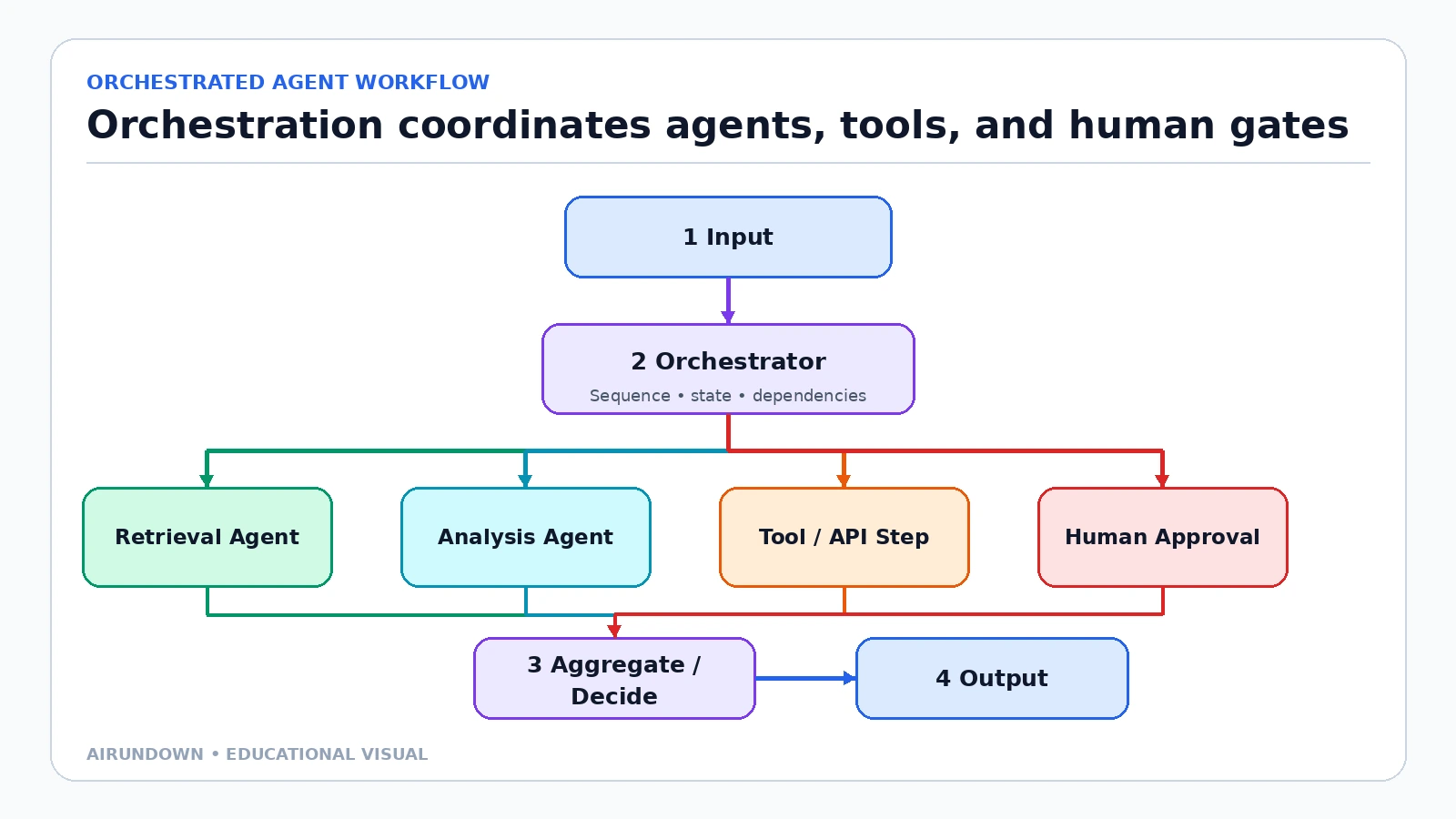
An AI agent may be capable of choosing its next action, but a production task still needs structure. Which step runs first? Which steps can run together? Where is state stored? What happens after a timeout? When must a person approve the result?
An [agent workflow](/glossary/agent-workflow/) defines the work. Orchestration coordinates its execution. The distinction matters because reasoning about a task is not the same as reliably running it.
This article explains workflows and orchestration from the level of a single step through branching, parallel execution, retries, checkpoints, and human approval.
TL;DR
- A workflow defines steps, dependencies, transitions, and completion rules.
- Orchestration schedules and coordinates those steps while maintaining execution state.
- A fixed workflow follows predetermined paths; an agentic workflow lets model decisions influence the route.
- The agent loop is the local reason-act-observe cycle; a workflow can contain one or many loops.
- Use deterministic control for permissions, dependencies, retries, and approvals. Use model judgment where ambiguity makes it valuable.
What is an agent workflow?
An agent workflow is a structured path for completing a goal with agents, model calls, tools, code, and human decisions. It can be simple:
Input → Retrieve → Generate → Validate → Output
Or it can contain branches, parallel work, retries, and long-running waits.
A workflow step is one bounded unit of work. It might:
- call an LLM;
- run an agent until a stopping condition;
- invoke an API;
- query a knowledge base;
- evaluate an output;
- wait for human approval;
- update a business system.
Not every step is an agent. A deterministic validator, database write, or notification is often safer and cheaper as ordinary code.
What is orchestration?
[Workflow orchestration](/glossary/workflow-orchestration/) is the control function that coordinates workflow execution. It determines what is runnable, schedules work, passes state, handles results, enforces limits, and records progress.
The orchestrator coordinates different kinds of work. It does not require every branch to be an autonomous agent.
In a production system, orchestration commonly owns:
- current workflow status;
- step dependencies;
- branch and route decisions;
- concurrency limits;
- timeouts and retries;
- checkpoint creation;
- resumability;
- error propagation;
- cancellation;
- human approval waits;
- final aggregation and completion.
The orchestrator may use deterministic code, an LLM, or both. OpenAI’s Agents SDK documentation describes the same broad choice: let an LLM decide the flow, orchestrate via code, or mix the two.
Workflow steps and contracts
Every step should have an explicit contract:
- Input: Which state fields or artifacts does it need?
- Output: What typed result does it produce?
- Side effect: What external system can it change?
- Permission: Who or what authorizes that change?
- Timeout: How long may it run?
- Retry policy: Which failures are safe to repeat?
- Completion: What counts as success, failure, or waiting?
Without contracts, orchestration becomes prompt folklore. A later step guesses what an earlier agent meant, and failures are difficult to classify.
For example, an analysis agent should return a structured finding with evidence and confidence boundaries—not merely a conversational paragraph that the next component must reinterpret.
Sequencing and dependencies
Sequencing means placing steps in an order. Dependencies explain why that order exists.
In a vendor-risk workflow:
- retrieve the vendor profile;
- run sanctions and security checks in parallel;
- wait for both results;
- generate a risk assessment;
- request human approval if the score exceeds a threshold;
- publish the decision.
The assessment depends on both checks. The orchestration layer should encode that dependency rather than asking a model to remember it.
Explicit dependencies improve reliability, enable parallel execution, and make a partial failure recoverable.
Branching and routing
A branch selects among possible paths. The decision can be deterministic:
- if amount exceeds $10,000, require approval;
- if retrieval returns no evidence, ask a clarifying question;
- if the user lacks permission, terminate.
Or model-driven:
- decide whether the request is a policy question or a data-analysis task;
- choose which specialist can handle an ambiguous case;
- determine whether another research step is useful.
Use code when a rule is known and auditable. Use model judgment when the classification depends on unstructured meaning. Even then, validate the model’s output against an allowed route set.
Parallel execution
Independent steps can run concurrently to reduce latency. A research workflow might ask market, product, and financial specialists to work in parallel before aggregation.
Parallel execution adds coordination problems:
- results may finish at different times;
- one branch may fail while others succeed;
- branches may write conflicting state;
- duplicate tools may hit the same rate limit;
- aggregated context may exceed the model’s budget.
Define a join policy. Must all branches succeed? Is a quorum enough? Can the workflow proceed with a partial result? How are conflicts resolved?
Parallelism is useful only when the tasks are genuinely independent and the aggregation contract is clear.
Fixed vs agentic workflows
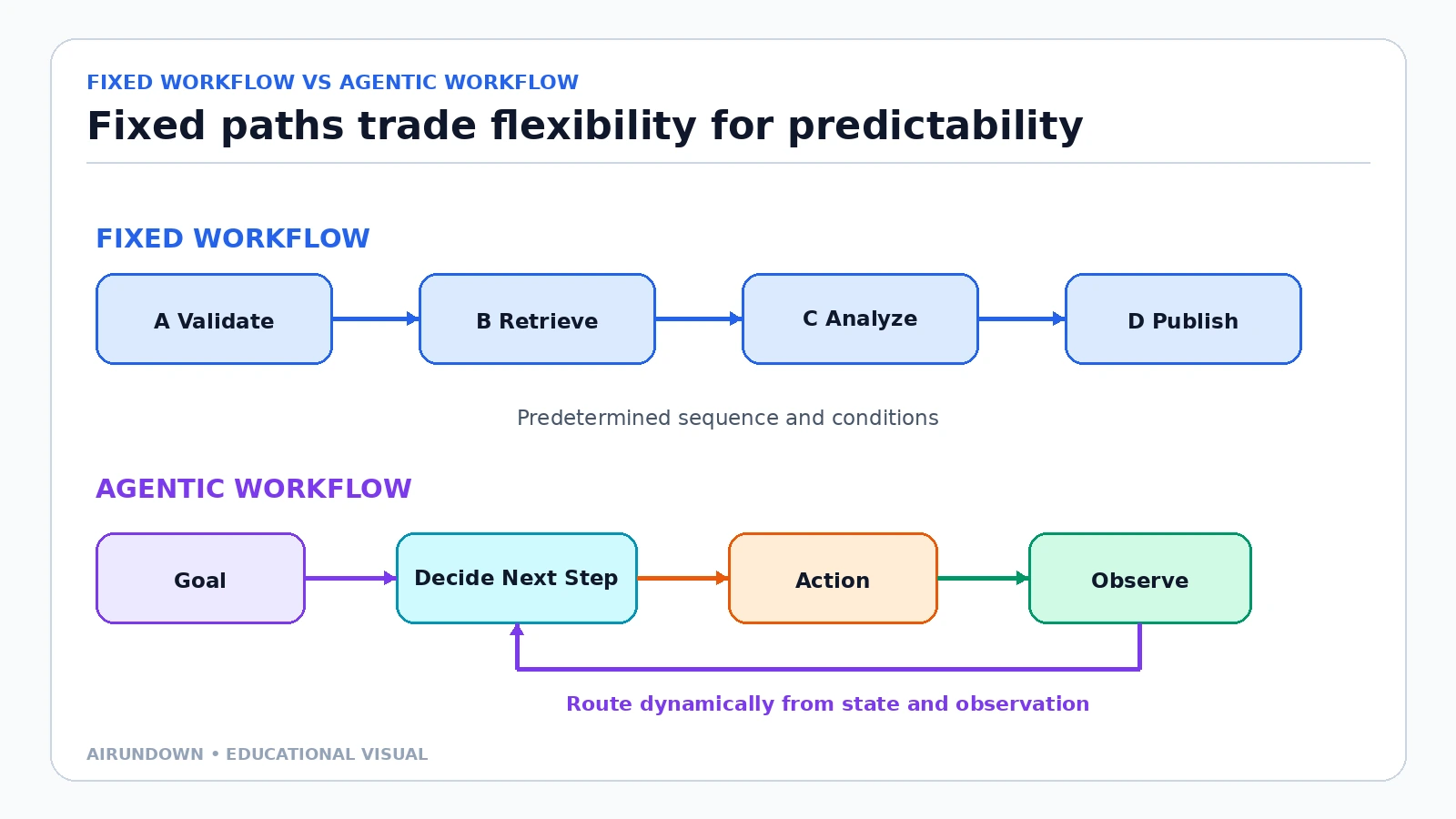
Fixed workflows make paths explicit. Agentic workflows allow the next step to change as new information appears.
Fixed workflow
A fixed workflow follows predefined paths and rules. An LLM may perform one step, but it does not control the overall sequence.
Use it when:
- the process is stable;
- compliance requires known transitions;
- inputs and exceptions are predictable;
- low latency and repeatability matter.
Agentic workflow
An agentic workflow lets a model influence what happens next. The workflow may still impose a graph, budgets, and allowed actions, but the path depends on reasoning and observations.
Use it when:
- the correct path cannot be fully specified in advance;
- information must be discovered iteratively;
- the task benefits from replanning;
- different cases need different tools.
The two styles can be combined. A deterministic workflow can contain an agentic research step, and an agent-controlled process can enter fixed approval and transaction steps.
Agent workflow vs agent loop
The [agent loop](/glossary/agent-loop/) is the repeated local cycle:
Reason → Decide → Act → Observe → Update
A workflow is the broader task structure. It may contain:
- one loop inside one agent step;
- several agent loops running in parallel;
- deterministic steps before and after an agent;
- human waits that last hours or days.
Confusing them leads to poor control. A model’s internal loop should not be responsible for durable scheduling, cross-step recovery, or long-running approval state.
Workflow vs plan
A [plan](/planning-in-ai-agents/) is a proposed sequence for reaching a goal. A workflow is an executable structure with contracts, state, transitions, and failure behavior.
A plan may be generated at runtime and stored in state. The workflow determines how to execute, validate, revise, or reject it.
For example, a research agent may plan to consult five sources. The workflow still enforces a maximum number of searches, validates citations, and decides when the output moves to review.
Workflow vs orchestration
The workflow is the definition of what may happen. Orchestration is the runtime coordination of what is happening now.
Think of a workflow as a map and orchestration as traffic control:
- the map defines paths and intersections;
- traffic control tracks vehicles, opens routes, handles incidents, and prevents conflicts.
A workflow can exist on paper. Orchestration turns it into a reliable execution.
Orchestration vs reasoning
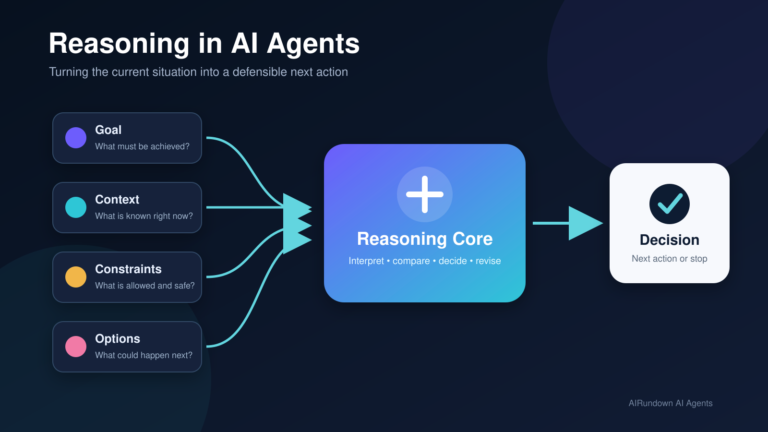
Reasoning judges meaning and chooses among options. Orchestration manages execution.
An orchestrator can ask a model, “Which specialist should handle this request?” But code should still:
- validate that the destination exists;
- transfer the allowed state;
- start the task;
- record the result;
- enforce the timeout;
- decide whether a retry is legal.
Putting scheduling and durable execution into natural-language reasoning makes failures opaque and difficult to resume.
Retries and failure handling
A [retry](/glossary/retry/) repeats a failed operation, usually because the failure may be transient. It should specify:
- retryable error types;
- maximum attempts;
- delay or backoff;
- timeout;
- idempotency behavior;
- final fallback.
Do not retry every error. Invalid credentials, denied permissions, and bad input require correction, not repetition. A model disagreement may need reflection or a different strategy rather than the same call again.
The orchestration layer should distinguish:
- step failed;
- step timed out;
- step produced an invalid result;
- step is waiting;
- workflow is blocked;
- workflow was cancelled.
Checkpoints and durable state
A checkpoint records enough workflow state to resume safely. It may contain completed steps, pending branches, tool results, approvals, counters, and the active route.
Checkpoints are important when:
- work lasts longer than one request;
- external tools can fail;
- human approval introduces a wait;
- the process has costly completed steps;
- operators need to inspect or replay execution.
Do not confuse checkpointed workflow state with long-term [agent memory](/memory-in-ai-agents/). A checkpoint preserves this run. Memory may carry information across runs.
Human approval
[Human-in-the-loop](/glossary/human-in-the-loop/) does not mean a person must approve every step. Place human control where judgment, accountability, or consequence requires it.
Typical gates include:
- sending an external message;
- approving a payment;
- publishing regulated content;
- accepting a low-confidence recommendation;
- resolving conflicting evidence.
A human approval step needs a durable waiting state, notification, expiry policy, and verified identity. “Pause and hope the process is still alive” is not orchestration.
Stopping conditions
The workflow must define terminal outcomes:
- completed successfully;
- completed with partial results;
- rejected by a human;
- insufficient evidence;
- failed after recovery attempts;
- cancelled;
- blocked by policy.
An agent’s “final answer” is not automatically workflow completion. The output may still need schema validation, evidence checks, approval, or a transactional commit.
Practical example: a product-brief workflow
Imagine an agentic workflow that prepares a product launch brief.
The orchestrator accepts a product ID and target market. It launches retrieval and sales-data steps in parallel. Each returns a typed artifact with provenance. When both complete, an analysis agent identifies positioning and risks.
If evidence conflicts, a router sends the case to a clarification step. If claims involve unreleased financial data, a deterministic policy adds human approval. The writing agent drafts the brief only after required evidence is available.
The final validator checks required sections and citations. A failed citation check returns the workflow to evidence gathering, while a tool timeout follows a bounded retry policy. The run completes only after validation and any required approval.
This architecture uses model judgment for analysis and rewriting while keeping dependencies, permissions, and completion deterministic.
Common architectural mistakes
Making every step an agent
Ordinary code is better for exact transformations, validation, and known rules. Agents add variability, latency, and cost.
Hiding the workflow in one giant prompt
The model cannot provide durable checkpoints, enforce concurrency, or guarantee permissions from instructions alone.
Parallelizing dependent work
If one branch needs another branch’s result, parallel execution creates rework or inconsistent assumptions.
Retrying without idempotency
Repeating a side-effecting tool can create duplicate emails, tickets, or payments. Use idempotency keys or a status check.
Passing all state to every step
Each step should receive the minimum relevant context. Oversized state transfer increases cost and exposes unnecessary data.
Treating human review as an exception
If approval is part of the product, model it as a normal state with ownership, timeout, and resume behavior.
My take
The best architecture is usually a deterministic workflow with small, intentional pockets of agentic decision-making. Use models to interpret ambiguous inputs, synthesize evidence, and adapt within bounded choices. Use orchestration to make the system resumable, observable, and enforceable.
Flexibility should be added where it improves task success—not spread across every transition.
Sources
- Building Effective Agents presents composable workflow patterns and distinguishes workflows from dynamically directed agents.
- Agent Orchestration in the OpenAI Agents SDK describes LLM-led orchestration, code-led orchestration, and mixed approaches.
- Workflows and Agents in LangGraph explains common workflow patterns and the distinction between predetermined paths and dynamic agents.
Continue learning
Review [How AI Agents Work](/how-ai-agents-work/) for the inner execution loop and [Single-Agent vs Multi-Agent Systems](/single-agent-vs-multi-agent-systems/) before introducing multiple specialist agents.