MCP vs APIs: What Changes and When to Use Each
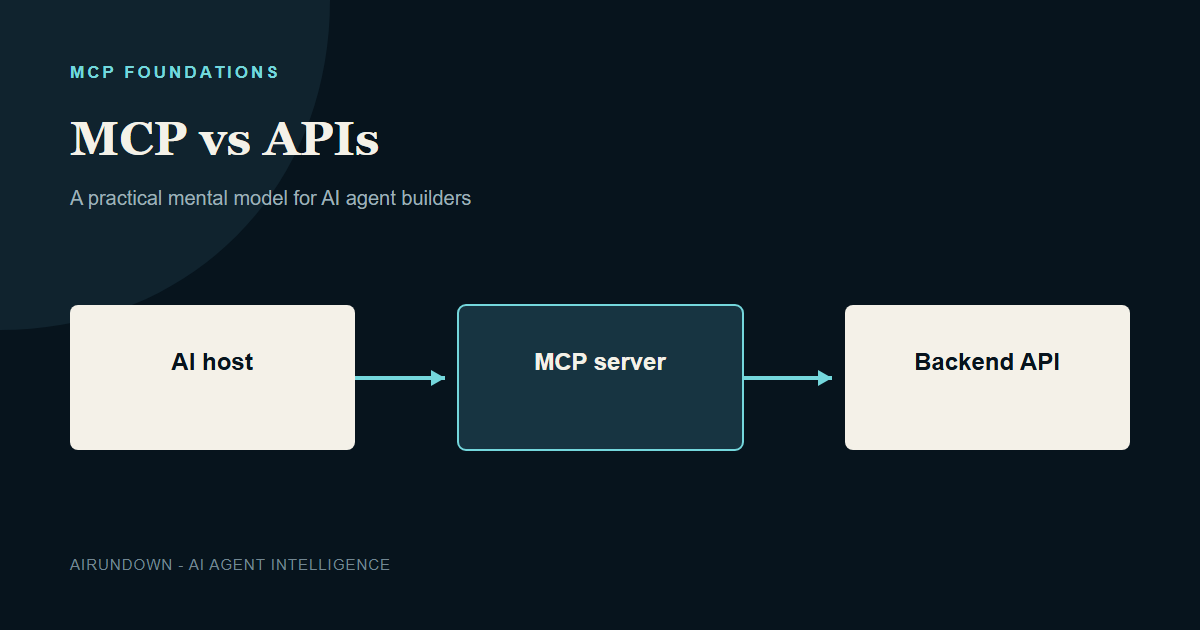
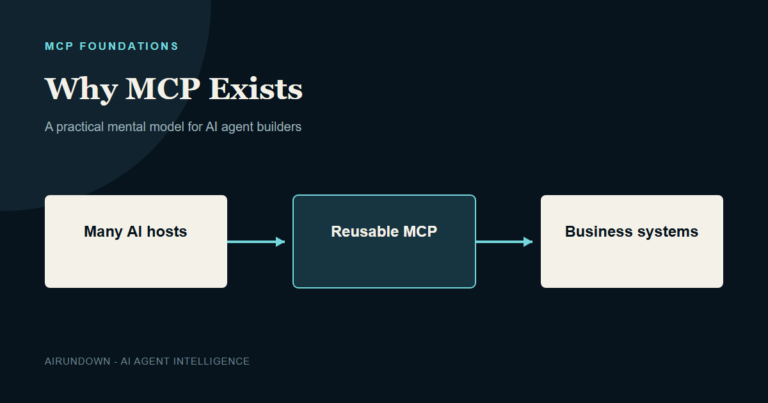
MCP and APIs solve related problems at different layers. In most production systems, an MCP server uses an API rather than replacing it.
Asking “MCP or API?” can hide the architecture. A REST API exposes business functionality to general software clients. MCP gives AI applications a standard way to discover and communicate with capability providers. They often belong in the same request path.
TL;DR
- APIs expose domain operations and data to many kinds of software.
- MCP standardizes how AI hosts discover and invoke model-facing capabilities.
- An MCP server commonly translates a tool call into REST, GraphQL, SDK, or database work.
- MCP should present task-level capabilities, not blindly mirror every endpoint.
- Direct API integration remains better for simple, fixed, single-host use cases.
What an API provides
An order API might provide GET /orders/{id}, GET /orders/{id}/events, and POST /support-tickets. It defines authentication, representations, status codes, pagination, and domain rules for websites, mobile applications, batch jobs, partner services, and internal tools.
REST is only one style. GraphQL, gRPC, database protocols, and product SDKs can expose the same underlying capability. These interfaces are designed for software developers and deterministic callers.
What MCP adds
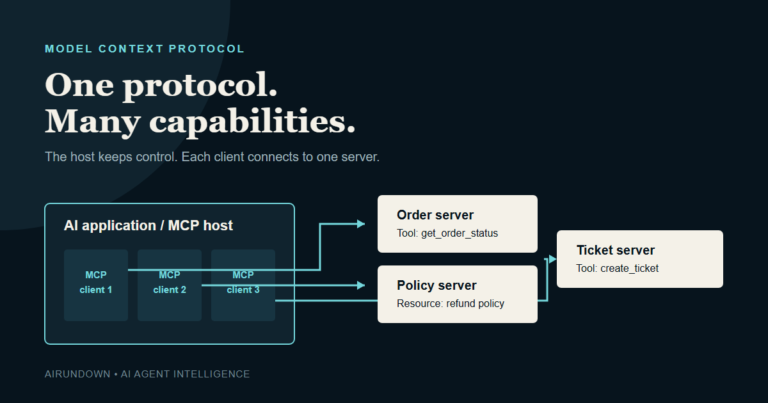
MCP defines host-client-server roles, protocol lifecycle, capability discovery, and model-facing primitives. An order server can expose a focused tool named investigate_delayed_order that reads several API endpoints, applies domain checks, and returns a normalized result.
The host does not need to know every backend endpoint. It discovers a smaller, purposeful contract. The server owns translation between that contract and the service interfaces behind it.
A request path using both
- The host discovers
get_order_statusfrom an MCP server. - The model proposes the tool with order ID 4812.
- The host validates permission and calls the server through its MCP client.
- The server uses the company’s REST API with scoped credentials.
- The server translates the API response into an MCP result.
- The host supplies the result to the model for the final answer.
Removing the API would require the server to access the database or another backend interface directly. MCP does not eliminate that domain boundary.
Side-by-side comparison
| Dimension | Backend API | MCP |
|---|---|---|
| Primary consumer | General software | AI application hosts |
| Discovery | Often documentation or API schema | Protocol operations for capabilities and primitives |
| Unit of design | Resources, methods, service operations | Tools, resources, prompts |
| Lifecycle | Defined by API style and platform | Common MCP lifecycle and capabilities |
| Model integration | Built by each application | Host maps discovered capabilities to the model interface |
| Business truth | Often owns or fronts the system of record | Usually adapts and composes existing systems |
MCP and SDKs
An SDK is a language-specific developer interface. An MCP SDK helps implement MCP clients or servers. A product SDK, such as an issue-tracker library, may run inside the server and call the product’s service API.
A perfectly normal stack is: model tool proposal, host policy, MCP client, MCP server, product SDK, service API, and database. Each layer removes a different kind of complexity.
Why you should not mirror every endpoint
Backend APIs are often granular because conventional applications compose them deterministically. Models work better with coherent operations whose descriptions explain intent and whose schemas constrain ambiguity.
Exposing 80 raw endpoints can increase selection errors, context cost, permission complexity, and accidental side effects. Prefer a smaller surface such as read_order_summary, estimate_refund_eligibility, and create_approved_refund, with business controls outside the model.
When a direct API is better
- One AI application uses one stable service.
- The integration is tiny and runtime discovery adds no value.
- Latency and operational simplicity are dominant constraints.
- The team controls both sides and has no portability requirement.
- The operation is deterministic and does not need a model-facing capability catalog.
When MCP earns its place
- Multiple AI hosts need the same capability provider.
- A domain team should own the AI-facing contract.
- Tools or resources change dynamically.
- You need consistent local and remote provider patterns.
- Portability and protocol-aware inspection matter.
Three decision scenarios
One internal assistant and one service
The assistant checks a stable inventory endpoint maintained by the same team. A direct typed client is likely simpler. Add host-side validation, logging, and permissions without introducing a new server process.
Several assistants need the same domain
Support, sales, and operations assistants all need customer summaries. A customer-domain MCP server can normalize access and give each host a consistent provider while hosts apply different exposure and approval policies.
A third-party platform already exposes MCP
Using its server may reduce adapter work, but review authentication, data handling, tool descriptions, result limits, and operational support. Protocol compatibility is not a substitute for vendor risk assessment.
A practical migration path
- Keep the existing API as the system boundary.
- Select two or three high-value model-facing operations.
- Design narrow MCP tools rather than copying endpoints.
- Reuse the API’s authentication and business rules inside the server.
- Connect one host, measure failures and selection quality, then expand.
This incremental path preserves proven backend behavior and makes the value of the MCP layer measurable.
Common mistakes
- Calling MCP an API replacement.
- Using the server as a transparent tunnel with no contract design.
- Moving backend authentication responsibility to the model.
- Adding MCP when one direct call is clearer.
My Take
An MCP server should be an adapter with judgment, not a proxy with a new label. Its value comes from a coherent model-facing contract, reuse, and policy-friendly boundaries. If it merely renames every REST endpoint, it adds operational surface without enough architectural benefit.
Knowledge check
- Why can an MCP server still need REST?
- What is wrong with exposing every backend endpoint as a tool?
- When is a direct API integration the more honest design?
Continue learning
Read Building an MCP Server for implementation context. The next comparison in this pathway is MCP vs Function Calling.