Orchestrator vs Supervisor vs Router in Multi-Agent Systems
Orchestrator, supervisor, and router are often used as if they describe the same component. They do not.
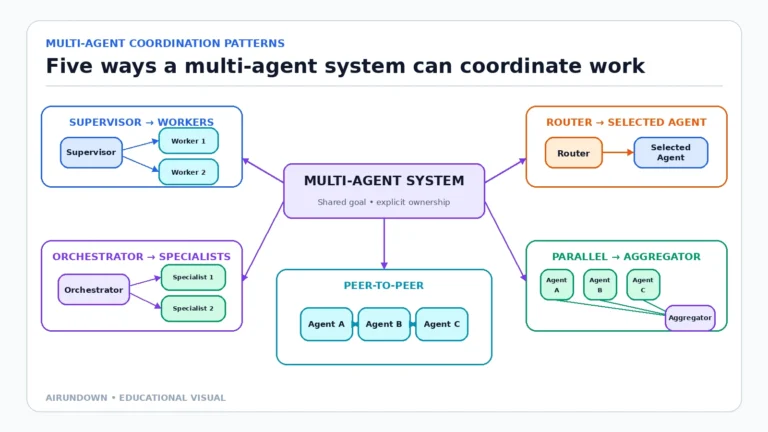
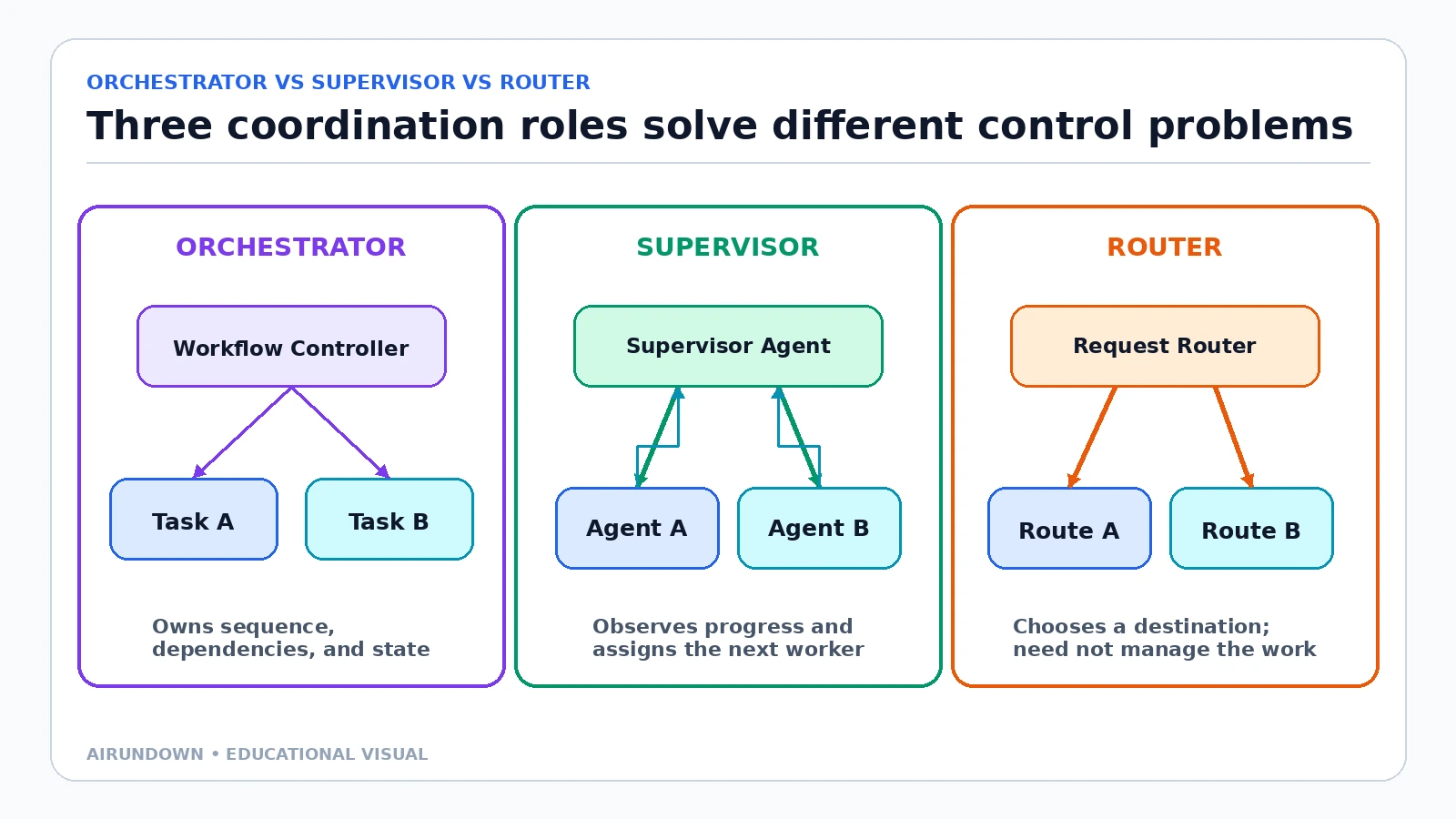
An orchestrator coordinates workflow execution. A supervisor observes or manages other agents and decides who should work next. A router selects a destination based on a request, intent, or state. One system may combine all three responsibilities, but the architecture is clearer when each responsibility is named explicitly.
This comparison shows what each role owns, where the boundaries overlap, and how to choose the simplest coordination pattern.
TL;DR
- An orchestrator owns execution flow, dependencies, and often workflow state.
- A supervisor manages workers and uses their progress or results to choose the next assignment.
- A router chooses a destination and may exit immediately after routing.
- Tool selection chooses a capability to invoke; routing chooses a component or path.
- Labels vary across frameworks, so define ownership, inputs, outputs, and stopping behavior instead of trusting the name.
Three different control problems
The roles overlap at “what happens next,” but they differ in what they continue to own after that decision.
The distinction is easiest to see by asking one question:
After the next destination is chosen, which component remains responsible for the work?
- The orchestrator usually keeps coordinating the workflow.
- The supervisor keeps monitoring and assigning agents.
- The router often finishes its job once the request is sent to the selected path.
What is an orchestrator?
An [orchestrator](/glossary/orchestrator/) coordinates execution across steps, agents, tools, and humans. It is concerned with the workflow as a whole.
Typical responsibilities include:
- reading the current workflow state;
- identifying runnable steps;
- enforcing dependencies;
- scheduling sequential or parallel work;
- passing inputs and collecting outputs;
- applying retries and timeouts;
- creating checkpoints;
- waiting for human approval;
- deciding when the workflow is complete.
An orchestrator can be deterministic code, an LLM-powered component, or a hybrid. In code-led orchestration, rules determine the route. In model-led orchestration, an LLM may choose the next specialist or task from an allowed set.
The orchestrator does not need to be an agent. A durable workflow engine can coordinate agent steps without doing natural-language reasoning.
What is a supervisor?
A [supervisor agent](/glossary/supervisor-agent/) manages other agents or workers. It observes progress, assesses results, delegates tasks, and decides who should act next.
Typical responsibilities include:
- decomposing a goal into assignments;
- selecting a specialist;
- reviewing a worker’s result;
- requesting revision;
- choosing another worker;
- merging or adjudicating outputs;
- deciding when the team has done enough.
The supervisor is usually part of a multi-agent pattern. It may itself be an LLM-based agent because selecting and reviewing specialists can require judgment.
However, “supervisor” does not automatically mean “safe.” A supervisor’s decisions still need limits. It should select from registered workers, respect budgets, transfer only relevant context, and stop delegation loops.
What is a router?
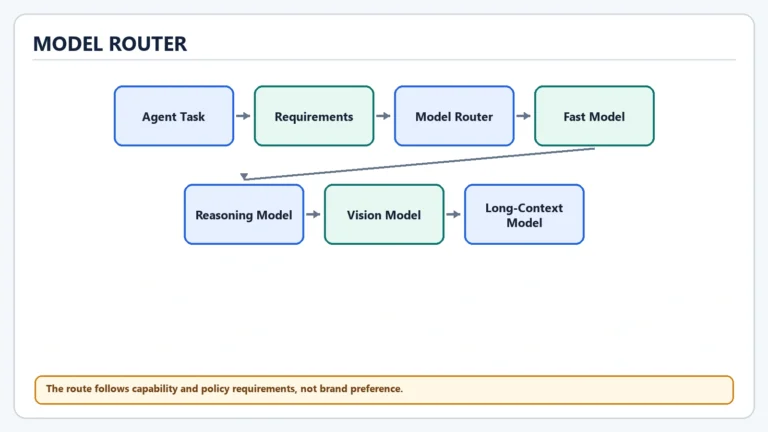
An [agent router](/glossary/agent-router/) classifies a request or state and selects a destination. The destination may be:
- a specialist agent;
- a workflow branch;
- a tool family;
- a model;
- a human queue;
- a refusal or fallback path.
A router can use deterministic rules, a classifier, embeddings, or an LLM. Its output should be a bounded route identifier, not arbitrary executable code.
Routers are useful when requests have distinct domains. A support system may route billing questions to a billing agent, technical incidents to a diagnostic workflow, and account-security cases to a human-controlled path.
Once the transfer succeeds, the router may no longer manage the case. That is the main boundary between routing and orchestration.
Responsibility comparison
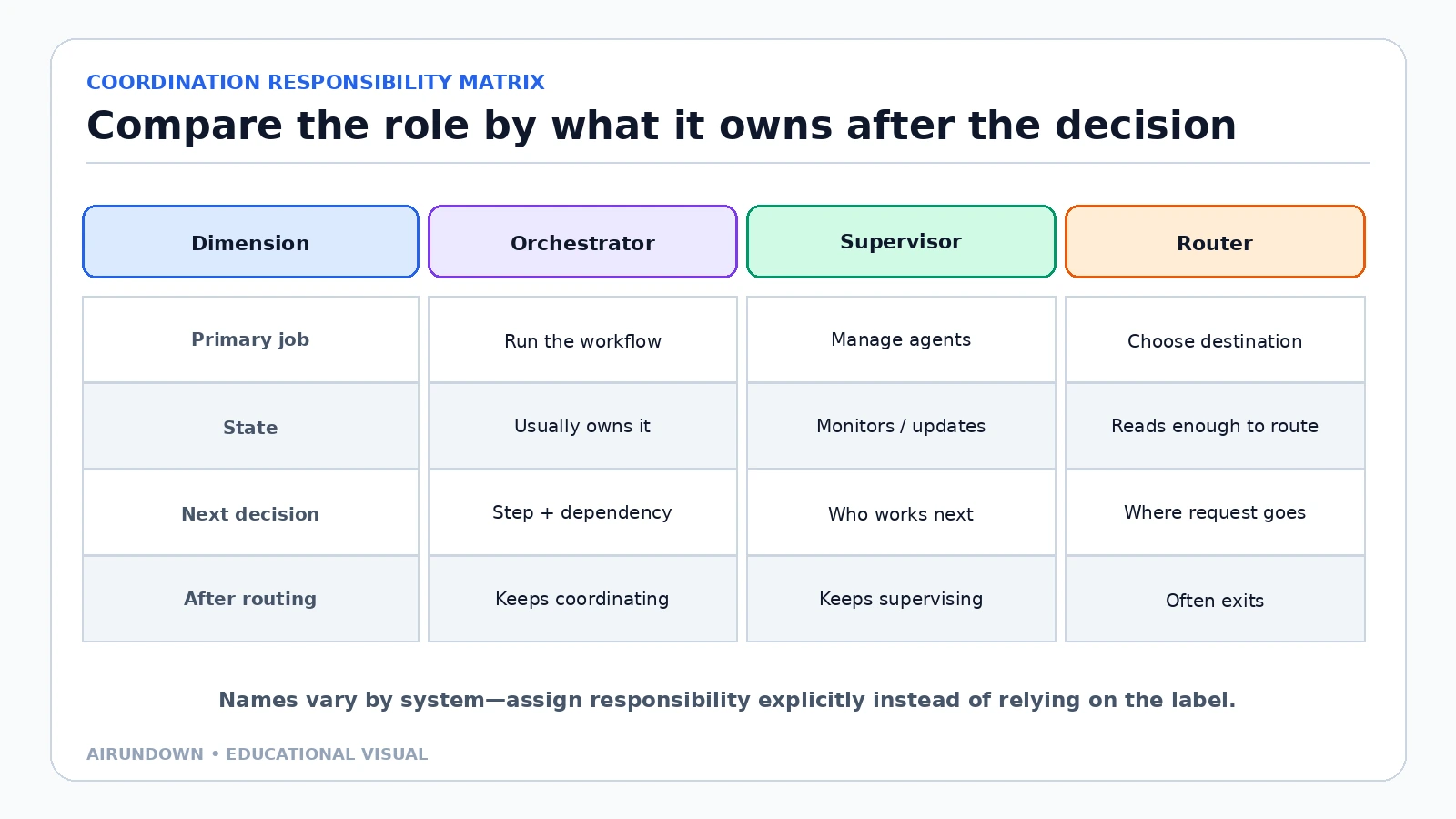
Names differ across implementations. The useful comparison is the responsibility each component owns.
| Dimension | Orchestrator | Supervisor | Router |
|---|---|---|---|
| Primary purpose | Coordinate workflow execution | Manage agents and their work | Choose a destination |
| Typical decision | Which step can run next? | Which agent should work next? | Where should this request go? |
| State responsibility | Often owns durable workflow state | Monitors team/task state | Reads enough state to classify |
| Dependencies | Enforces step dependencies | May create or revise assignments | Usually does not manage dependencies |
| Delegation | Can dispatch any workflow unit | Delegates to worker agents | Transfers to a selected route |
| Result handling | Aggregates and advances workflow | Reviews or combines worker results | Often not involved after transfer |
| Typical implementation | Workflow engine, code, or hybrid | LLM agent with worker registry | Rules, classifier, small model, or LLM |
| Best fit | Multi-step, durable processes | Adaptive multi-agent collaboration | Front-door classification and dispatch |
The table describes common architectural roles, not universal product names. A framework may call its orchestrator a supervisor or package routing inside a manager agent.
Orchestrator vs supervisor
Both can decide what happens next and dispatch work. The difference is their primary object of control.
An orchestrator manages workflow execution:
- steps;
- dependencies;
- branches;
- retries;
- timers;
- checkpoints;
- terminal states.
A supervisor manages agents and assignments:
- roles;
- worker selection;
- task delegation;
- progress review;
- revision;
- aggregation.
A supervisor can run inside an orchestrated workflow. For example, the workflow engine starts a research-team step; the supervisor then delegates research tasks to specialists. When the team returns a validated report, the workflow moves to human approval.
Combining the roles may be reasonable for a small system. For long-running or consequential work, separating durable execution from model-based supervision makes recovery and auditing easier.
Supervisor vs router
A router makes a destination decision. A supervisor remains responsible for the team’s progress.
Consider a customer-support request:
- Router: “This is a refund case; send it to the refund agent.”
- Supervisor: “The refund agent found missing purchase evidence; ask the order agent to retrieve it, then return to the refund agent.”
The router usually makes one classification. The supervisor reasons over a sequence of worker observations.
A router can be stateful, but statefulness alone does not make it a supervisor. The question is whether it manages continuing work.
Router vs tool selection
Routing selects a component or path. [Tool selection](/tool-use-in-ai-agents/) selects a capability to invoke.
Examples:
- Route to the security workflow.
- Call the
checkloginhistorytool.
Some frameworks represent agents as tools. In that implementation, a model may “call” a specialist agent. Architecturally, it is still useful to ask whether the caller keeps ownership and receives a result, or transfers active control.
Do not let an SDK abstraction erase the product-level ownership model.
Orchestrator vs agent
An agent is a goal-directed system that can reason and act. An orchestrator is a coordination role.
An orchestrator may be:
- ordinary code with no LLM;
- an agent that reasons about tasks;
- a hybrid where code owns execution and an LLM recommends routes.
Similarly, an agent can operate without an orchestrator when its [agent loop](/glossary/agent-loop/) and tools are sufficient for a simple task.
The terms answer different questions:
- Agent: what entity pursues a goal?
- Orchestrator: what coordinates the execution?
Practical example: market-entry analysis
Suppose a company wants a market-entry report for a new country.
Router
The front-door router classifies the request as market research rather than customer support or finance operations. It starts the market-analysis workflow.
Orchestrator
The orchestrator creates a run, starts regulatory and competitor research in parallel, waits for both, then schedules synthesis. It tracks timeouts, evidence artifacts, and human approval.
Supervisor
Inside the research step, a supervisor assigns a regulatory specialist and competitor specialist. It reviews their outputs, notices that the regulatory result lacks current licensing evidence, and sends a bounded revision task back to that specialist.
The roles cooperate:
Router → Orchestrated Workflow → Supervised Specialist Team
The architecture does not require three separate models. The router may be deterministic, the orchestrator may be code, and only the supervisor and specialists may use LLMs.
Central coordination vs decentralized collaboration
An orchestrator or supervisor creates central coordination: one component maintains a global view and directs work.
Benefits:
- clear ownership;
- easier budgeting and stopping;
- consistent policy enforcement;
- simpler tracing and aggregation.
Costs:
- central bottleneck;
- larger context requirement;
- single coordination failure;
- supervisor errors can affect every worker.
In decentralized collaboration, peer agents [hand off](/glossary/agent-handoff/) work to one another based on their specializations.
Benefits:
- local autonomy;
- modular domain boundaries;
- no single agent needs every detail.
Costs:
- ambiguous ownership;
- delegation loops;
- inconsistent state;
- harder global optimization and debugging.
OpenAI’s practical guide describes a similar distinction between a manager pattern, where a central agent calls specialists, and a decentralized pattern, where agents hand work to peers.
Where responsibilities overlap
Real systems often combine responsibilities:
- A supervisor routes each task to a worker.
- An orchestrator uses an LLM to select a branch.
- A router records a case and retries transfer.
- A manager agent both delegates and aggregates results.
Overlap is not the problem. Hidden responsibility is.
Document:
- who owns the active goal;
- who may create tasks;
- who stores state;
- who can retry;
- who validates results;
- who decides completion;
- what happens when a transfer fails.
If two components both believe they own completion, the workflow may duplicate work. If neither owns it, the run stalls.
Common architectural mistakes
Calling every dispatcher an orchestrator
A one-time classifier is a router. Giving it an expansive name can lead teams to assume it handles state, retries, and aggregation when it does not.
Asking the supervisor to be the durable runtime
An LLM supervisor should not be the only record of pending tasks, approvals, and timers. Persist execution state outside the prompt.
Routing without a transfer contract
The destination needs a task, relevant context, permissions, and an expected result shape. A route label alone is not a handoff.
Letting the router invent destinations
Validate routes against a registry. Unknown destinations should produce a fallback, not an arbitrary tool or prompt.
Giving the orchestrator all business judgment
Use deterministic rules for known policy. Model-based decisions should be bounded, observable, and evaluated.
Building a multi-agent hierarchy for a one-agent task
Coordination adds calls, latency, context transfer, and failure modes. A single capable agent with clear tools may be the better design.
Decision guide
Use a router when the main problem is selecting one destination from known options.
Use a supervisor when specialist agents need adaptive assignment, review, and revision.
Use an orchestrator when the task needs durable coordination of steps, dependencies, parallel work, waits, and recovery.
Use them together when the task genuinely has all three problems. Keep deterministic coordination in code where possible and introduce LLM judgment at the smallest useful boundary.
My take
Architecture discussions become clearer when labels are replaced with verbs:
- route the request;
- assign the worker;
- schedule the step;
- persist the state;
- review the result;
- decide completion.
Once those verbs have explicit owners, the team can choose names and frameworks without losing the control model.
Sources
- Agent Orchestration in the OpenAI Agents SDK distinguishes LLM-led and code-led orchestration patterns.
- A Practical Guide to Building AI Agents describes manager-style and decentralized multi-agent patterns.
- AutoGen: Enabling Next-Gen LLM Applications via Multi-Agent Conversation presents customizable multi-agent conversation and interaction patterns.
Continue learning
Read [Single-Agent vs Multi-Agent Systems](/single-agent-vs-multi-agent-systems/) before choosing a team architecture, and use the [orchestrator glossary entry](/glossary/orchestrator/) as a quick reference.