Vector Databases Explained for AI Agents
An AI agent can only use knowledge it can reach at the moment it needs it. A vector database is one way to make a large collection of text, images, or other content searchable by meaning instead of relying only on exact words.
That makes vector databases useful in [retrieval-augmented generation](/glossary/retrieval-augmented-generation/), agent memory, product search, support assistants, and other systems that must find relevant information before a model responds or acts. The database does not understand a business problem, write the final answer, or make an agent autonomous. Its narrower job is to store searchable representations and return likely matches quickly.
The short version
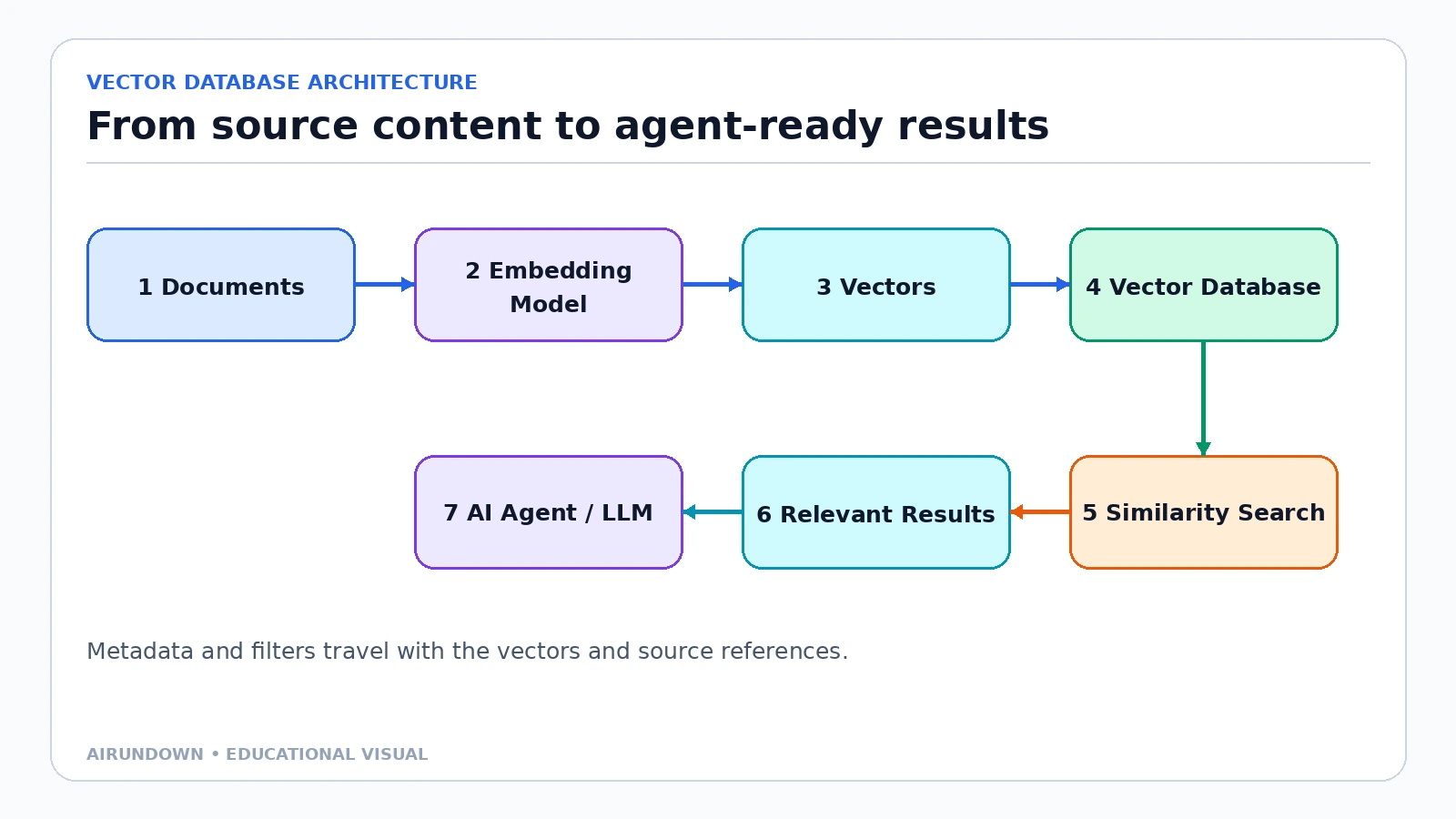
A vector database stores high-dimensional numerical representations called [vectors](/glossary/vector/) alongside identifiers and metadata. At query time, it finds stored vectors that are close to a query vector according to a similarity measure.
The usual flow is:
- Split source material into retrievable units.
- Convert each unit into an [embedding](/glossary/embedding/).
- Store the vector with its source text, identifier, and metadata.
- Embed a new query with a compatible embedding model.
- search for nearby vectors, apply filters, and return matching source content.
A vector database supports both indexing and retrieval. The vector is the search key; the source content remains the evidence supplied to the model.
What a vector database actually stores
An embedding is an ordered list of numbers produced by an embedding model. Those numbers place an item at a location in a mathematical space. Items with related meanings often end up near one another, even when they use different wording.
A production record normally contains more than the vector:
- the embedding itself;
- an ID that remains stable across updates;
- the original text or a pointer to it;
- source information, such as a document URL and section;
- metadata, such as language, date, department, product, or permission group;
- sometimes the embedding-model version and content checksum.
Keeping the evidence and provenance connected to the vector matters. A list of numbers cannot be quoted, cited, or inspected by a reader. The agent needs the source chunk and enough metadata to judge where it came from.
How similarity search works
Suppose an employee asks, “Can I get my travel costs reimbursed?” A keyword search may miss a policy titled “Business Expense Rules.” An embedding model can represent the question and the policy passage so that their semantic relationship is reflected in the vector space.
The vector database compares the query vector with stored vectors using a measure such as cosine similarity, dot product, or distance. It returns a ranked candidate list. The exact score is model- and metric-dependent; a score is not a universal probability that a passage is correct.
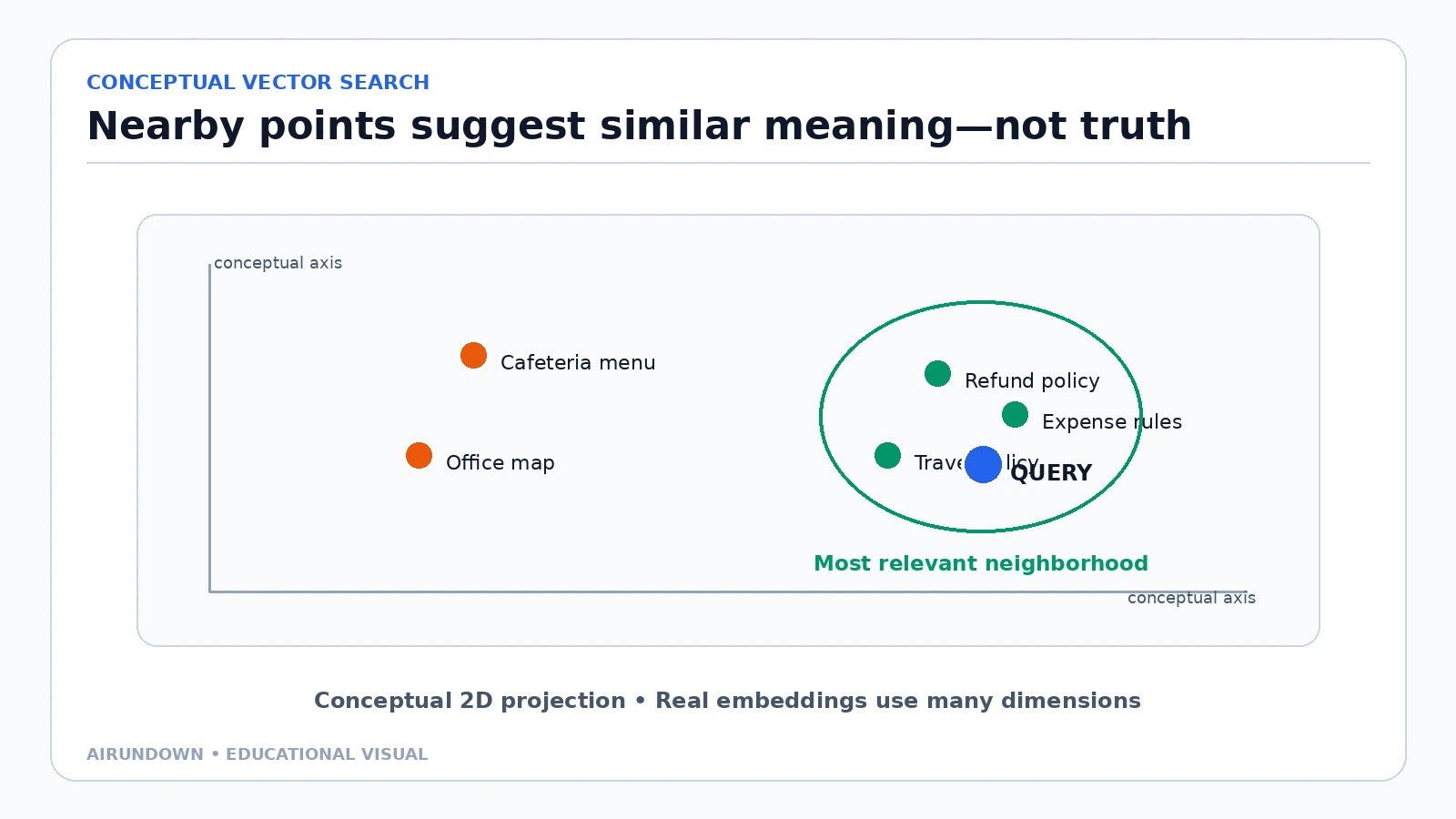
Real embeddings use many dimensions. This two-dimensional projection illustrates neighborhood search, not the literal shape of an embedding index.
The picture also reveals a key limitation: proximity indicates representational similarity, not truth, authority, freshness, or permission. Those properties need separate controls.
Why vector databases are useful for AI agents
A normal RAG application usually retrieves on every question. An [AI agent](/glossary/ai-agent/) may decide whether retrieval is necessary, select among sources, rewrite a query, retrieve again, or take a different action based on the result.
Vector search can support several agent capabilities:
Knowledge retrieval
The agent can fetch passages from manuals, policies, product documentation, or research notes and place them in the model's [context](/glossary/context/). This grounds the response in external material that can be updated without retraining the model.
Semantic memory
An agent may store facts, preferences, or distilled observations and retrieve them later. The infrastructure may look like RAG, but the concept differs: RAG retrieves external knowledge, while [agent memory](/glossary/agent-memory/) preserves information relevant to the agent's past interactions or ongoing work. The distinction is explained further in [RAG vs Agent Memory](/rag-vs-agent-memory/).
Tool and item selection
Embeddings can help narrow a large catalog of tools, products, examples, or workflows to a smaller candidate set. The agent still needs rules or reasoning to make the final selection.
Vector database vs relational database
A vector database is not a replacement for every database. A relational database is excellent when the question can be expressed with exact fields and conditions: “Find unpaid invoices for account 8472 created this month.” It preserves structured relationships, transactions, and exact values.
Vector search is better suited to fuzzy semantic questions: “Which support notes discuss customers who cannot finish billing setup?” It can find conceptually related language without a predetermined set of keywords.
Many useful systems combine both. A semantic search can retrieve candidates while [metadata filtering](/glossary/metadata-filtering/) limits results to the correct tenant, language, date range, or document type. Exact records such as balances and order status should usually come from the authoritative structured system, not from a vectorized passage.
Vector database vs knowledge base
A [knowledge base](/glossary/knowledge-base/) is the organized body of information a system can consult. It may contain documents, records, relationships, access rules, and publishing workflows. A [vector database](/glossary/vector-database/) is an infrastructure component that can index some or all of that knowledge for semantic retrieval.
The two terms are not interchangeable. A company wiki is a knowledge base before it has any vector index. Conversely, a vector database can store embeddings for products, images, or agent memories that are not a traditional document knowledge base.
Indexing, approximate search, and scale
Comparing a query with every stored vector is exact but becomes expensive as a collection grows. Vector systems therefore commonly use approximate nearest-neighbor indexes. These structures examine a promising portion of the collection and trade a small amount of recall for much faster search.
One well-known approach is Hierarchical Navigable Small World graphs, or HNSW. It organizes vectors as a multilayer proximity graph that can be traversed from broad neighborhoods to closer candidates. Other approaches partition the space, compress vectors, or combine methods.
The operational choices matter:
- Recall: How often does the index include the truly useful items?
- Latency: How long does retrieval add to the task?
- Memory and storage: How much infrastructure does the index require?
- Update behavior: How quickly do new, changed, or deleted records appear correctly?
- Filtering: Can permissions and metadata conditions be enforced during search?
“Fast” is not enough if the right evidence is absent from the candidate set.
The retrieval pipeline around the database
The database is only one stage in a [retrieval pipeline](/glossary/retrieval-pipeline/). Before indexing, documents need parsing, cleaning, [chunking](/glossary/chunking/), embedding, and metadata. At runtime, the system may perform [query rewriting](/glossary/query-rewriting/), dense or [hybrid search](/glossary/hybrid-search/), filtering, and [reranking](/glossary/reranking/) before constructing model context.
If retrieval quality is poor, changing database vendors is rarely the first useful experiment. The fault may be incomplete source content, badly chosen chunk boundaries, incompatible embedding models, missing metadata, a weak query, an overly small candidate count, or no reranking.
Common misconceptions
“The closest result must be correct”
Similarity is only a ranking signal. A close passage may be outdated, contradicted by a more authoritative source, or merely use similar language. Preserve provenance and instruct the application to distinguish retrieved evidence from verified facts.
“More vectors automatically produce better answers”
Adding duplicate, low-quality, or poorly segmented content can make retrieval noisier. Quality, coverage, structure, and evaluation matter more than raw record count.
“A vector database gives the model long-term memory”
It can be part of a memory system, but persistence alone is not memory design. The system still needs rules for what to write, how to update or forget it, whose memory it is, and when retrieved information should influence the agent.
“A larger context window removes the need for retrieval”
A large [context window](/glossary/context-window/) does not make every source current, authorized, or cheap to send on every request. Retrieval can reduce the amount of content presented to the model, but poor retrieval can also hide relevant material. These are system trade-offs, not mutually exclusive features.
When you may not need one
Do not add a vector database just because the application uses an LLM. A small, stable reference document may fit directly in context. Exact lookups may belong in SQL or an API. A tightly controlled decision tree may need no semantic search at all.
A vector database becomes more compelling when the corpus is too large to include directly, users express the same idea in varied language, content changes independently of the model, or the agent must retrieve relevant evidence repeatedly. Start with the information need and an evaluation set, then choose the simplest storage and retrieval design that meets it.
Practical checklist
Before selecting or configuring a vector database, answer these questions:
- What source is authoritative, and how are deletions propagated?
- What is the retrievable unit: paragraph, section, record, image, or something else?
- Which embedding model and distance measure will be used consistently?
- Which metadata fields and permission filters are mandatory?
- How will you test recall, ranking quality, answer groundedness, latency, and cost?
- What happens when retrieval returns weak or conflicting evidence?
That checklist keeps the vector database in its proper role: an efficient retrieval component inside a larger, evaluated system.
Sources
- Retrieval-Augmented Generation for Knowledge-Intensive NLP Tasks introduced a widely cited RAG formulation combining parametric and retrieved non-parametric memory.
- Sentence-BERT describes sentence embeddings designed for efficient semantic similarity search.
- Efficient and Robust Approximate Nearest Neighbor Search Using Hierarchical Navigable Small World Graphs presents HNSW, a common approximate nearest-neighbor indexing approach.
Continue learning
Read [How RAG Works](/how-rag-works/) for the full query-to-context pipeline, then use [Embeddings Explained for AI Agents](/embeddings-for-ai-agents/) to deepen the representation concepts behind vector search.