Reasoning in AI Agents: How Agents Decide What to Do Next
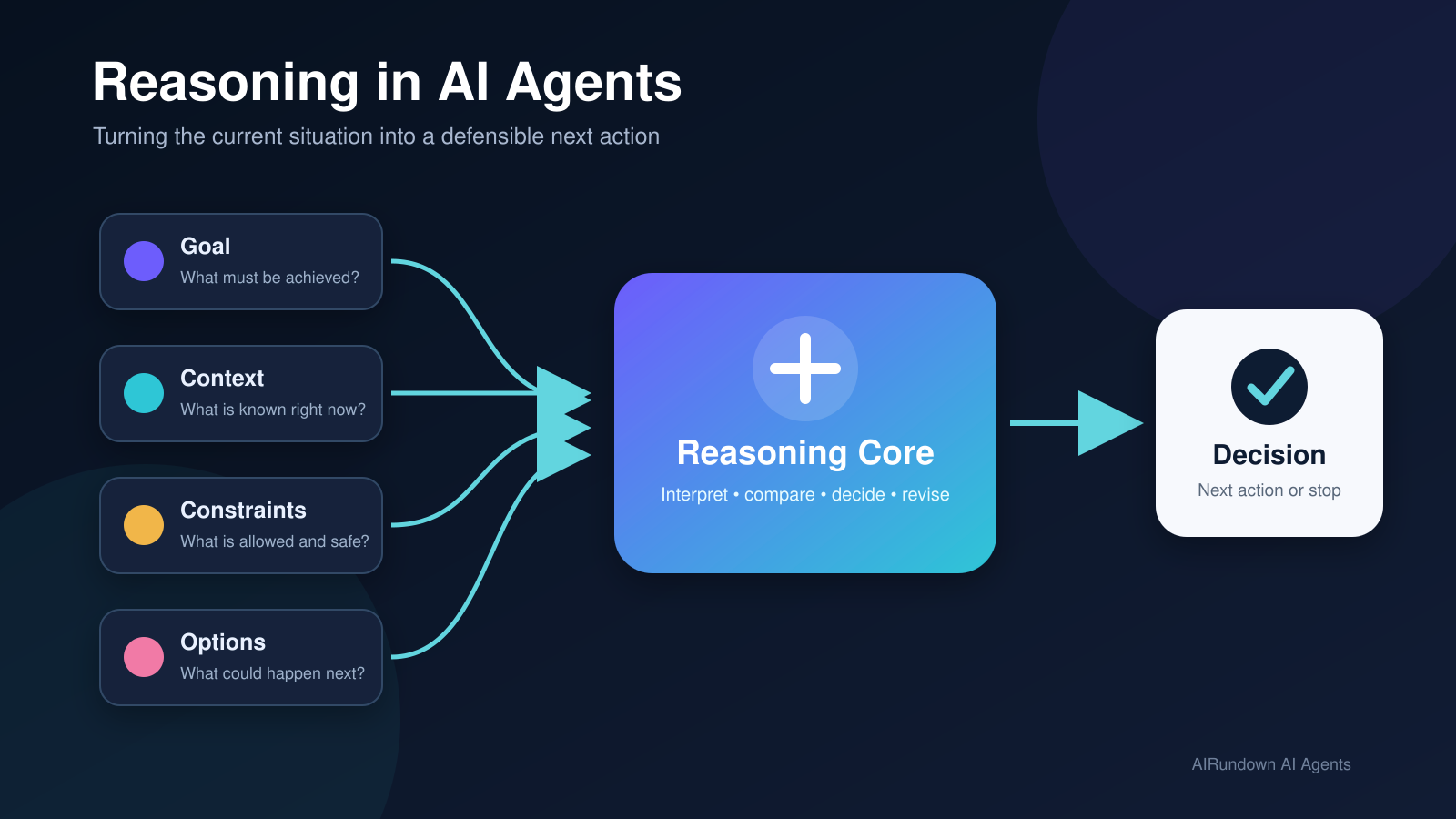
Reasoning is the part of an agent that turns a goal, the current context, and new evidence into a decision about what should happen next.
An AI agent rarely receives a perfectly defined task. “Refund the duplicate charge” sounds simple until the agent has to identify the customer, distinguish a duplicate from a pending authorization, check policy, decide whether it has enough evidence, and choose whether to act or escalate.
That gap between a request and a safe next action is where reasoning matters.
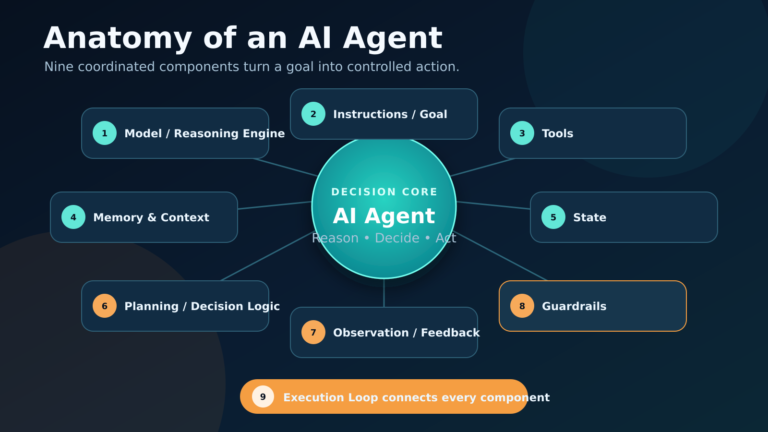
If you are new to the topic, first read [What Is an AI Agent?](/what-is-an-ai-agent/), then [How AI Agents Work](/how-ai-agents-work/) for the full execution loop. This lesson zooms in on the reasoning engine introduced in [Anatomy of an AI Agent](/anatomy-of-an-ai-agent/).
What you will learn
By the end, you should be able to explain:
- how an agent interprets a goal and its surrounding context;
- how it decomposes a task and evaluates possible next steps;
- how reasoning differs from planning and tool execution;
- how observations and reflection change later decisions; and
- why plausible reasoning can still produce a wrong or unsafe action.
TL;DR
- LLM reasoning happens inside a model call; agent reasoning uses model reasoning inside a stateful goal–action–observation loop.
- Reasoning evaluates the current situation and selects a next step. Planning organizes multiple future steps. Tool execution performs an action.
- Good reasoning includes uncertainty: the agent must recognize missing evidence and decide whether to search, ask, act, or stop.
- More intermediate text does not automatically mean better reasoning. Evidence, decision quality, and recovery matter more than verbosity.
- Reliable systems place checks at action boundaries, preserve useful state, and evaluate decisions across complete trajectories—not only final answers.
A practical definition of agent reasoning
Agent reasoning is the process of forming a working interpretation of the task, comparing possible actions, and choosing the next step under the system’s goals, evidence, constraints, and current state.
It is useful to think of it as a repeated decision:
Given what I am trying to achieve, what I know now, what I am allowed to do, and what remains uncertain, what is the best next step?
The answer might be:
- respond directly;
- retrieve more information;
- call a tool;
- ask the user a clarifying question;
- update or replace a plan;
- escalate for human approval; or
- stop because the goal is complete or unsafe.
Reasoning is therefore not just “thinking before answering.” In an agent, it controls what the system does next.
LLM reasoning vs agent reasoning
The two are related, but they are not the same system boundary.
| Dimension | LLM reasoning | Agent reasoning |
|---|---|---|
| Where it happens | Within one model inference or model turn | Across an agent loop that may contain many model and tool calls |
| Typical input | Prompt and current context | Goal, instructions, state, memory, observations, available tools, and constraints |
| Typical output | Answer, structured decision, rationale, or tool request | A next action plus updates to plan or state |
| Access to the world | None by itself | Indirectly through tools and observations |
| Persistence | Ends with the model call unless saved | Can preserve selected state across steps |
| Feedback | Mostly context supplied before the call | New evidence arrives after actions and can change later decisions |
Research on chain-of-thought prompting showed that intermediate reasoning steps can improve performance on some multi-step tasks. But an LLM producing a good answer in one call is still not automatically an agent.
Agent reasoning begins when that model capability is embedded in a system that can maintain state, choose actions, observe results, and revise its behavior. The ReAct pattern made this distinction concrete by interleaving reasoning with actions and observations.
One caution: a written rationale is not a guaranteed window into every internal computation that produced a decision. For product and safety review, it is usually more useful to record the decision, evidence used, uncertainty, chosen tool, arguments, and outcome than to depend on a long free-form reasoning transcript.
The reasoning process inside an agent
The exact implementation varies, but most useful agent reasoning contains the following functions.
1. Goal interpretation
The agent converts the user’s request into an operational objective.
For “refund the duplicate charge,” a weak interpretation is:
Issue a refund.
A stronger interpretation is:
Identify whether two settled charges represent the same purchase and, if policy permits, reverse only the duplicate without affecting the valid payment.
The stronger version captures the intended outcome, not merely the verb in the request. It also exposes constraints: confirm duplication, protect the valid charge, and follow refund policy.
Goal interpretation can fail when instructions conflict, success is vague, or the agent optimizes a proxy. “Close the ticket quickly” may conflict with “resolve the customer’s problem correctly.” A production agent needs explicit priority rules for such conflicts.
2. Context understanding
The agent builds a working view of the current situation from:
- the user’s message;
- system instructions and policies;
- conversation history;
- relevant memory;
- current workflow state;
- available tools and their descriptions; and
- recent observations from the environment.
“Understanding” here does not mean human comprehension. It means producing a task-relevant representation that supports the next decision.
More context is not always better. Irrelevant history can distract the model, outdated memory can conflict with current records, and important evidence can be buried in a long prompt. Context engineering is the discipline of selecting and structuring what the agent needs now.
3. Task decomposition
Complex goals become easier to manage when divided into smaller subproblems.
The refund agent might decompose its task into:
- identify the customer and transaction;
- retrieve recent charges;
- compare merchant, amount, time, and settlement status;
- check refund and dispute policy;
- decide whether automated refund criteria are met;
- execute or escalate; and
- verify the final account state.
Decomposition reduces cognitive load and creates checkpoints. It can also fail: the agent may omit a necessary step, choose the wrong order, or split tightly coupled work into fragments that lose important context.
4. Intermediate reasoning
At each step, the agent connects evidence to a conclusion or decision.
For example:
- two charges have the same amount and merchant;
- one is pending and one has settled;
- policy says a pending authorization is not yet refundable;
- therefore, do not issue a refund now;
- explain the hold and set the appropriate follow-up.
The value of intermediate reasoning is not its length. Its value is whether it preserves the relevant facts, applies the correct rule, and supports the next action.
Structured fields can be more reliable than an unrestricted scratchpad:
current_goal: resolve reported duplicate charge
known_facts: one settled charge; one pending authorization
missing_evidence: whether the pending item settles
policy_constraint: refund only settled duplicate charges
next_decision: explain and wait; do not refund
This structure makes it easier to test whether the decision used the right evidence.
5. Decision-making
The agent compares possible next moves. It may implicitly or explicitly consider:
- expected progress toward the goal;
- evidence quality;
- cost and latency;
- reversibility;
- permission level;
- risk of side effects;
- policy constraints; and
- whether a human decision is required.
The “best” action is not always the most autonomous one. When evidence is incomplete and the action is difficult to reverse, asking or escalating can be the most intelligent decision.
6. Uncertainty handling
Agents operate with at least three kinds of uncertainty:
- fact uncertainty: “I do not know whether the second charge settled.”
- interpretation uncertainty: “The user may mean a card authorization rather than a completed charge.”
- action uncertainty: “I am not sure whether this account is eligible for an automatic refund.”
A capable agent should respond to uncertainty with a policy, not with confidence theatre. Useful responses include:
- retrieve evidence;
- ask a targeted question;
- choose a reversible action;
- request approval;
- abstain; or
- stop at a defined limit.
Self-reported confidence alone is not enough because models can be miscalibrated. Ground uncertainty decisions in observable conditions such as missing fields, conflicting records, low retrieval quality, tool errors, or high-risk action types.
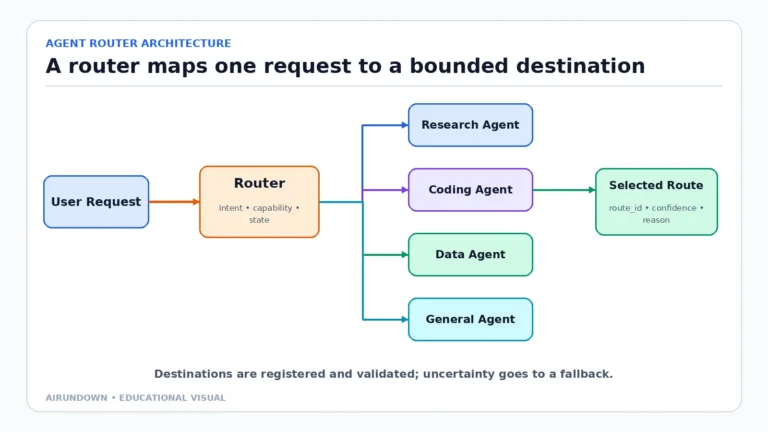
7. Tool-selection decisions
Reasoning decides whether a tool is needed and, if so:
- which tool fits the subtask;
- when to call it;
- which arguments to pass;
- whether approval is required;
- how to interpret the result; and
- whether another call is justified.
The actual API call is execution, not reasoning.
This distinction matters. If an agent selects the correct refund API but passes the wrong transaction ID, the reasoning-to-action translation failed. If it passes correct arguments but the API is unavailable, execution failed. Those problems require different fixes.
Research such as Toolformer explored models that learn when to call tools, which tool to call, what arguments to use, and how to incorporate results. In real systems, tool descriptions, schemas, permissions, and error messages strongly shape those choices.
8. Reflection
Reflection is a deliberate review of a decision, result, or completed attempt.
It may ask:
- Did the action produce the expected state?
- Which assumption was wrong?
- Does new evidence invalidate the plan?
- Is the goal actually complete?
- Should this failure change the next attempt?
The Reflexion framework demonstrated one approach: convert feedback about an attempt into verbal guidance stored for a later attempt, without changing model weights.
Reflection is not simply asking the same model, “Are you sure?” Without new evidence, independent criteria, or a different perspective, the model may repeat or rationalize the original mistake.
Reasoning vs planning vs tool execution
These capabilities work together, but each has a different responsibility.
| Capability | Core question | Output | Example |
|---|---|---|---|
| Reasoning | What does the current evidence mean, and what should happen next? | Judgment or next-step decision | “The second charge is pending, so refunding now is incorrect.” |
| Planning | What sequence of steps could achieve the goal? | Ordered, revisable strategy | “Check charges, compare status, apply policy, then refund or escalate.” |
| Tool execution | Perform the selected operation | External result or observation | The payment API returns transaction status pending. |
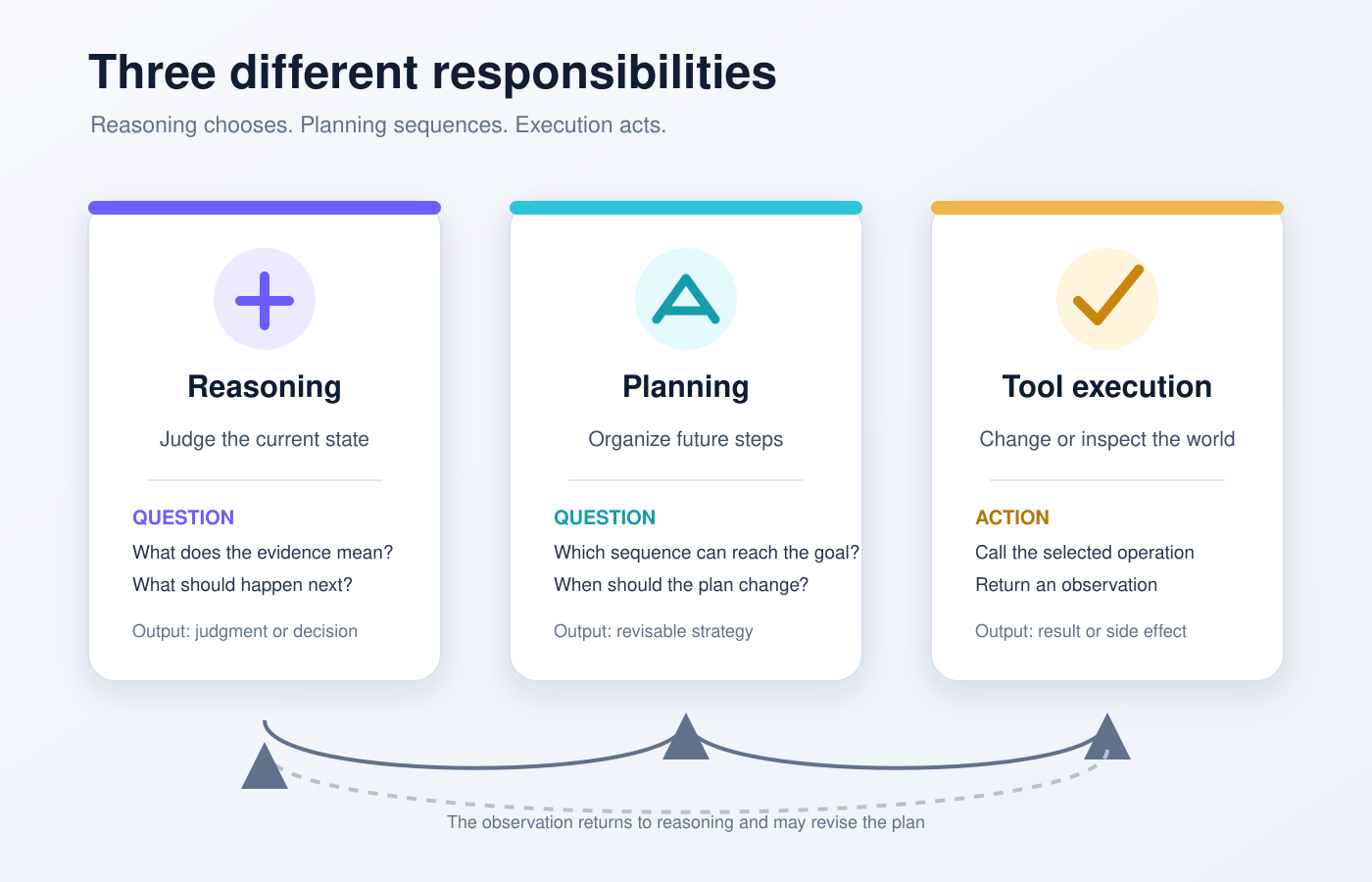
Reasoning chooses, planning sequences, and execution acts.
Planning is often an output of reasoning: the agent reasons about the goal and proposes a sequence. Later reasoning decides whether that plan still fits after new observations.
Not every decision needs a long plan. A simple task may require one evidence check and one action. Conversely, a detailed plan is not useful if the agent cannot reason about when to revise it.
The Plan-and-Solve approach separates creating a plan from carrying out its subtasks. That separation can reduce missing-step errors, but the agent still needs reasoning during execution because the environment may not match the original assumptions.
Tool execution is the boundary where a model-generated decision can change the outside world. That boundary deserves stronger controls than ordinary text generation: schema validation, permission checks, previews, idempotency, approval gates, and post-action verification.
A complete example: the duplicate-charge request
Consider this user message:
“I was charged twice for yesterday’s order. Refund the duplicate.”
Here is a simplified trajectory.
| Stage | Agent behavior |
|---|---|
| Interpret | Define success as resolving a true duplicate while preserving the valid payment. |
| Understand context | Identify the customer, order, payment method, policy, and available payment tools. |
| Decompose | Retrieve charges → compare records → check policy → decide → act → verify. |
| Recognize uncertainty | The message alone does not prove that both charges settled. |
| Select tool | Choose the read-only transaction lookup before the refund tool. |
| Execute | Retrieve two records: one settled payment and one pending authorization. |
| Observe | The evidence does not show two completed charges. |
| Reason again | A refund is not currently justified; explain the pending hold and expected resolution path. |
| Reflect and verify | Confirm no refund was issued, document the evidence, and set a follow-up only if policy supports it. |
The important behavior is restraint. A less capable agent might treat the user’s wording as verified fact and call the refund tool immediately. A reasoning agent tests the claim against the environment before taking an irreversible action.
Common reasoning failure modes
| Failure mode | What it looks like | Practical control |
|---|---|---|
| Goal drift | The agent optimizes speed instead of correct resolution | Explicit success criteria and priority rules |
| Semantic misunderstanding | “Pending” is treated as “settled” | Typed state, domain definitions, and policy examples |
| Context omission | A relevant restriction is not included or retrieved | Context checks and required evidence fields |
| Context overload | The model focuses on irrelevant history | Retrieve only task-relevant context and summarize stale state |
| Bad decomposition | A verification step is skipped | Required checkpoints or workflow gates |
| Premature commitment | The first plausible explanation becomes the final answer | Alternative check and evidence threshold |
| Tool mismatch | A write tool is selected when a read tool would resolve uncertainty | Clear tool boundaries and least-privilege design |
| Hallucinated state | The agent claims an action succeeded without observing the result | Treat tool output as authoritative and verify postconditions |
| Looping | The agent repeats searches or reflections without progress | Iteration budgets, progress tests, and stop conditions |
| False confidence | The agent acts despite missing or conflicting evidence | Risk-based approval and abstention rules |
| Rubber-stamp reflection | Review repeats the original conclusion | Use explicit criteria, new evidence, or an independent evaluator |
Failures can compound across long trajectories. A small interpretation error can lead to the wrong plan, the wrong tool, and a confident but harmful action. Evaluate the whole decision path, not just whether the final prose sounds reasonable.
What builders should design and measure
Make state explicit
Separate stable instructions, current task state, retrieved evidence, past observations, and tentative assumptions. Do not force the model to reconstruct all of them from a long transcript.
Put guardrails at action boundaries
Validate tool names, arguments, permissions, policy conditions, and approval requirements before execution. Recheck the external state afterward.
Prefer evidence-backed decision records
For each important action, capture:
- the current goal;
- evidence used;
- missing or conflicting information;
- selected action;
- tool arguments;
- applicable constraint or approval;
- observed result; and
- reason for stopping or continuing.
This creates useful observability without treating unrestricted hidden reasoning as an audit log.
Evaluate trajectories, not only answers
Useful evaluation dimensions include:
- goal interpretation accuracy;
- decomposition completeness;
- evidence selection;
- correct tool choice;
- argument accuracy;
- unnecessary tool calls;
- policy compliance;
- recovery after failure;
- calibration of escalation or abstention; and
- final task success.
An agent can reach the right answer for the wrong reason, or fail safely after making several good decisions. A single final-answer score misses both.
Match reasoning effort to task risk
Simple, reversible tasks should not pay the latency and cost of elaborate deliberation. High-impact, ambiguous, or irreversible actions deserve more evidence checks, stronger validation, and often human approval.
My Take
The clearest sign of good agent reasoning is not a long explanation. It is disciplined control of the next action.
A useful agent can distinguish facts from assumptions, notice when evidence is missing, choose the least risky way to reduce uncertainty, and change direction when the environment disagrees. That is more valuable than producing a polished rationale after committing to the wrong path.
Start with a small reasoning structure: goal, known facts, uncertainty, constraints, next action, and expected result. Add planning depth or reflection loops only when evaluations show that the simpler design fails.
The next step
Reasoning chooses what should happen next, but an agent needs a safe interface to make that decision real. Continue through the [Start Here learning path](/start-here/) to learn how agents select, call, and verify tools.
Sources
- Wei et al., “Chain-of-Thought Prompting Elicits Reasoning in Large Language Models”, 2022.
- Yao et al., “ReAct: Synergizing Reasoning and Acting in Language Models”, 2022/2023.
- Schick et al., “Toolformer: Language Models Can Teach Themselves to Use Tools”, 2023.
- Wang et al., “Plan-and-Solve Prompting: Improving Zero-Shot Chain-of-Thought Reasoning by Large Language Models”, 2023.
- Shinn et al., “Reflexion: Language Agents with Verbal Reinforcement Learning”, 2023.
- Anthropic, “Building Effective Agents”, 2024.