RAG vs AI Agent: What’s the Difference?
RAG answers a knowledge-access problem. An AI agent manages a goal-directed execution problem. Confusing them creates systems with too much complexity—or too little capability.
TL;DR
- RAG retrieves external information and supplies it to a model for generation.
- An AI agent decides and acts across one or more steps to pursue a goal.
- Retrieval is not autonomy, and generating an answer is not the same as taking action.
- RAG alone is often enough for document-backed question answering.
- An agent can use RAG as a tool when retrieval is one step inside a larger task.
The difference in one sentence
[RAG](/glossary/retrieval-augmented-generation/) is a knowledge-retrieval architecture; an [AI agent](/glossary/ai-agent/) is a goal-directed execution system.
That distinction is more useful than asking which one is “better.” They solve different problems and can be combined.
What RAG solves
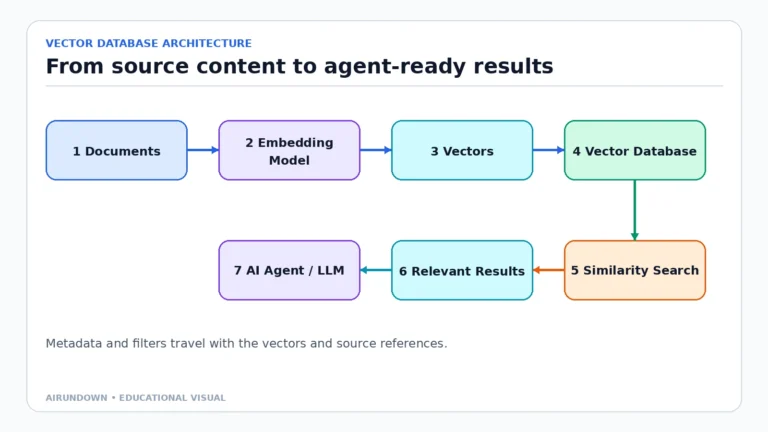
A RAG system helps a model answer using information that is external to its trained parameters. A common [retrieval pipeline](/glossary/retrieval-pipeline/) does this:
Query → Retrieve evidence → Build context → Generate answer
The core decision is which information should enter the model’s context. A basic RAG application may perform one retrieval operation and one generation operation for each user question.
Typical RAG use cases include:
- answering questions from product documentation;
- explaining internal policies;
- searching research literature;
- summarizing account-specific records;
- producing source-linked support responses.
RAG may include sophisticated query rewriting, filtering, reranking, and answer validation. That sophistication does not automatically make it an agent. The architecture can still be a predefined pipeline.
What an AI agent solves
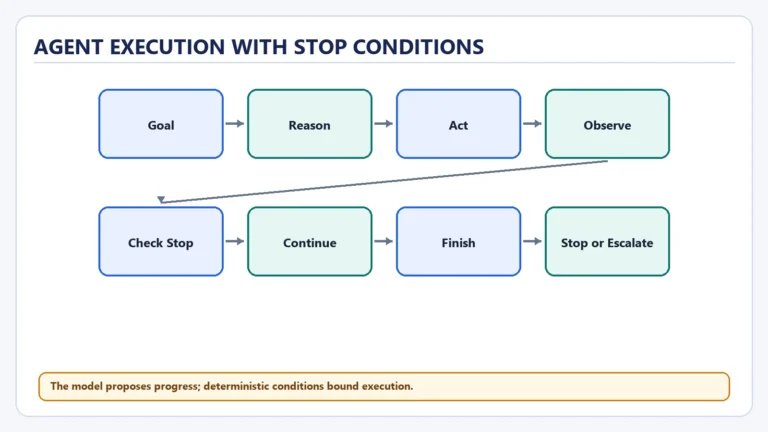
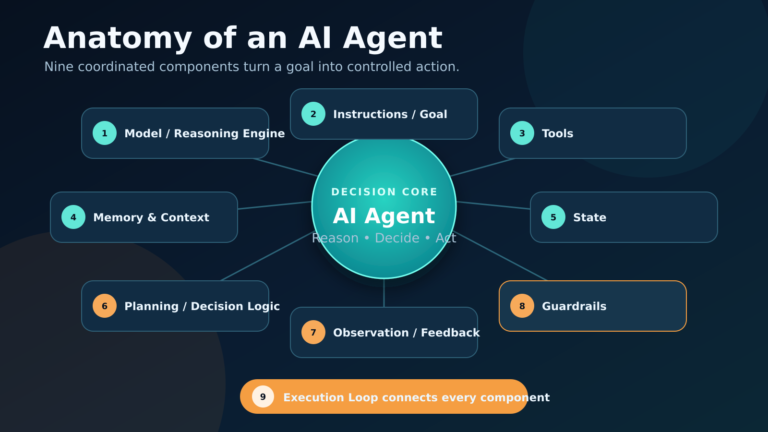
An AI agent pursues a goal by interpreting the situation, deciding what to do, taking an action, observing the result, updating [agent state](/glossary/agent-state/), and continuing until a [stopping condition](/glossary/stopping-condition/) is met.
A simplified [agent loop](/glossary/agent-loop/) is:
Goal → Reason/plan → Choose action → Act → Observe → Update state → Continue or stop
Actions can include retrieval, but also:
- calling APIs;
- modifying records;
- running code;
- sending messages;
- asking a user for clarification;
- delegating to another agent;
- revising a plan after failure.
The key capability is not “uses an LLM many times.” It is the control loop that chooses and adapts actions based on observations.
Side-by-side comparison
| Dimension | RAG | AI agent |
|---|---|---|
| Primary purpose | Access relevant external knowledge | Pursue a goal through decisions and actions |
| Core loop | Retrieve, augment context, generate | Decide, act, observe, update, repeat |
| Main output | Usually an evidence-backed response | A completed task, state change, or result |
| Autonomy | Not required | Varies, but some action selection is central |
| Tool use | Retrieval components may be fixed | Chooses among tools or actions at runtime |
| State | Often query and retrieved context | Tracks progress, observations, decisions, and outcomes |
| Planning | Usually unnecessary for a single query | Useful for multi-step or constrained goals |
| Main risk | Wrong or misleading evidence | Wrong actions plus all retrieval and model risks |
| Complexity | Lower when pipeline is fixed | Higher due to loops, branching, recovery, and permissions |
Retrieval versus action
[Retrieval](/glossary/retrieval/) obtains information. An action changes or interrogates an environment through an interface.
Retrieval can be implemented as a tool call, but its purpose remains knowledge access. An agent might retrieve a refund policy, then use a different tool to create the refund, record the decision, and notify the customer.
The policy lookup is RAG-like knowledge access. The refund creation is an operational action. Treating both as “RAG” hides the permissions and consequences of the second step.
Knowledge access versus autonomy
A system can use excellent retrieval with no meaningful autonomy. The application may always run the same search, place the top passages into context, and return one answer.
Conversely, an agent can operate without RAG. A scheduling agent might use calendar APIs and deterministic rules without searching a document knowledge base.
Autonomy describes how much the system can decide and execute without immediate human direction. It is not created by adding a vector database.
RAG pipeline versus agent loop
The distinction becomes clear when something unexpected happens.
Suppose the first search returns no useful evidence:
- A fixed RAG pipeline may return “I could not find the answer” or execute a predefined fallback query.
- An agent may inspect the failure, rewrite the question, select another knowledge source, ask a clarifying question, compare results, and decide when enough evidence exists.
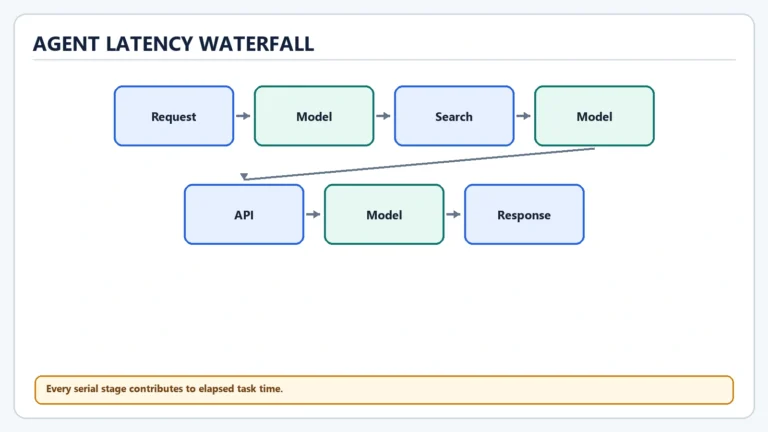
The agent’s behavior branches based on observations. That flexibility can improve task completion, but it also adds latency, cost, and new failure modes.
A worked example
Consider two employee-support systems.
System A: RAG policy assistant
The user asks whether a travel expense is reimbursable. The system retrieves the current policy, filters by country and employment type, and generates an answer with citations.
It does not submit a claim or decide what to do next. RAG is enough.
System B: expense-resolution agent
The user asks, “Resolve the rejected taxi claim from yesterday.”
The system must:
- identify the correct expense record;
- retrieve the applicable policy;
- inspect the rejection reason;
- ask for a missing receipt if necessary;
- prepare or update the claim;
- request human approval for a sensitive change;
- resubmit through an expense API;
- verify the new status;
- report the outcome.
RAG supplies policy knowledge, but the overall system is an agent because it manages a goal across decisions, tools, state, and observations.
When RAG alone is enough
Choose a fixed RAG application when:
- the user primarily needs answers or summaries;
- the workflow is predictable;
- retrieval sources are known in advance;
- the system should not change external state;
- a clear “insufficient evidence” response is acceptable;
- lower latency and simpler evaluation matter.
Examples include documentation search, policy Q&A, research discovery, and source-backed support drafting.
Do not add an agent loop merely to make the architecture sound advanced. Every loop introduces more model calls, branches, and operational risk.
When an agent is needed
Consider an agent when the task requires:
- choosing among several actions based on intermediate results;
- working across multiple systems;
- maintaining progress over a longer task;
- planning or task decomposition;
- recovering from tool failures;
- asking for missing information;
- performing authorized changes;
- verifying that the goal was actually achieved.
An agent is justified by adaptive execution, not by the presence of a chatbot interface.
When to use RAG inside an agent
RAG belongs inside an agent when correct action depends on external knowledge. The agent can treat retrieval as one capability:
- determine what information is missing;
- formulate a retrieval query;
- choose the appropriate knowledge source;
- inspect evidence quality;
- use the evidence to decide an action;
- cite or record the source in the final result.
This pattern appears in research agents, customer-support agents, coding agents, compliance workflows, and enterprise assistants.
The agent should not assume the top retrieval result is authoritative. Source permissions, dates, conflicts, and evidence strength need explicit treatment.
Common misconceptions
“A RAG chatbot is automatically an agent”
No. If it follows a fixed retrieve-and-answer sequence, it is a RAG application. It may still be useful and technically sophisticated.
“Agents make RAG unnecessary”
No. An agent’s reasoning cannot recover facts it cannot access. Retrieval can provide the policies, records, and current information needed for a sound decision.
“More autonomy makes retrieval better”
Not automatically. An agent can generate poor queries, search unnecessary sources, or loop over noisy evidence. Retrieval quality needs its own evaluation.
“An agent is just RAG with more LLM calls”
Multiple calls do not define an agent. The defining pattern is stateful, goal-directed decision and action based on observations.
Trade-offs and risks
RAG systems need source governance, access control, retrieval evaluation, and grounding checks.
Agents need all of that plus:
- tool permissions;
- action validation;
- retry and recovery policies;
- state management;
- stopping limits;
- human approval for high-impact operations;
- end-to-end traces and evaluation.
Adding RAG to an agent combines their capabilities and their risks. Retrieved content can also contain prompt injection, so external text should not be treated as trusted instructions.
Decision guide
Use this sequence:
- Does the user need external knowledge? If yes, add retrieval.
- Is the expected output an answer or summary? A fixed RAG pipeline may be enough.
- Must the system choose and perform actions? Consider an agent.
- Do later decisions depend on earlier observations? An agent loop is likely justified.
- Can the workflow be expressed safely as fixed steps? Prefer the simpler workflow when it meets the need.
My Take
RAG is often the right first architecture because it narrows the problem to evidence access and answer quality. An agent should be added only when the product needs adaptive execution.
The strongest systems do not maximize autonomy. They use the least complex control pattern that can complete the real job safely.
Next step
Read [How RAG Works](/how-rag-works/) for the retrieval pipeline, then [Anatomy of an AI Agent](/anatomy-of-an-ai-agent/) for the components required around goal-directed execution.
Sources
- Patrick Lewis et al., Retrieval-Augmented Generation for Knowledge-Intensive NLP Tasks, NeurIPS 2020.
- Vladimir Karpukhin et al., Dense Passage Retrieval for Open-Domain Question Answering, EMNLP 2020.