Hybrid Search vs Dense vs Sparse Retrieval
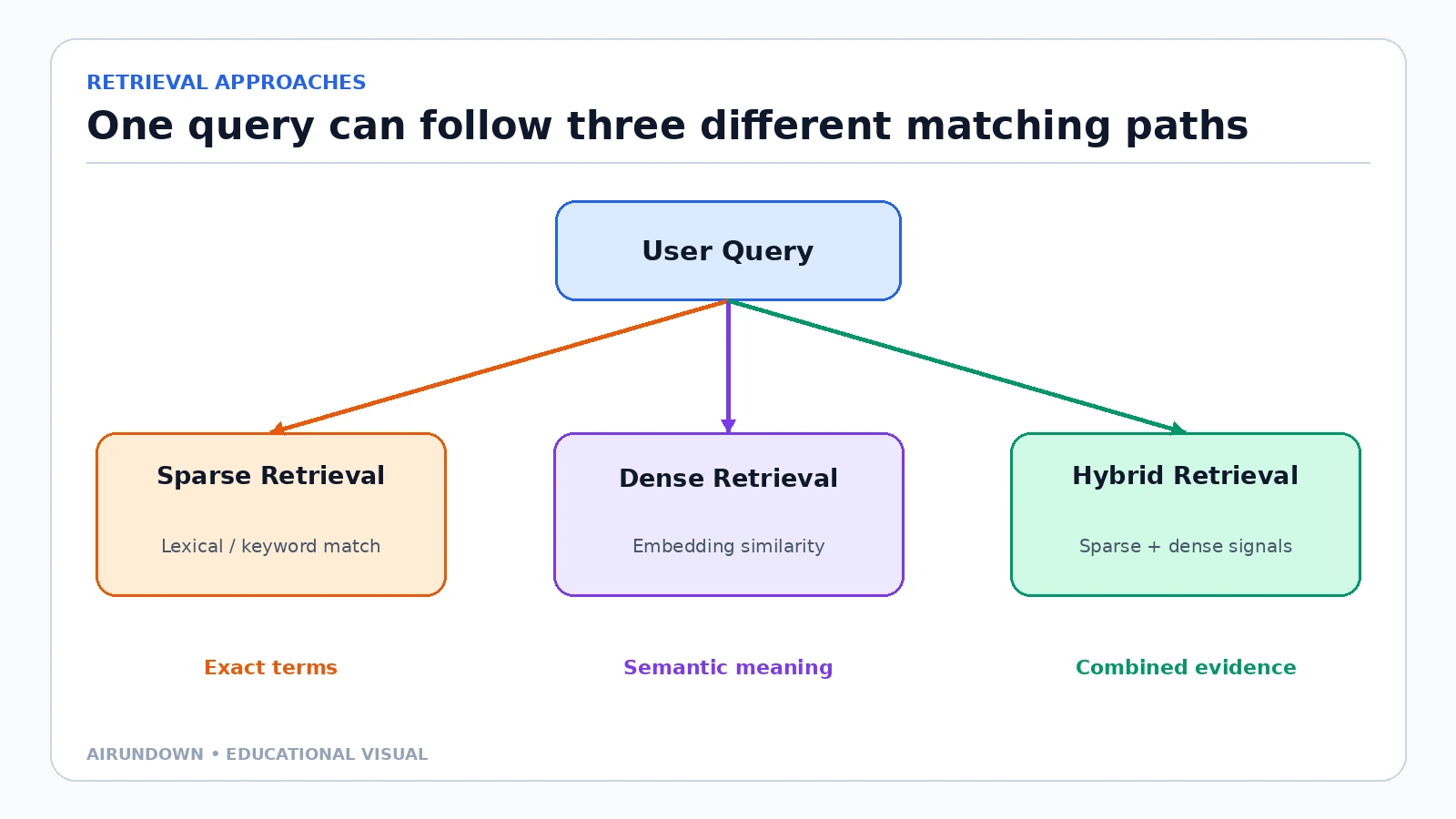
Retrieval systems do not all define relevance the same way. Sparse retrieval emphasizes shared terms. Dense retrieval compares learned vector representations of meaning. Hybrid search combines signals from both.
The right choice depends on the corpus and the query. A semantic question may benefit from dense retrieval, while a product code or error string often rewards exact lexical matching. A hybrid system can cover both, but it introduces score-combination and evaluation decisions.
This comparison explains how each approach works, where it fails, and how to select a practical baseline for [retrieval-augmented generation](/glossary/retrieval-augmented-generation/) or an AI agent.
The difference in one view
Sparse, dense, and hybrid retrieval start with the same information need but use different evidence to rank candidates.
| Dimension | Sparse retrieval | Dense retrieval | Hybrid search |
|---|---|---|---|
| Primary signal | Term occurrence and importance | Similarity between learned embeddings | Combined sparse and dense signals |
| Strong at | Exact names, IDs, rare phrases, keyword-rich domains | Paraphrases, synonyms, conceptual similarity | Mixed query sets and broader coverage |
| Common weakness | Vocabulary mismatch | Exact-string misses and semantic look-alikes | More tuning, latency, and operational complexity |
| Typical index | Inverted index | Vector index | Both indexes or a system supporting both |
| Query representation | Terms and weights | Query embedding | Terms, embedding, and a fusion rule |
| Best starting point | Exact-term-heavy corpus | Semantically varied corpus with clean embeddings | When both failure modes matter and evidence supports the complexity |
None of these methods guarantees that a retrieved passage is true or sufficient. They produce candidates for later filtering, [reranking](/glossary/reranking/), and context construction.
How sparse retrieval works
[Sparse retrieval](/glossary/sparse-retrieval/) represents a document and query by terms in a very large vocabulary. Most values are zero, which is why the representation is called sparse. An inverted index maps each term to documents containing it.
Traditional scoring methods reward documents containing query terms while accounting for factors such as term rarity, frequency, and document length. BM25 is a widely used example.
Consider the query ERRAUTH042. An exact match to a troubleshooting page is highly informative. The string may be too new, rare, or arbitrary for an embedding model to represent reliably. Sparse retrieval can find it directly.
Sparse methods are also interpretable at the term level: you can inspect which words matched. They are efficient and mature, and they do not require an embedding model to index the corpus.
Where sparse retrieval struggles
The main limitation is vocabulary mismatch. A document might say “travel reimbursement,” while the user asks, “How do I get paid back for a work trip?” The meaning aligns, but the important words may not.
Stemming, synonyms, query expansion, and learned sparse models can reduce this gap. However, classic lexical retrieval still depends heavily on the words present in the query and document.
How dense retrieval works
[Dense retrieval](/glossary/dense-retrieval/) uses an embedding model to encode a query and document chunks as fixed-length [vectors](/glossary/vector/). Most dimensions contain nonzero values. The system retrieves vectors that are nearby according to a similarity measure.
Because the model learned patterns from language, dense retrieval can connect paraphrases and related concepts without exact word overlap. The travel-reimbursement question can match a “Business Expense Policy” passage.
Dense Passage Retrieval, or DPR, demonstrated a dual-encoder approach in which questions and passages are encoded separately and compared efficiently. Modern systems vary in training data, model architecture, dimensions, and supported languages, so an embedding model that works well in one domain may not transfer perfectly to another.
Where dense retrieval struggles
Semantic similarity can be too broad. A query about canceling a subscription may retrieve a passage about pausing one because both discuss account changes. Dense models can also underweight exact identifiers, numbers, unfamiliar names, and newly introduced terminology.
Vector similarity scores are not calibrated truth probabilities. A “close” passage can still be outdated or wrong for the user's product version. [Metadata filtering](/glossary/metadata-filtering/) and provenance remain essential.
How hybrid search works
[Hybrid search](/glossary/hybrid-search/) runs or represents both sparse and dense retrieval, then combines the candidate lists or scores. It aims to preserve exact-match strength while gaining semantic recall.
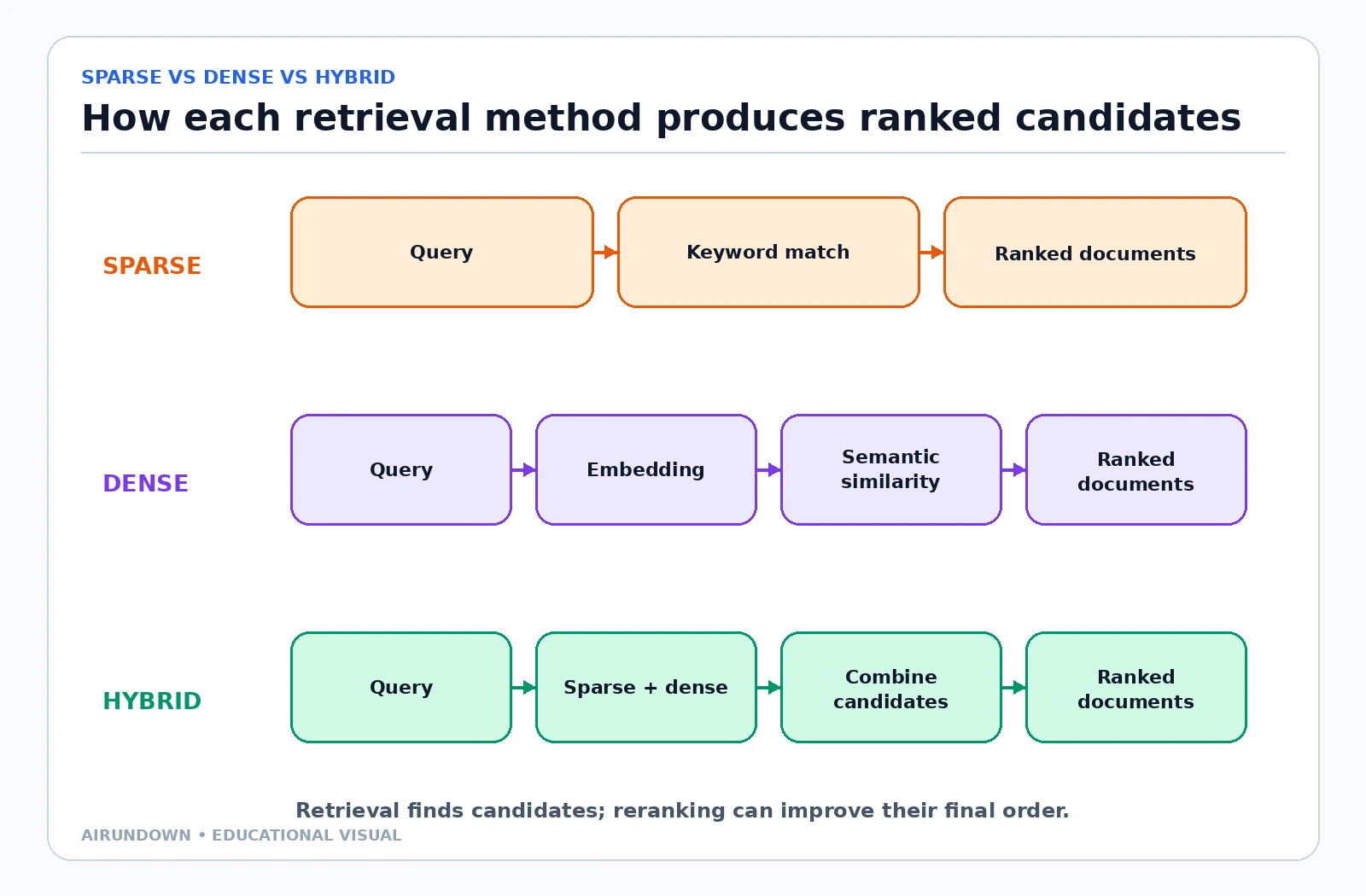
Hybrid search is a candidate-generation strategy. A reranker can still apply a more precise query-document comparison afterward.
There are several ways to combine results:
Score fusion
Normalize sparse and dense scores and compute a weighted combination. This provides direct control over the balance, but score distributions can differ across methods, query types, and systems. A weight tuned on one dataset may not generalize.
Rank fusion
Combine positions rather than raw scores. Reciprocal Rank Fusion, for example, rewards documents that rank highly in one or both lists. Rank-based methods avoid comparing incompatible score scales, though their parameters still need evaluation.
Candidate union followed by reranking
Take the union of the top results from each retriever, remove duplicates, then apply a reranker. This separates broad candidate recall from final ordering. It may improve quality but adds latency and compute.
Hybrid does not mean “always better.” If sparse and dense retrieval return largely redundant candidates, the second path may add cost without useful recall. Poor fusion can also demote the best result.
Retrieval is candidate generation
It helps to separate two objectives:
- Candidate recall: Did the first stage find the evidence somewhere in its top set?
- Final ranking: Did the most useful evidence reach the positions that will be sent to the model?
A fast retriever often optimizes the first objective over a large corpus. A [reranker](/glossary/reranking/) can then evaluate a smaller candidate set more carefully. This architecture allows sparse and dense methods to focus on breadth while a cross-encoder or other model improves ordering.
If the relevant passage never enters the candidate set, reranking cannot recover it.
Query examples
Exact identifier
Query: “What causes PX-4471?”
Sparse retrieval is a strong baseline because the identifier itself is the best signal. Dense retrieval may help with descriptive language around the error, but it should not replace exact matching.
Natural-language paraphrase
Query: “Can contractors get reimbursed for home-office equipment?”
Dense retrieval may connect “get reimbursed” with “eligible expenses” and “contract personnel” even when wording differs. Sparse retrieval can still help if the policy uses the same distinctive terms.
Ambiguous product question
Query: “How do I rotate keys for Atlas?”
Sparse retrieval can emphasize “Atlas” and “rotate keys.” Dense retrieval can find passages using “credential renewal.” Hybrid search can capture both, while metadata restricts results to the relevant product and current version.
Negation and fine distinctions
Query: “Which plans do not include audit logs?”
All three methods may retrieve passages about plans and audit logs without reliably resolving the negation. This is a candidate-generation problem followed by a reading problem. A reranker and the generation model must compare the actual conditions in the evidence.
Query rewriting changes the comparison
[Query rewriting](/glossary/query-rewriting/) can turn a conversational question into a better search query. It may add an acronym, remove chat history that dilutes the topic, or generate both an exact and semantic version.
For sparse retrieval, rewriting can introduce vocabulary used in the corpus. For dense retrieval, it can clarify the intended meaning. In hybrid systems, multiple query variants can improve coverage but also expand cost and noise.
Do not let a model rewrite away important identifiers, negations, dates, or quoted phrases. Preserve the original query and evaluate rewriting as its own pipeline stage.
Filters are separate from similarity
Relevance is not authorization. A highly similar document may belong to another customer, region, or product version. Apply mandatory filters based on trusted metadata.
Filtering before search narrows the candidate pool and enforces scope. Filtering after search may leave too few usable results if the top candidates are removed. The exact behavior depends on the index and filter selectivity, so test realistic permission and metadata conditions.
How to choose
Choose from evidence, not fashion.
Start with a representative query set containing easy, hard, exact, semantic, and no-answer cases. Label the chunks that should support each answer. Compare sparse and dense baselines using the same corpus and chunking. Measure recall at candidate depths the downstream system can afford.
Use sparse retrieval when exact vocabulary is dominant and vocabulary mismatch is limited. Use dense retrieval when paraphrase and conceptual matching are central. Test hybrid when each method finds relevant items the other misses often enough to justify another index and fusion layer.
Then test downstream outcomes: grounded answer quality, citation accuracy, latency, token use, and failure behavior. A small retrieval gain may not be worthwhile if it doubles response time on an interactive workflow.
Common misconceptions
“Dense retrieval understands the document”
An embedding compresses patterns useful for similarity. It does not verify claims, execute logic, or preserve every detail. Dense retrieval can return semantically plausible but factually irrelevant passages.
“Sparse means primitive”
Exact lexical evidence remains valuable, especially for names, codes, legal phrases, and technical terminology. Mature sparse systems can be extremely effective.
“Hybrid search eliminates reranking”
Fusion combines retrieval signals. Reranking performs a more focused assessment of query-document relevance. They solve related but distinct problems and can be used together.
“The highest retrieval score should become the answer”
Retrieval scores rank candidates inside a method. The model should answer from the source content, not repeat a score as confidence. The application still needs [grounding](/glossary/grounding/), citations, and an appropriate no-answer behavior.
A practical default
If you are building a first RAG system, implement a strong sparse baseline and a strong dense baseline before combining them. The comparison reveals whether your corpus is dominated by vocabulary mismatch, exact identifiers, or both.
When hybrid search is justified, begin with a simple, explainable fusion method. Retrieve enough from each path to preserve recall, deduplicate results, apply required filters, and add reranking only when measured quality warrants it.
The best retrieval method is the one that consistently supplies the right evidence for your real queries within the system's latency, cost, and operational constraints.
Sources
- <a href="https://www.staff.city.ac.uk/~sbrp622/papers/foundationsbm25review.pdf”>The Probabilistic Relevance Framework: BM25 and Beyond reviews the probabilistic foundations and development of BM25-style retrieval.
- Dense Passage Retrieval for Open-Domain Question Answering presents a dense dual-encoder retrieval approach for question answering.
- Sentence-BERT describes sentence embeddings designed for efficient semantic similarity comparison.
Continue learning
Use [Reranking in RAG](/reranking-in-rag/) to understand the second-stage ranking problem, or revisit [How RAG Works](/how-rag-works/) for the complete retrieval-to-generation pipeline.