Multi-Agent Coordination Patterns Explained
Giving several agents the same goal does not create a team. It creates several possible actors—and a coordination problem.
A working multi-agent design must decide who divides the work, who owns each task, how agents exchange useful information, how dependencies are enforced, who resolves disagreement, who combines results, and who can declare the run complete. The pattern you choose determines those answers.
This article explains seven practical coordination patterns and the trade-offs behind them. It builds on [AI Agent Architecture](/ai-agent-architecture/) and the role boundaries in [Orchestrator vs Supervisor vs Router](/orchestrator-vs-supervisor-vs-router/).
TL;DR
- Coordination assigns work and manages dependencies; communication only moves information.
- Supervisor-worker and orchestrator-specialist patterns keep global control in one place.
- Sequential pipelines preserve dependencies, while parallel specialists reduce elapsed time for independent work.
- Routers choose a destination; peer systems distribute decision authority; hierarchies coordinate teams of teams.
- A reliable design makes task ownership, shared state, aggregation, conflict resolution, and stopping explicit.
What multi-agent coordination actually controls
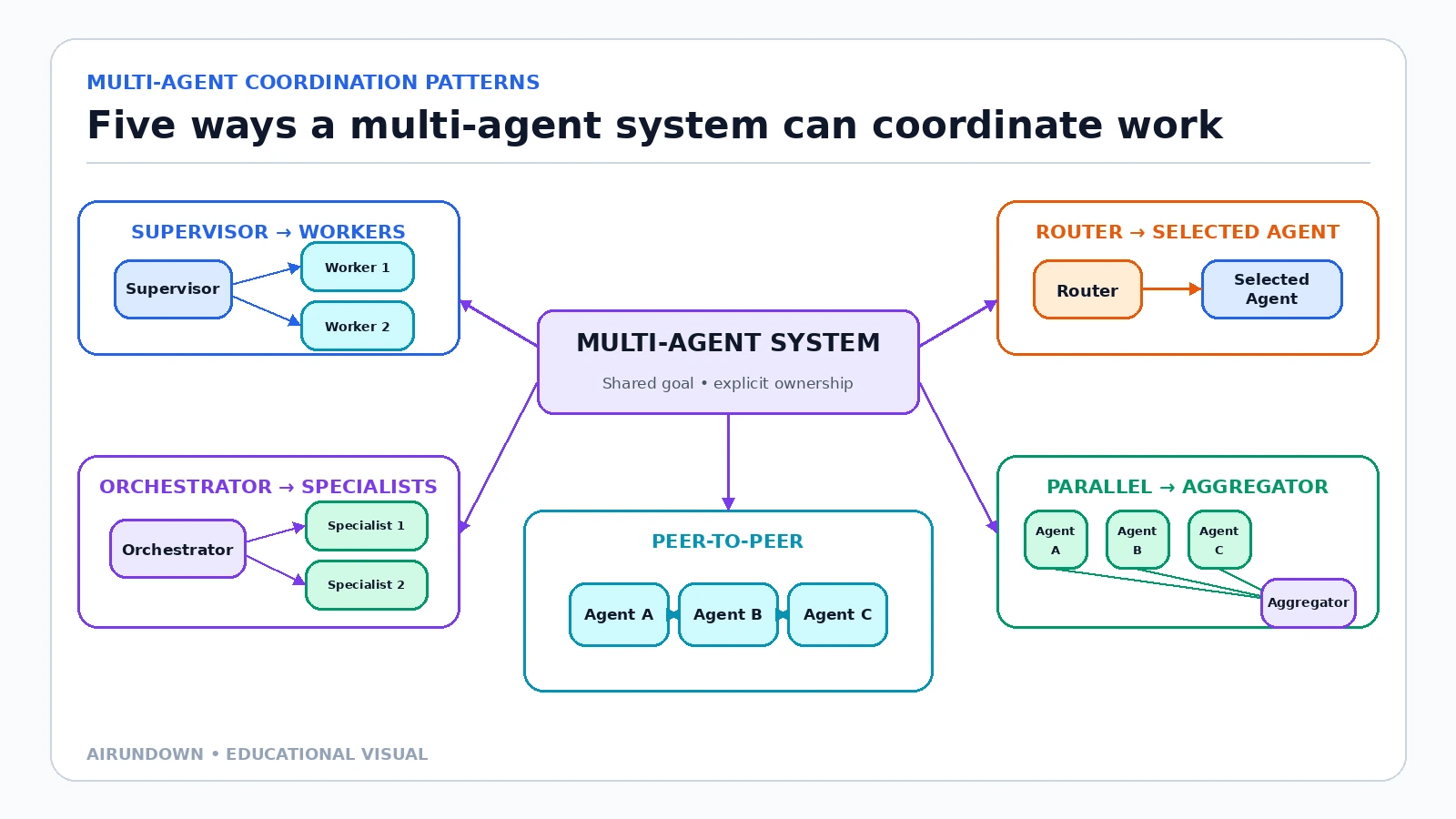
Coordination patterns differ in who divides work, chooses owners, shares state, combines results, and decides when the team is done.
A [multi-agent system](/glossary/multi-agent-system/) uses multiple agents whose work contributes to a larger outcome. Coordination is the control structure that turns their separate actions into one coherent run.
That structure normally covers:
- roles: what each agent is qualified and permitted to do;
- task ownership: which component is accountable for each open item;
- assignment: how work reaches an owner;
- dependencies: which results must exist before another task can start;
- information flow: messages, context, artifacts, and state updates;
- aggregation: how partial results become a usable whole;
- conflict resolution: what happens when agents disagree or update the same item;
- stopping: who evaluates the outcome and applies a [stopping condition](/glossary/stopping-condition/).
An agent may communicate constantly and still coordinate badly. A busy group chat does not tell you who owns the final answer.
Coordination vs communication
Communication transports information: a message, tool result, artifact reference, status update, or request. Coordination uses that information to organize joint work.
For example, a research agent sends a source summary to a writing agent. That is communication. The rule that research must be validated before writing starts, and that the writing agent now owns the draft, is coordination.
Message passing is one implementation mechanism. A shared-state store is another. Neither mechanism defines the decision policy by itself.
Coordination also differs from orchestration. Coordination is the broader problem of aligning multiple actors. [Workflow orchestration](/agent-workflows-and-orchestration/) is a specific form of coordination in which a component or runtime controls execution flow, dependencies, retries, waits, and completion. Peer agents can coordinate without one central orchestrator.
The coordination lifecycle
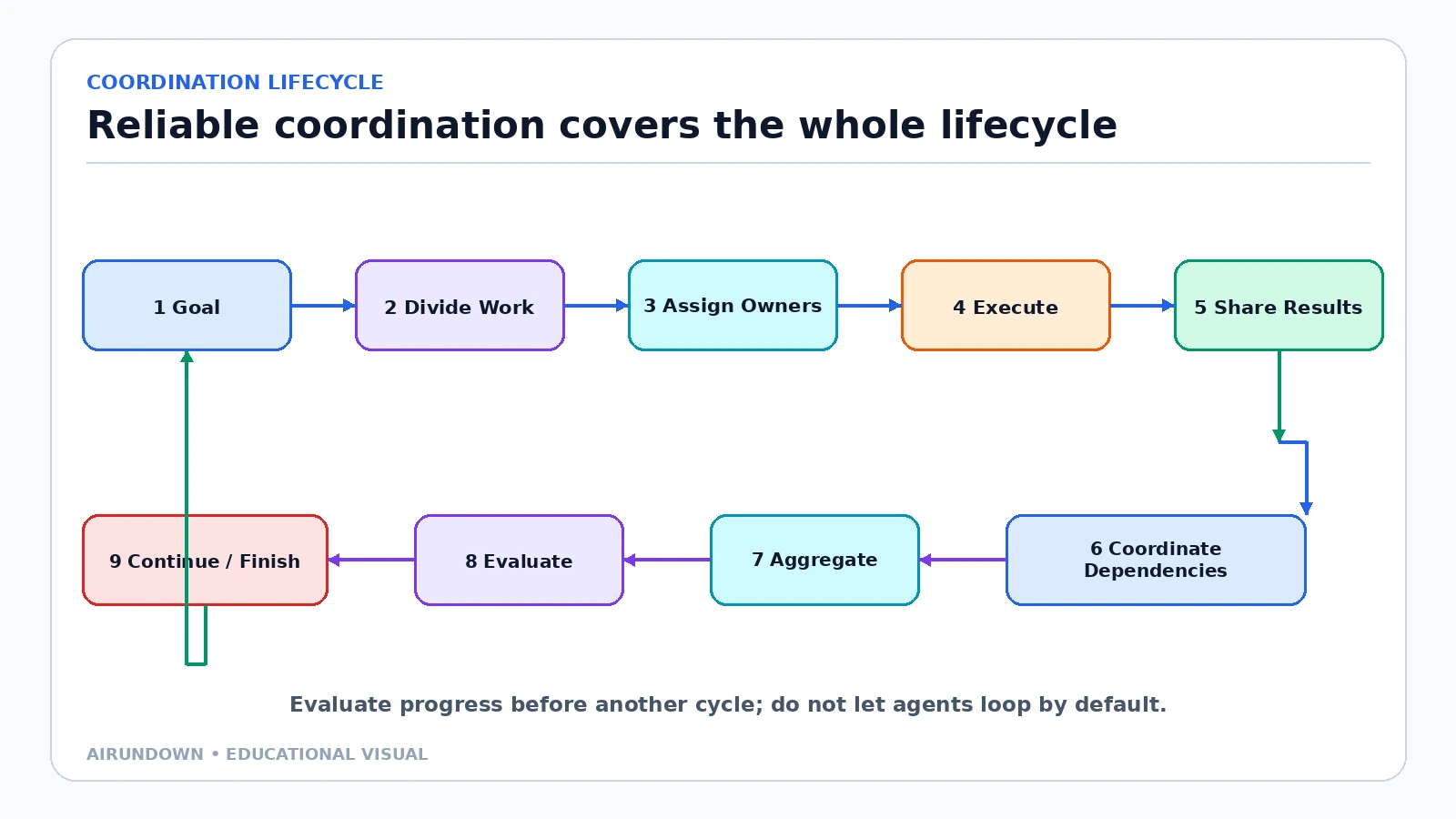
The topology may change, but every reliable coordination design must cover ownership, dependencies, result integration, evaluation, and stopping.
Most coordination designs implement the same lifecycle:
- Interpret the goal.
- Divide it into work units.
- assign an owner to each unit.
- Execute the runnable work.
- Share results or references to them.
- Unblock dependent tasks.
- Aggregate partial outputs.
- Evaluate quality and completeness.
- Continue, revise, escalate, or finish.
The agent that performs each step can vary. In a centralized system, one supervisor may do most of them. In a decentralized system, responsibility may move between peers. The lifecycle is a useful review checklist because it exposes missing control even when framework terminology differs.
Seven major coordination patterns
1. Supervisor / worker
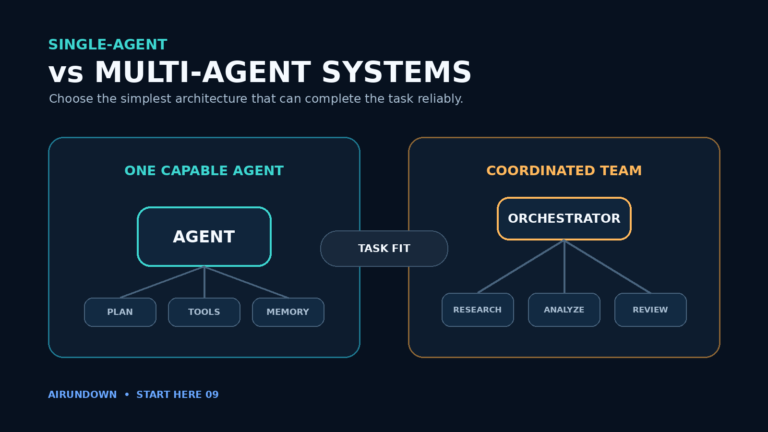
A [supervisor agent](/glossary/supervisor-agent/) assigns bounded tasks to workers, observes progress, evaluates their results, and decides what happens next. Workers specialize; the supervisor retains team-level ownership.
Use it when decomposition and review require judgment—for example, a research supervisor that asks market, regulatory, and competitor workers for evidence, then requests revisions where coverage is weak.
Benefits include a clear owner and consistent review. Risks include a supervisor bottleneck, a large supervisor context, and correlated failure: one bad assignment policy affects every worker.
2. Orchestrator / specialists
An [orchestrator](/glossary/orchestrator/) schedules specialists according to workflow state and dependencies. Unlike a supervisor, the orchestrator may be deterministic code rather than an LLM.
Use it for durable, multi-step processes with parallel branches, timeouts, approvals, or recovery. A compliance workflow might run document extraction, policy checks, and identity verification, then wait for human approval.
This pattern makes execution predictable and observable. It can become rigid if every exception must be pre-modeled. A hybrid often works best: code owns durable state while a model recommends bounded decisions.
3. Sequential pipeline
Agents run in a fixed or conditionally ordered chain. Each output becomes part of the next agent’s input:
Research → Analysis → Drafting → Review
Use it when tasks have real dependencies or when each stage transforms the previous result. The design is easy to understand, but latency accumulates and an early error can contaminate downstream work.
Sequential execution does not automatically imply a [handoff](/glossary/agent-handoff/). An orchestrator can keep ownership while calling each agent and passing outputs forward.
4. Parallel specialists
Several agents work simultaneously on independent slices or perspectives, then an aggregator combines their results.
Use it when subtasks do not require one another’s output: market sizing, technical feasibility, and risk analysis can often start from the same brief. Parallel work can reduce wall-clock time, but total model cost may rise. The merge step needs a contract for result shape, evidence, missing data, and conflicts.
Parallel specialist calls are not necessarily a multi-agent system. They may simply be multiple LLM calls in one workflow with no continuing identity, state, or autonomous coordination.
5. Router / specialists
A router classifies a request or current state and selects one specialist or workflow branch. A support router might send refund, account-security, and technical questions to different destinations.
Use it when domains are distinct and one destination should take the case. The router should choose from a registered set, provide a confidence signal, and support a safe default.
A router is narrower than an orchestrator: it selects a route but may not manage the downstream work. The deeper [agent-routing patterns article](/agent-routing-patterns/) covers deterministic, classifier, semantic, and model-based options.
6. Peer-to-peer collaboration
Agents communicate or transfer work directly without one component controlling every decision. Each peer has local capabilities and rules for when another peer should take over.
Use it when domain boundaries are strong and central coordination would require excessive context—for example, regional support agents that transfer a case when jurisdiction changes.
Peer coordination can be modular, but global ownership is harder. Common failures include transfer loops, duplicated work, inconsistent state, and no agent knowing whether the overall goal is complete.
7. Hierarchical multi-agent system
A hierarchy coordinates teams through multiple levels: a top coordinator delegates to team supervisors, which coordinate specialist workers.
Use it when the task is too broad for one supervisor’s context or when organizational boundaries matter. A software-delivery system might have product, implementation, testing, and security teams, each with its own supervisor.
Hierarchy reduces the span of control at each level, but adds latency and information loss. Summaries can become distorted as they move upward, while instructions can lose nuance moving downward.
Delegation vs handoff
[Delegation](/glossary/delegation/) assigns a task to another agent while the delegator usually retains responsibility for the overall goal. The specialist returns a result to the delegator.
An [agent handoff](/glossary/agent-handoff/) transfers active ownership to another agent. The receiving agent becomes responsible for the next part of the interaction or workflow.
The distinction matters because it determines where results return, who sees the user, and who decides completion. [Agent Handoffs, Delegation, and Sub-Agents](/agent-handoffs-delegation-sub-agents/) explains the transfer contract in detail.
Shared state, context, and message passing
Coordination requires shared facts, but it does not require identical prompts.
A useful design separates:
- agent-local instructions and working context;
- global task status and dependencies;
- durable artifacts such as reports or code;
- result summaries and provenance;
- permissions and ownership;
- the authoritative completion decision.
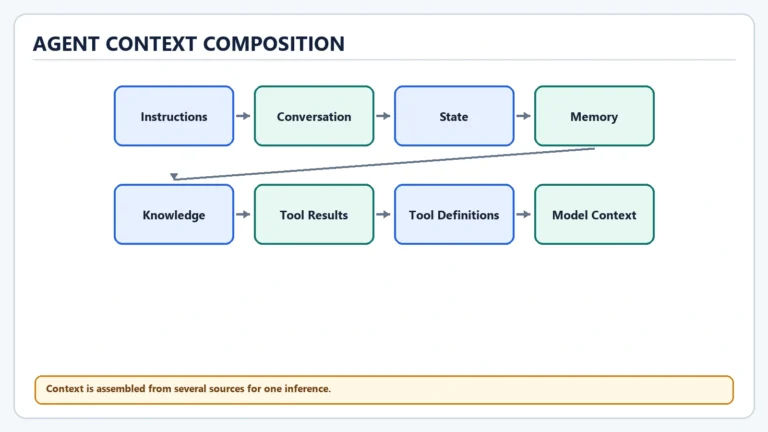
Agents can exchange messages, read a shared store, or publish artifacts. Large outputs should usually be stored once and shared by reference. Copying the entire conversation into every agent increases token cost, exposes irrelevant information, and makes stale copies difficult to detect.
The dedicated [shared state and context article](/shared-state-and-context-in-multi-agent-systems/) explains update ownership, checkpoints, and merge rules.
Aggregation and conflict resolution
Aggregation is not concatenation. It must define how the system:
- checks that every required result arrived;
- validates output schemas and evidence;
- identifies contradictions;
- chooses between competing claims;
- handles missing or low-confidence work;
- preserves provenance in the final result.
For factual work, the aggregator may prefer better evidence rather than majority vote. For creative work, it may synthesize complementary options. For policy decisions, a human may be the required arbiter.
Conflict rules belong in the architecture before agents run. Letting an aggregator invent them case by case makes outcomes hard to evaluate.
Failure modes and when not to use multiple agents
Multi-agent coordination adds failure surfaces:
- ambiguous or duplicated ownership;
- delegation or routing loops;
- workers using incompatible assumptions;
- stale shared state;
- inconsistent output formats;
- one worker blocking a whole fan-in;
- supervisors repeatedly revising good work;
- no enforceable stopping condition.
Do not create multiple agents merely to assign personas. If one capable agent can use several tools, keep the relevant context, and satisfy the task within a clear loop, a single-agent design will usually be cheaper and easier to debug. Start with [Single-Agent vs Multi-Agent Systems](/single-agent-vs-multi-agent-systems/) before adding coordination overhead.
A practical selection rule
Choose the pattern from the task topology:
- real stage dependencies → sequential pipeline;
- independent slices → parallel specialists plus aggregation;
- one front-door classification → router;
- adaptive assignments and review → supervisor-worker;
- durable waits, retries, and dependencies → orchestrator-specialists;
- strong domain ownership with direct transfers → peers;
- too many teams for one coordinator → hierarchy.
Patterns can be composed. A router can start an orchestrated workflow containing a supervisor that runs parallel workers. Composition is useful only when each layer owns a distinct control problem.
My take
The most important architecture diagram is not the box layout. It is the ownership map.
For every open task, result, state field, conflict, retry, and completion decision, name one authoritative owner. If that cannot be done, adding another agent will make the system less coordinated, not more capable.
Sources
- Agent orchestration in the OpenAI Agents SDK distinguishes model-led and code-led orchestration, agents-as-tools, handoffs, chaining, and parallel execution.
- Building Effective AI Agents describes routing, parallelization, and orchestrator-worker workflows with their appropriate use cases.
- AutoGen: Enabling Next-Gen LLM Applications via Multi-Agent Conversation presents composable multi-agent conversation patterns using models, humans, and tools.
Continue learning
Next, compare [Sequential vs Parallel Agent Execution](/sequential-vs-parallel-agent-execution/), then review [Agent Graphs and State Machines](/agent-graphs-and-state-machines/) for explicit transitions and terminal states.