Centralized vs Decentralized Multi-Agent Architectures
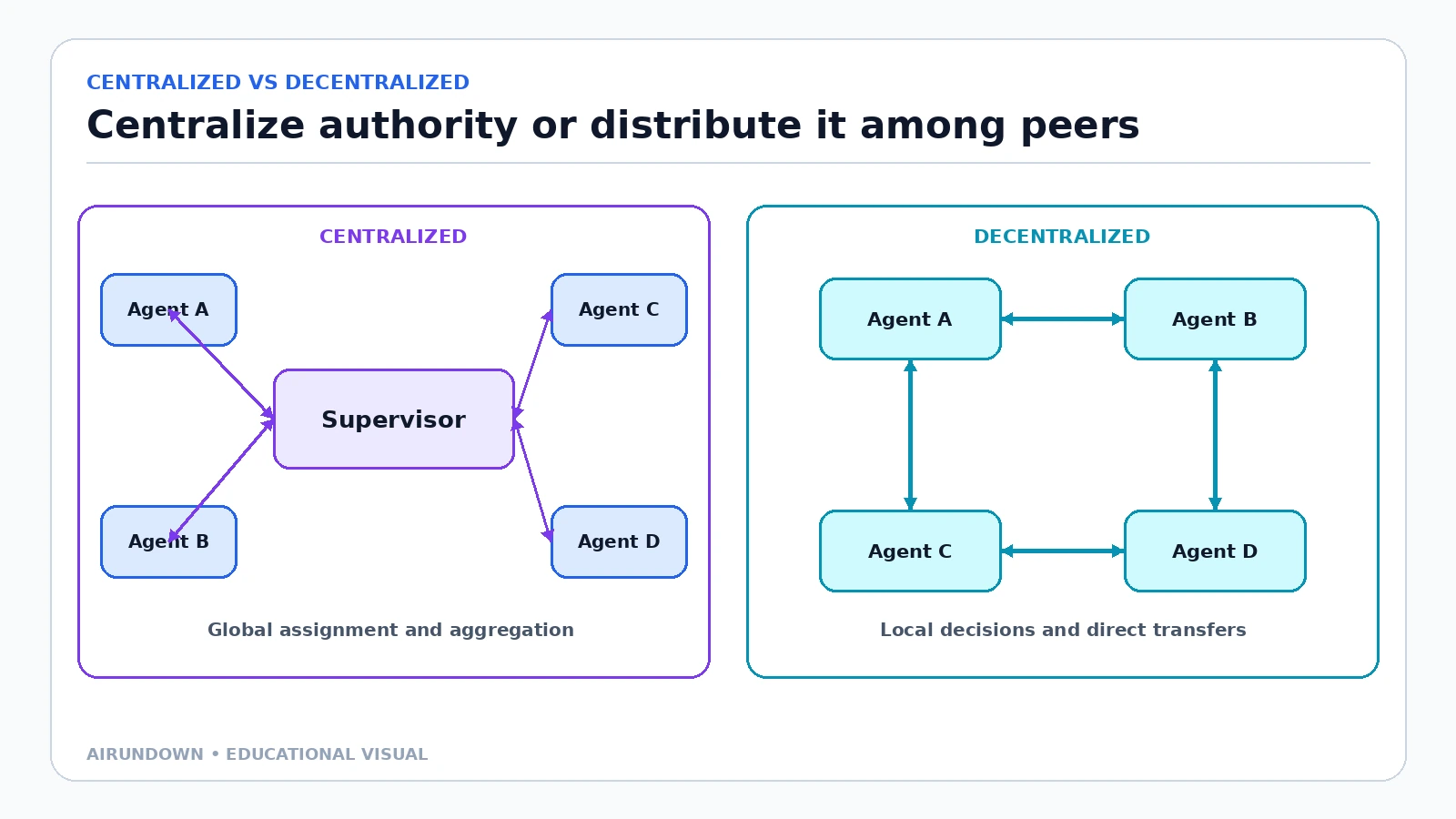
Centralized and decentralized multi-agent architectures distribute decision authority differently.
In a centralized design, a supervisor or orchestrator maintains a global view and coordinates other agents. In a decentralized design, agents coordinate through direct communication or transfers without one component controlling every decision.
Neither design is inherently more intelligent, autonomous, or “agentic.” The choice is about control, state, communication, resilience, and operational accountability.
TL;DR
- Centralized systems provide clear ownership, consistent policy, and simpler observability, but create bottlenecks and concentrated failure.
- Decentralized systems preserve local domain autonomy and can reduce central context, but make global state, stopping, and conflict resolution harder.
- Hierarchical architecture is still centralized at each coordination level; peer-to-peer is one kind of decentralization.
- Hybrid designs centralize global policy and durable workflow state while distributing domain decisions.
- Choose from task boundaries and governance requirements, not from an assumption that decentralization is more advanced.
The architectural difference
Centralization concentrates coordination authority; decentralization distributes it. Neither choice determines how intelligent or autonomous the agents are.
In a centralized architecture, agents report to a central supervisor or orchestrator. That component assigns work, tracks progress, aggregates results, and often decides when the goal is complete.
In a decentralized architecture, agents communicate, delegate, or hand work to peers according to local rules. No single component must approve every transition.
The distinction is a spectrum. A system may centralize durable state and permissions while allowing teams to choose their own subtask sequence. Another may use a central router only at entry, then transfer control into a peer network.
Side-by-side comparison
| Dimension | Centralized architecture | Decentralized architecture |
|---|---|---|
| Control | One coordinator owns major decisions | Decision authority is distributed among agents |
| Coordination | Global scheduling and assignment | Local rules, messages, negotiation, or handoffs |
| State management | Central workflow view is natural | State may be replicated, partitioned, or exchanged |
| Scalability | Coordinator can become a throughput/context bottleneck | Work can scale by domain, but coordination traffic grows |
| Observability | Easier to build one end-to-end trace | Requires correlation across agents and transfers |
| Fault tolerance | Coordinator is a concentrated failure point | Peer failures may be isolated, but recovery ownership is harder |
| Implementation complexity | Simpler control model; complex coordinator | Simpler local agents; complex global behavior |
| Governance | Central policy and approval are easier to enforce | Policies must be enforced consistently at multiple boundaries |
| Typical use case | Regulated, durable, cross-domain workflow | Strong domain ownership and direct peer transfers |
The table describes tendencies, not guarantees. A poorly designed centralized system can be unobservable, and a decentralized system can use excellent distributed tracing.
Centralized architecture
A centralized system usually has:
- a worker or specialist registry;
- one global task view;
- central assignment or scheduling;
- controlled context distribution;
- result validation and aggregation;
- budget and stopping authority.
The coordinator may be an LLM-based [supervisor agent](/glossary/supervisor-agent/), a code-led [orchestrator](/glossary/orchestrator/), or a hybrid. [Orchestrator vs Supervisor vs Router](/orchestrator-vs-supervisor-vs-router/) explains those roles separately.
Strengths
Clear ownership: one component remains accountable for the overall goal.
Consistent governance: permissions, budgets, quality gates, and human approvals can be applied centrally.
Simpler state: tasks and results can be recorded in one authoritative workflow model.
Straightforward aggregation: workers return results to a known component.
Better global optimization: the coordinator can see dependencies and avoid duplicated assignments.
Weaknesses
Bottleneck: every decision or result passes through one point.
Large context: the coordinator may need summaries from many workers and can lose critical detail.
Concentrated failure: a bad supervisor decision, unavailable orchestrator, or corrupted state can affect the whole run.
Reduced domain autonomy: local specialists may wait for central decisions they could safely make themselves.
Correlated policy error: one flawed instruction can be propagated consistently to every worker.
Centralization is useful when the workflow crosses several domains but requires one outcome, consistent policy, durable state, or auditable approvals.
Decentralized architecture
A decentralized system distributes coordination among agents. A peer can decide to:
- handle a request;
- request information from another peer;
- delegate a bounded subtask;
- perform an [agent handoff](/glossary/agent-handoff/);
- update shared or domain-local state;
- escalate when no peer can continue.
OpenAI’s decentralized pattern uses handoffs that transfer execution between specialist agents. Other systems may use messages, shared task queues, or peer negotiation.
Strengths
Local autonomy: domain agents can make decisions from specialized context.
Modularity: teams can own their agents, policies, and data boundaries.
Reduced central context: no single model must receive every detail.
Potential fault isolation: one peer can fail without corrupting a central coordinator’s entire context.
Natural domain transfer: a case can move to the specialist that now owns it.
Weaknesses
Ambiguous global ownership: who ensures the overall goal is complete?
State consistency: peers may hold stale or conflicting views.
Routing and handoff loops: work can circulate without progress.
Harder observability: traces must follow changing owners and multiple stores.
Policy drift: different agents may apply governance differently.
Difficult aggregation: no obvious component may own reconciliation of conflicting outputs.
Decentralization is useful when domains have strong boundaries, local decisions dominate, and direct transfer reduces central coordination overhead. It is a poor fit when the task needs one tightly governed transaction and globally consistent state.
Centralized vs hierarchical
A hierarchical architecture has several coordination levels:
Top Coordinator → Team Supervisors → Specialist Agents
It is not the opposite of centralized. Each team is centrally coordinated by its supervisor, and the top coordinator still governs cross-team work.
Hierarchy reduces one coordinator’s span of control and limits context at each level. It also adds reporting layers, latency, and information compression. The architecture should define what decisions stay local and what must move upward.
Decentralized vs peer-to-peer
Peer-to-peer is one decentralized topology in which agents connect directly as peers. Decentralization can also use shared queues, distributed registries, or domain gateways.
Conversely, direct agent-to-agent messages do not prove the system is decentralized. A central orchestrator may still authorize every transfer and own the state.
Classify the architecture by decision authority, not network arrows.
Supervisor vs orchestrator architecture
A supervisor architecture centralizes management of agents: assignments, progress, review, and revision.
An orchestrator architecture centralizes workflow execution: dependencies, timers, retries, checkpoints, approvals, and terminal states.
A central system may use both. Code can own durable workflow state while an LLM supervisor selects and reviews specialists. [Agent Workflows and Orchestration](/agent-workflows-and-orchestration/) explains that separation.
Decentralized agents vs unrelated independent agents
Several agents running separately are not a decentralized team unless their work contributes to a shared goal and they have coordination mechanisms.
Four agents producing unrelated reports have multiple executions, not a multi-agent architecture. A decentralized [multi-agent system](/glossary/multi-agent-system/) still needs task boundaries, communication, ownership transfer, shared outcomes, and stopping rules.
Hybrid architecture
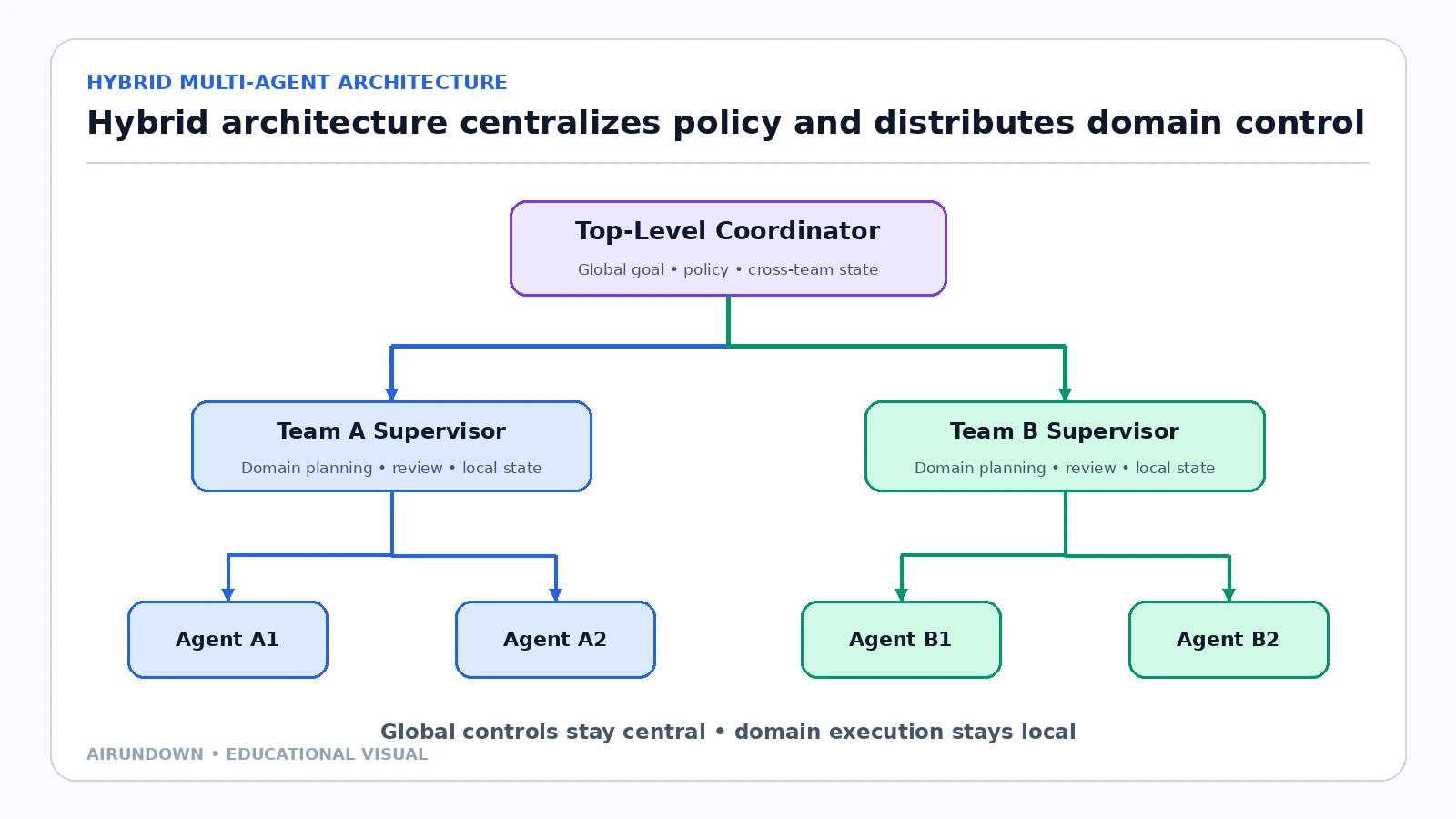
Hybrid designs centralize portfolio-level control while keeping domain-specific coordination and state within teams.
Hybrid architectures centralize what must be global and distribute what benefits from local judgment.
A practical design might centralize:
- identity, permissions, and policy;
- workflow IDs and terminal state;
- budgets and deadlines;
- artifact catalog and audit trail;
- cross-team dependencies;
- human approval.
It might distribute:
- domain task decomposition;
- specialist selection inside a team;
- local context and tools;
- intermediate review;
- retry decisions within a bounded budget.
The top coordinator sends a clear goal and contract to each team supervisor. Team supervisors return validated artifacts and status—not their entire internal conversation.
State and communication choices
Centralized systems often use one authoritative store. Decentralized systems must choose among:
- partitioned state owned by each domain;
- replicated summaries;
- event-based updates;
- a small global coordination record plus local stores;
- shared immutable artifacts.
The [shared state and context article](/shared-state-and-context-in-multi-agent-systems/) explains why agents should not freely overwrite the same fields and why full-history copying is not a state strategy.
Communication volume also matters. A network of peers can generate many pairwise messages. Hierarchy or brokers reduce connections but concentrate traffic. The best topology follows real domain boundaries and dependency frequency.
Fault tolerance and recovery
Centralized recovery is conceptually simple: restore the coordinator’s checkpoint and resume pending tasks. But coordinator failure can pause everything.
Decentralized recovery may let unaffected peers continue. However, the system must elect or identify a recovery owner, reconcile conflicting state, and avoid replaying side effects.
Fault tolerance therefore requires more than removing a central box. It requires:
- durable task identifiers;
- accepted ownership transitions;
- idempotent updates;
- timeouts and leases;
- versioned state;
- replay-safe events;
- explicit escalation and stopping.
[Agent Graphs and State Machines](/agent-graphs-and-state-machines/) can model these lifecycle states.
Observability and governance
Centralized systems can attach one trace to the coordinator and nest worker spans beneath it. Decentralized systems need correlation IDs that survive handoffs and messages.
Good [observability](/glossary/observability/) should show:
- current and previous owner;
- route or delegation reason;
- state versions read and written;
- tools and artifacts used;
- retries and timeouts;
- policy decisions;
- final stopping reason.
Governance must follow authority. If peers can approve spending or external actions, each peer must enforce the policy or call a shared policy service. A human approval gate should not disappear merely because work changed owners.
Failure modes
Centralized bottleneck
The coordinator serializes every small decision. Push bounded local decisions to teams or parallelize independent work.
Supervisor context collapse
The central model receives too many worker transcripts. Exchange structured summaries and artifact references.
Decentralized loops
Peers repeatedly hand off the same task. Track visited owners and transfer counts, then escalate.
Split-brain ownership
Two agents believe they own the task. Require explicit transfer acceptance and versioned ownership.
Inconsistent governance
Peers apply different rules. Centralize policy evaluation or distribute versioned, testable policy components.
No global stopping condition
Local agents finish, but the shared goal remains open. Maintain one authoritative terminal decision even if execution is distributed.
When to choose each architecture
Choose centralized coordination when:
- one outcome needs global synthesis;
- dependencies cross domains;
- state consistency and auditability matter;
- approvals and budgets must be enforced uniformly;
- the task volume fits a central control plane.
Choose decentralized coordination when:
- domain boundaries are strong;
- local agents have the context to decide safely;
- direct transfers are common;
- centralizing every detail would be impractical;
- the organization can operate distributed tracing and state reconciliation.
Choose a hybrid when global governance and local autonomy are both real requirements—which is common in production.
My take
Decentralization is not a maturity level. It is a trade.
Distributing authority removes some central bottlenecks but creates consistency, ownership, and observability work. Centralize the decisions that require one truth; distribute the decisions where local knowledge genuinely improves outcomes.
Sources
- A Practical Guide to Building AI Agents distinguishes a central manager pattern from decentralized handoffs between peer specialists.
- Agent orchestration in the OpenAI Agents SDK compares agents-as-tools, where a manager retains control, with handoffs that transfer active execution.
- AutoGen: Enabling Next-Gen LLM Applications via Multi-Agent Conversation describes customizable multi-agent interaction patterns using models, humans, and tools.
Continue learning
Review [Multi-Agent Coordination Patterns](/multi-agent-coordination-patterns/) for pattern selection, then use [Agent Routing Patterns](/agent-routing-patterns/) to design bounded transitions between workers and teams.