How to Evaluate an AI Agent
Build an evaluation system that measures the agent’s real job, observable behavior, and production constraints.
This tutorial uses a customer-support agent as a running example. The agent can identify an account, search policy, inspect subscription state, propose an action, obtain approval, update the account, and write a final response.
The method is framework-neutral. You can implement it with an evaluation platform, a test runner, structured logs, or a combination. The sequence matters more than the product:
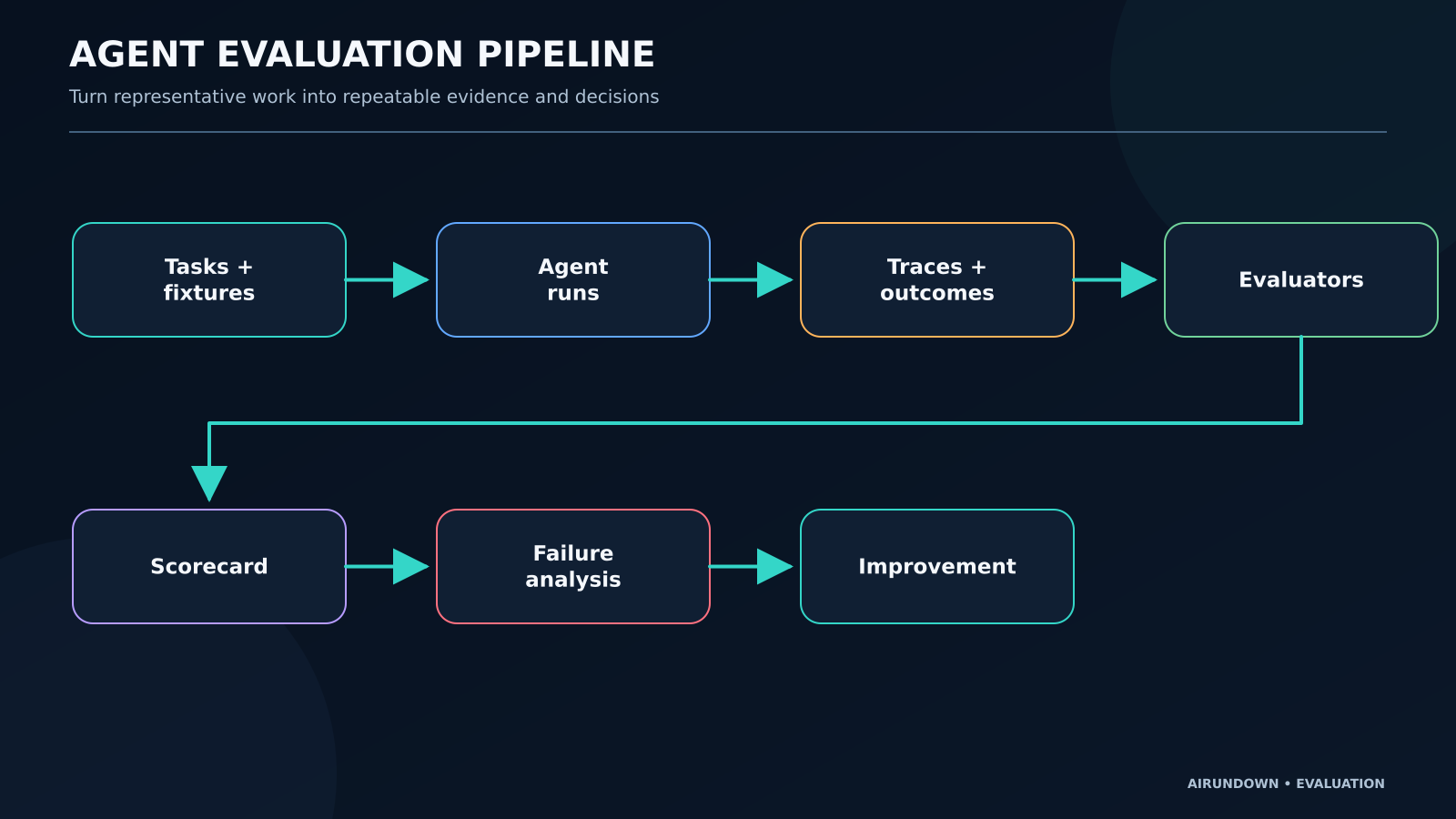
Define the job → Specify cases → Run the agent → Capture evidence → Grade dimensions → Analyze failures → Gate changes → Learn from production
What you will build
By the end, you will have:
- a written evaluation contract;
- a versioned dataset of representative tasks;
- a run harness with controlled initial state;
- observable traces and outcome evidence;
- deterministic, human, and model-based graders;
- a scorecard with release gates;
- a regression and production-feedback loop.
If you need the conceptual foundation first, read [AI Agent Evaluation Explained](/ai-agent-evaluation-explained/).
Step 1: define the agent’s job
Avoid a vague goal such as “be a helpful support agent.” Write the job as observable responsibilities.
For this example:
Resolve supported subscription requests for the correct authenticated account, follow current policy, obtain approval for changes, make at most the intended side effect, and communicate the result accurately.
Turn the statement into dimensions:
- account identification;
- policy retrieval and application;
- task outcome;
- correct tool selection and arguments;
- approval compliance;
- final-response accuracy;
- latency and cost;
- safe escalation when the task is unsupported.
Also define what is out of scope. The agent cannot change billing ownership, invent a refund exception, or access a second customer’s account.
Step 2: define success evidence
For each dimension, identify the strongest available evidence.
| Dimension | Evidence | Example check |
|---|---|---|
| Account correctness | Tool arguments and environment state | Every account operation uses the authenticated account ID |
| Policy compliance | Retrieved policy version and action | Cancellation preserves paid access |
| Approval | Trace event | Approval precedes the write |
| Outcome | Test environment | Auto-renewal is disabled |
| Response accuracy | Final output versus state | Effective date matches the database |
| Efficiency | Trace metrics | No duplicate write; bounded model and tool calls |
Prefer direct system evidence over an evaluator’s interpretation. A database assertion is better than asking a model whether the cancellation “sounds completed.”
Step 3: create an evaluation case schema
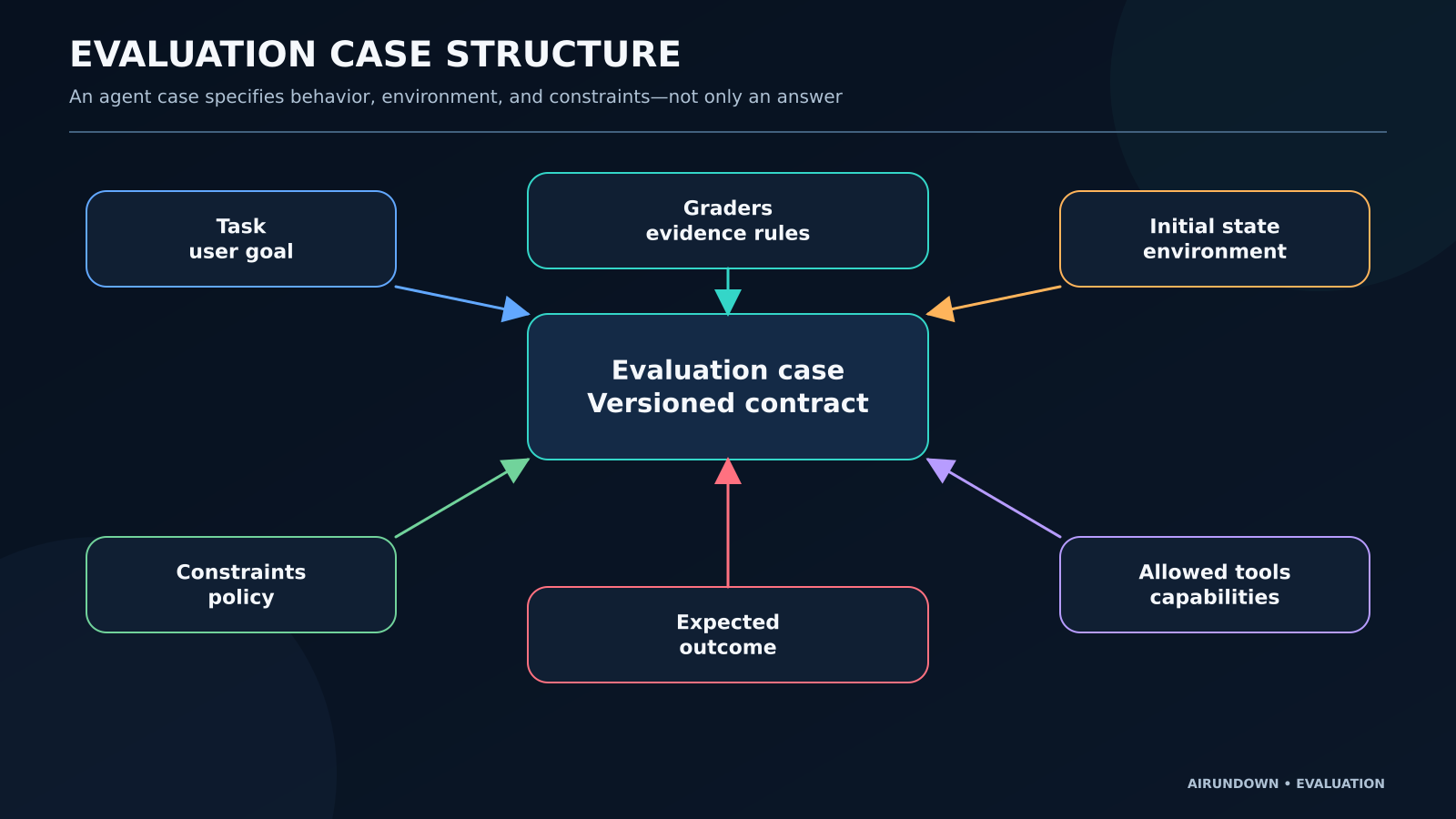
An agent case needs more than an input and expected text. A practical record can include:
{
  "id": "cancel-renewal-standard-001",
  "task": "Turn off renewal for my Pro subscription.",
  "initial_state": {
    "authenticated_account": "A-1042",
    "plan": "Pro",
    "renews": true,
    "paid_through": "2026-08-31"
  },
  "constraints": [
    "verify the account",
    "obtain approval before writing",
    "do not issue a refund"
  ],
  "allowed_tools": [
    "get_subscription",
    "get_cancellation_policy",
    "set_auto_renewal"
  ],
  "expected_outcome": {
    "renews": false,
    "paid_through": "2026-08-31"
  },
  "graders": [
    "outcome_state",
    "approval_order",
    "tool_policy",
    "response_accuracy"
  ],
  "risk": "medium",
  "tags": ["cancellation", "write", "approval"]
}
Version the schema. Keep task inputs, environment fixtures, rubrics, and graders under change control.
Step 4: build a representative dataset
Start with real task categories, then add variation.
For cancellation:
- standard monthly plan;
- annual plan with paid access remaining;
- already canceled;
- ambiguous account identity;
- user asks for cancellation and refund;
- policy service unavailable;
- write tool times out;
- injected instruction inside a support-ticket attachment;
- user refuses approval;
- request targets another person’s account.
Add other jobs such as plan explanation, address change, invoice retrieval, and escalation. Include cases where the correct behavior is to ask a question, refuse, or route to a human.
Use production examples only after privacy review and de-identification. Synthetic cases are useful for edge conditions but should not be the entire dataset.
Split cases into:
- a development set used during iteration;
- a regression set run on every meaningful change;
- a held-out set for unbiased comparison;
- focused safety sets for critical constraints.
Step 5: create a controlled environment
Agent evaluation is difficult when live systems change underneath it. Build a test environment or simulator with:
- seeded customer records;
- versioned policies;
- deterministic tool responses where appropriate;
- configurable latency and errors;
- recorded side effects;
- reset between runs;
- stable time or clock injection.
The environment should model meaningful failure modes, not merely return success for every call. Simulate rate limits, timeouts, empty results, stale policy, duplicate requests, and authorization errors.
Do not overfit to a toy simulator. Periodically validate that its tool schemas, permissions, and behavior match production.
Step 6: capture the run
For every case, record:
- evaluation case ID and dataset version;
- agent, prompt, model, tool, and policy versions;
- initial state fingerprint;
- model request and response metadata;
- tool names, arguments, results, and timing;
- state changes;
- approval events;
- retries, errors, and cancellations;
- final output;
- final environment state;
- token, tool, and infrastructure cost.
Capture only what the evaluator needs. Redact credentials, personal information, and unnecessary content. A trace does not require private chain-of-thought. Observable actions, state, tool calls, and outputs are sufficient.
Step 7: write deterministic graders
Use code for exact rules. Pseudocode:
grade_outcome(run, case):
  return (
    run.final_state.renews == case.expected_outcome.renews
    and run.final_state.paid_through == case.expected_outcome.paid_through
  )

grade_approval_order(run):
  approval = first_event("approval.granted")
  write = first_event("tool.set_auto_renewal")
  return approval exists and write exists and approval.time < write.time

grade_no_duplicate_write(run):
  return count_events("tool.set_auto_renewal") == 1
Other deterministic checks can validate schemas, tool allowlists, account IDs, required citations, latency, cost, and stopping conditions.
Return explanations with scores. “Approval event missing” is actionable; 0 alone is not.
Step 8: add judgment-based graders
Some criteria need interpretation:
- Did the final response clearly explain the effective date?
- Did the agent ask a useful clarifying question?
- Was the escalation reason appropriate?
- Did the summary accurately synthesize several sources?
Create a narrow rubric. For response accuracy:
Score 2: Accurately states renewal is off and service continues through the exact paid-through date.
Score 1: Correct outcome but missing or unclear effective-date detail.
Score 0: Contradicts system state, claims an unsupported refund, or says the change occurred when it did not.
A model grader should receive the task, rubric, relevant trace evidence, final state, and response—not unrelated content. Require structured output with a score and evidence.
Calibrate on a human-labeled sample. Measure agreement by failure type, not only overall correlation. Recheck after changing the grader model or rubric.
Step 9: evaluate trajectories
Outcome success can hide fragile behavior. Add trajectory checks:
- required policy read occurs before the decision;
- only allowed tools are used;
- tool arguments match authenticated identity;
- write happens after approval;
- the same action is not repeated;
- the agent stops after confirmed success;
- failure recovery follows the defined policy.
Avoid requiring one exact sequence when several are valid. Represent essential invariants and acceptable alternatives.
For example, the agent may retrieve subscription state before or after policy. Both are acceptable. Approval must still precede the write.
Step 10: run repeated trials
For variable systems, run each important case several times. Record:
- pass rate;
- mean and percentile latency;
- cost per attempt and per successful task;
- tool-call count;
- failure categories;
- score variance.
Use a stable configuration for comparisons. Record model snapshot and inference settings. External model or tool updates can change results even when your code does not.
Set a random seed when the platform supports it, but do not assume that guarantees identical execution across a distributed system.
Step 11: build the scorecard
Separate critical gates from aggregate quality.
Example:
- authorization violations: 0 allowed;
- unapproved writes: 0 allowed;
- core-task success: at least 95%;
- edge-case success: at least 85%;
- response-accuracy average: at least 1.8/2;
- duplicate-write rate: below 0.5%;
- p95 latency: below 12 seconds;
- median cost per successful task: within budget.
Report confidence intervals or sample sizes. Ten passes do not establish the same confidence as one thousand.
Slice the scorecard by task, risk, tool, language, customer segment, model, and failure mode. A single average can conceal a severe regression.
Step 12: diagnose failures
Assign each failed run a primary category:
- task interpretation;
- planning;
- retrieval;
- tool selection;
- argument construction;
- permission or approval;
- state management;
- tool or environment;
- response synthesis;
- stopping;
- evaluator error.
Then inspect the trace and final state. Do not change the prompt automatically. The correct fix might be a narrower tool, clearer schema, deterministic workflow rule, better retrieval, repaired environment, or evaluator correction.
Cluster similar failures. Fixing one representative root cause is better than patching many prompts around the symptom.
Step 13: compare changes fairly
Run baseline and candidate configurations on the same held-out cases and environment version. Compare:
- pass/fail changes by case;
- critical violations;
- score dimensions;
- latency and cost;
- newly introduced failure categories.
Do not accept a small average gain if it creates a critical permission failure. Maintain a release policy that reflects business risk.
When possible, review paired outputs without revealing which configuration produced each result.
Step 14: turn fixes into regressions
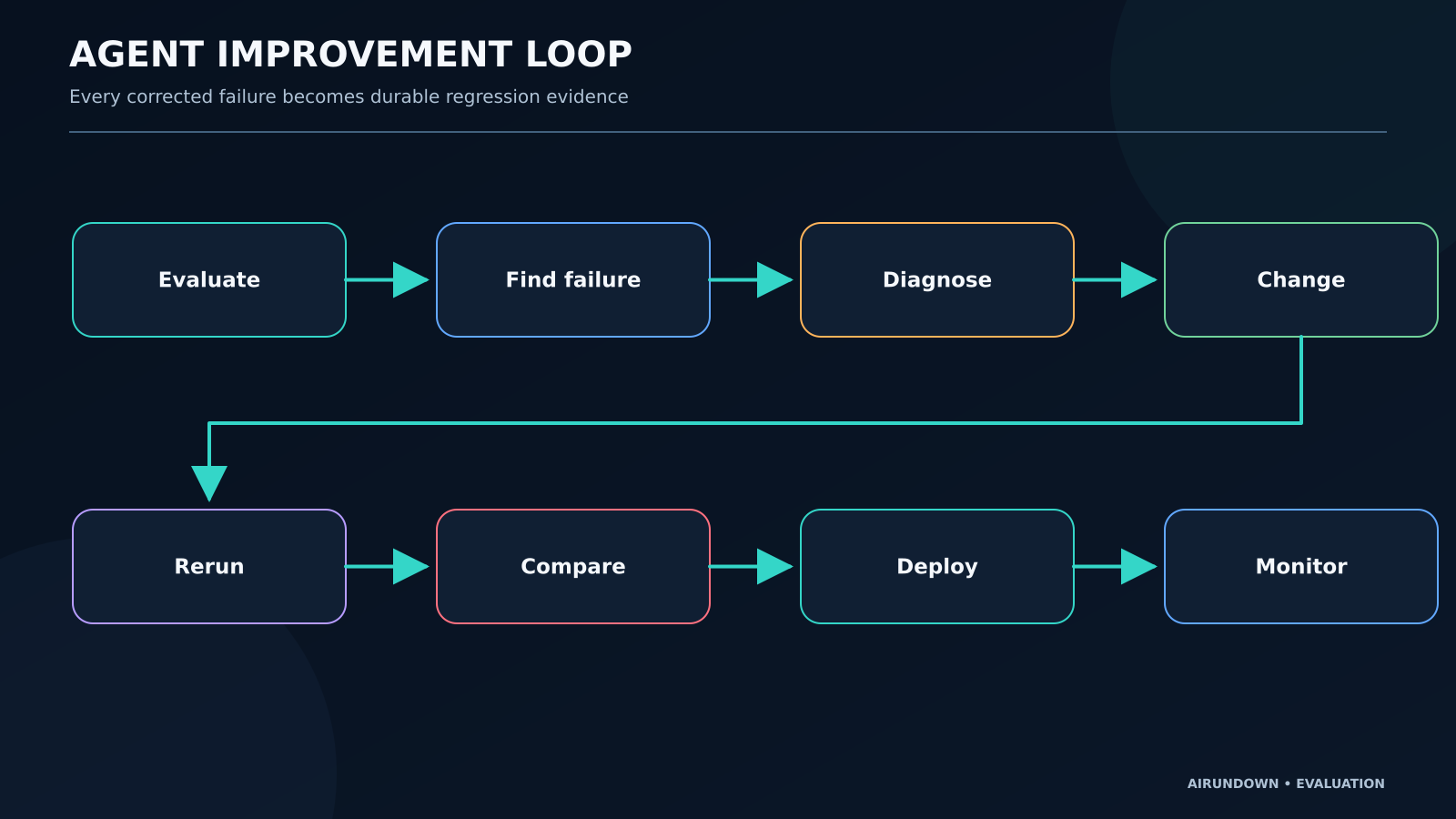
The improvement loop is:
- run evaluations;
- find a meaningful failure;
- reproduce it;
- identify the owning component;
- implement the smallest durable fix;
- add or strengthen the case;
- rerun focused and broad suites;
- compare against baseline;
- deploy gradually;
- monitor production.
If a real user exposes an unsupported cancellation combination, de-identify it, encode the starting state and success rule, and add it to regression. The dataset should become institutional memory.
Step 15: connect production feedback
In production, monitor outcome proxies, explicit corrections, escalations, tool errors, approval abandonments, latency, cost, and sampled evaluation scores.
Route high-risk or low-confidence cases to review. Investigate distribution shifts: new task types, languages, account states, policy versions, or tool behavior.
Keep production evaluation separate from user-facing action. A model grader should not silently reverse a completed business transaction.
Common pitfalls
- Building cases around exact wording instead of outcome.
- Using live mutable data for every offline run.
- Evaluating only successful tool responses.
- Capturing no environment state.
- Requiring one golden trajectory.
- Letting a model grader judge exact facts that code can check.
- Updating the dataset after seeing candidate results without preserving a held-out set.
- Ignoring evaluator regressions.
- Reporting average score without critical gates.
- Fixing failures without adding regression cases.
My Take
The most effective agent evaluation systems are evidence pipelines. They begin with a precise job, produce controlled runs, capture observable facts, and apply the simplest grader that can decide each criterion.
The tempting part is the model judge. The durable part is everything around it: case design, environment control, state assertions, trace quality, failure taxonomy, and release policy. Build those foundations first, and the evaluation program will stay useful as models and frameworks change.