What Is MCP? A Practical Guide for AI Agent Builders
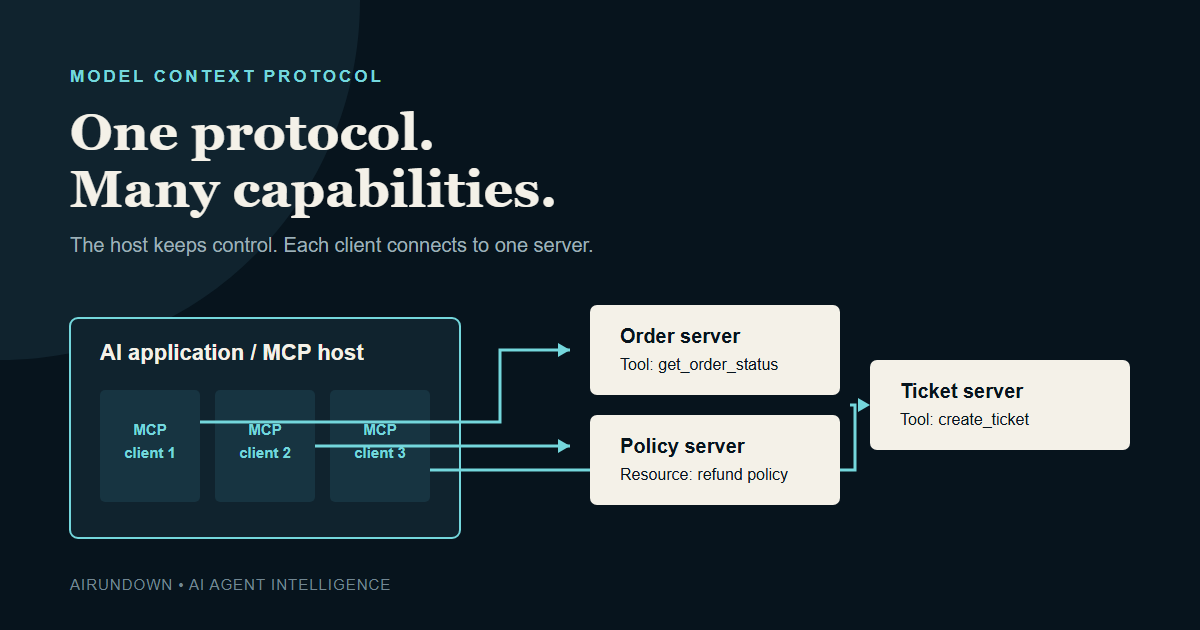
MCP gives AI applications a shared way to discover and use external context and capabilities without rebuilding every connection from scratch.
A language model can explain a refund policy, but it cannot inspect a private order, read the latest internal rules, or create a support ticket unless an application connects it to those systems. The Model Context Protocol (MCP) standardizes that connection boundary.
The useful mental model is simple: MCP is a protocol between an AI application and capability providers. It is not the model, the agent, the database, or the business API behind the capability.
TL;DR
- MCP is an open protocol for connecting AI applications to external context and actions.
- An MCP host creates a dedicated MCP client for each MCP server connection.
- Servers can expose tools, resources, and prompts through a consistent contract.
- MCP complements model function calling and existing APIs; it does not replace either one.
- The protocol improves interoperability, but security and approval remain application responsibilities.
What is MCP?
The Model Context Protocol defines how an AI application communicates with programs that provide useful context or capabilities. Those programs may run on the same computer or on a remote service. In both cases, MCP gives clients and servers a common vocabulary for discovery, requests, results, and updates.
Think of USB-C as an analogy, with an important limit. A standard connector reduces the number of custom plugs you need, but it does not make every attached device trustworthy or useful. MCP similarly standardizes a software connection; the application must still decide what to connect, what to expose to the model, and what the user may authorize.
The three participants: host, client, and server
MCP uses a client-server architecture, but the word host is essential:
- MCP host: the AI application that owns the user experience, coordinates the model, applies policy, and manages connections.
- MCP client: the component inside the host that maintains a connection with one server.
- MCP server: a program that exposes focused context or capabilities through MCP.
A host normally creates one client for each server connection. If a coding assistant connects to a filesystem server, a source-control server, and an issue-tracker server, the host manages three client connections. That separation helps the host control which context crosses each boundary.
“Server” describes the program’s protocol role, not necessarily another machine. A local filesystem server can run beside the host using standard input and output. A remote server can run on the internet and communicate over HTTP.
What an MCP server can expose
For a beginner, the three server-side primitives are the most useful part of the protocol:
| Primitive | What it provides | Support-agent example |
|---|---|---|
| Tools | Callable operations that retrieve information or perform an action | get_order_status or create_support_ticket |
| Resources | Readable context identified by the server | The current refund policy or an order record |
| Prompts | Reusable interaction templates presented by the application | A guided “investigate delayed shipment” workflow |
The distinction is practical. A policy document is naturally readable context. Creating a ticket is an operation with a side effect. Treating everything as a tool makes permissions harder to understand and encourages applications to expose more action surface than the model needs.
A concrete example: the support agent
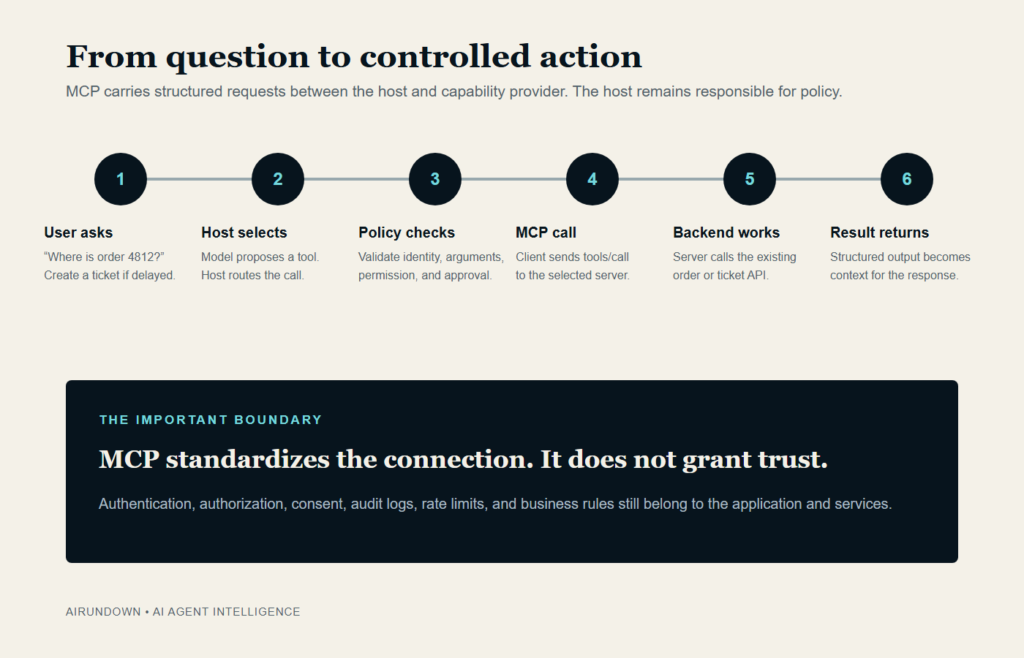
Suppose a customer says: “Where is order 4812? If it is delayed, create a support ticket.”
- The host receives the user’s request and makes the relevant tool descriptions available to the model.
- The model proposes calling
get_order_statuswith order number4812. - The host validates the arguments and checks the user’s access before routing the request.
- The relevant MCP client sends the structured tool request to the order server.
- The server calls the company’s existing order API and returns a structured result.
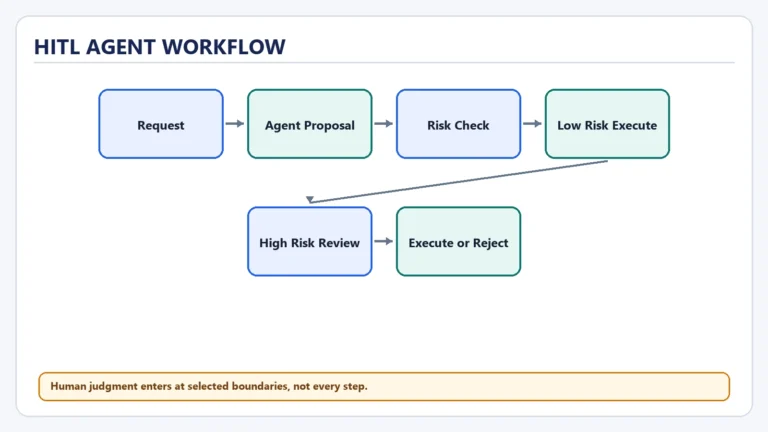
- If a ticket is required, the host can request confirmation before sending a second call to the ticket server.
The order database and ticketing API still do their original jobs. MCP wraps a consistent discovery and invocation contract around them. This is why saying “MCP replaces APIs” is incorrect.
How MCP works beneath the mental model
MCP separates the meaning of a request from the communication channel carrying it. Its data layer defines structured protocol messages and primitives. Its transport layer handles how those messages move between participants. Current implementations commonly use a local standard-input/output transport or a remote HTTP transport.
The interaction usually follows a recognizable pattern: the client learns what the server supports, discovers available capabilities, sends a structured request, and receives a structured result. Official SDKs handle much of this wire-level work, so builders can focus on useful capability contracts instead of hand-authoring protocol messages.
Discovery is one of MCP’s central benefits. A client can ask a server which tools or resources are available and inspect their schemas. That is materially different from copying a fixed list of functions into every application integration.
MCP vs function calling vs APIs
| Layer | Main job | Typical question |
|---|---|---|
| Model function calling | Lets a model produce a structured request for a function or tool | “Which operation should the model request, with what arguments?” |
| MCP | Lets the host discover and communicate with external capability providers | “How does the application find and invoke that capability?” |
| Backend API | Implements domain behavior and accesses the system of record | “How does the order or ticket service perform the actual work?” |
These layers often work together. A host converts selected MCP tool definitions into the format its model provider expects. When the model proposes a tool call, the host maps it back to the correct MCP client. The server may then call a REST, GraphQL, database, or proprietary backend interface.
Why MCP matters
Without a shared protocol, each AI application and external system needs a custom adapter. As the number of applications and integrations grows, duplicated discovery logic, authentication handling, schemas, error mapping, and lifecycle code grow with it.
MCP does not eliminate integration work. It moves that work toward reusable servers and consistent clients. A well-designed server can serve more than one compatible host, while a host can connect to new servers through a familiar contract. The practical result can be faster integration, clearer boundaries, and less dependence on one model provider’s tool format.
What MCP does not solve
MCP is not an automatic trust layer. Connecting a server does not prove that its code, descriptions, outputs, or downstream systems are safe. A production host still needs:
- Authentication and authorization
- Least-privilege credentials and scoped tools
- Argument validation and output handling
- User consent for consequential actions
- Rate limits, timeouts, audit logs, and failure recovery
- Protection against prompt injection and malicious content
Local servers also deserve scrutiny because they can inherit access to files, processes, and credentials on the user’s machine. “Local” is a deployment fact, not a security guarantee.
When MCP is a good fit
Use MCP when a capability should be reusable across hosts, when tools or resources change dynamically, when you need a standard boundary between the AI layer and capability providers, or when portability is worth the additional protocol layer.
A direct integration may be simpler when one application calls one stable internal API, there is no reuse requirement, and the team controls both sides. MCP is an architectural choice, not a badge every agent project needs.
Common mistakes
- Thinking the model is the MCP client. The host application owns the client and decides what reaches the model.
- Mirroring every backend endpoint as a tool. Design task-level capabilities with narrow permissions and clear schemas.
- Confusing transport with capability. Whether a server is local or remote does not determine what it can expose.
- Assuming standardization removes governance. Permission, consent, observability, and incident response remain essential.
My Take
MCP matters because agent systems often become fragile at their integration boundaries. The protocol makes that boundary explicit and reusable, but the quality of the system still depends on good capability design. A vague, overpowered tool remains a vague, overpowered tool even when exposed perfectly through MCP.
The strongest MCP implementations will not be the ones with the largest tool catalogs. They will offer a small set of understandable capabilities, strict permissions, useful schemas, and observable behavior.
Knowledge check
- Which component owns the user experience and policy decisions?
- Why does a host normally create a separate client for each server?
- How is an MCP resource different from an MCP tool?
- Why can MCP and model function calling be used together?
- When would a direct API integration be the more sensible choice?
Continue learning
Next in the planned MCP foundations pathway: Why MCP Exists, followed by How MCP Works and MCP Architecture. For supporting concepts already available, read Tool Use in AI Agents, MCP Client Architecture, and MCP Security and Permissions.