Scaling AI Agent Systems
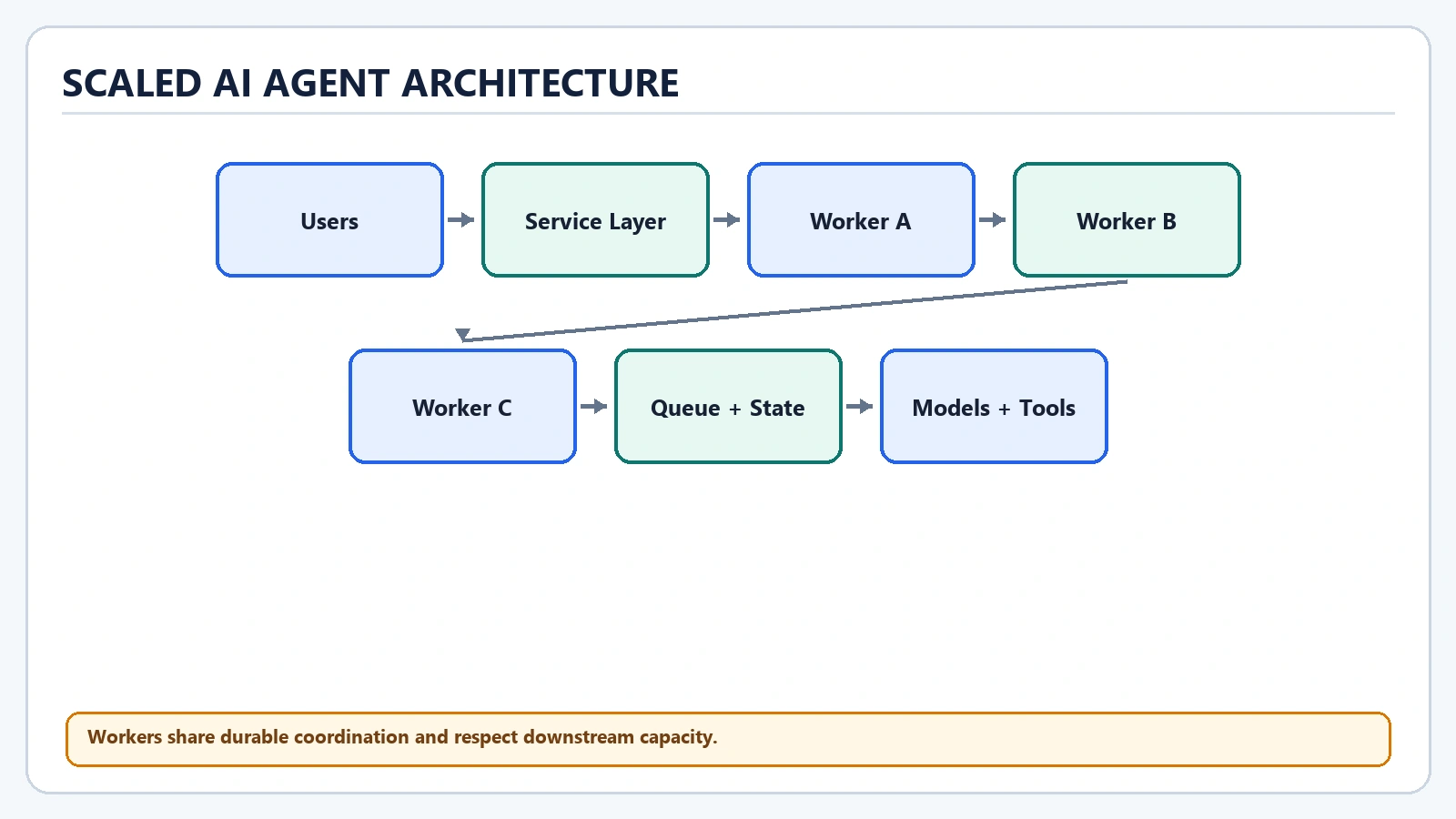
Grow workload capacity safely by separating stateless runtimes from durable tasks and protecting constrained dependencies.
TL;DR
- Scaling means handling more concurrent work or throughput while preserving correctness, quality, latency, reliability, and cost. It does not mean adding more agent personas. Start with the smallest architecture that meets demand; introduce replicas, workers, queues, and specialized services only when measurements justify them.
- Start by making workload, concurrency, and throughput and horizontal and vertical scaling visible in the complete task path.
- Avoid the shortcut of adding workers beyond provider capacity; test the failure state before release.
- Judge the result with arrival and completion rate and active tasks and queue depth, not an isolated infrastructure number.
The production mental model
Scaling means handling more concurrent work or throughput while preserving correctness, quality, latency, reliability, and cost. It does not mean adding more agent personas. Start with the smallest architecture that meets demand; introduce replicas, workers, queues, and specialized services only when measurements justify them.
Keep five layers separate. Model optimization changes inference; agent optimization changes decisions and tool use; workflow optimization changes sequencing and recovery; infrastructure optimization changes capacity and execution; business optimization changes whether the result is worthwhile. For Scaling AI Agent Systems, the most revealing evidence is usually arrival and completion rate together with active tasks and queue depth. That pairing prevents a local improvement from disguising a worse task outcome.
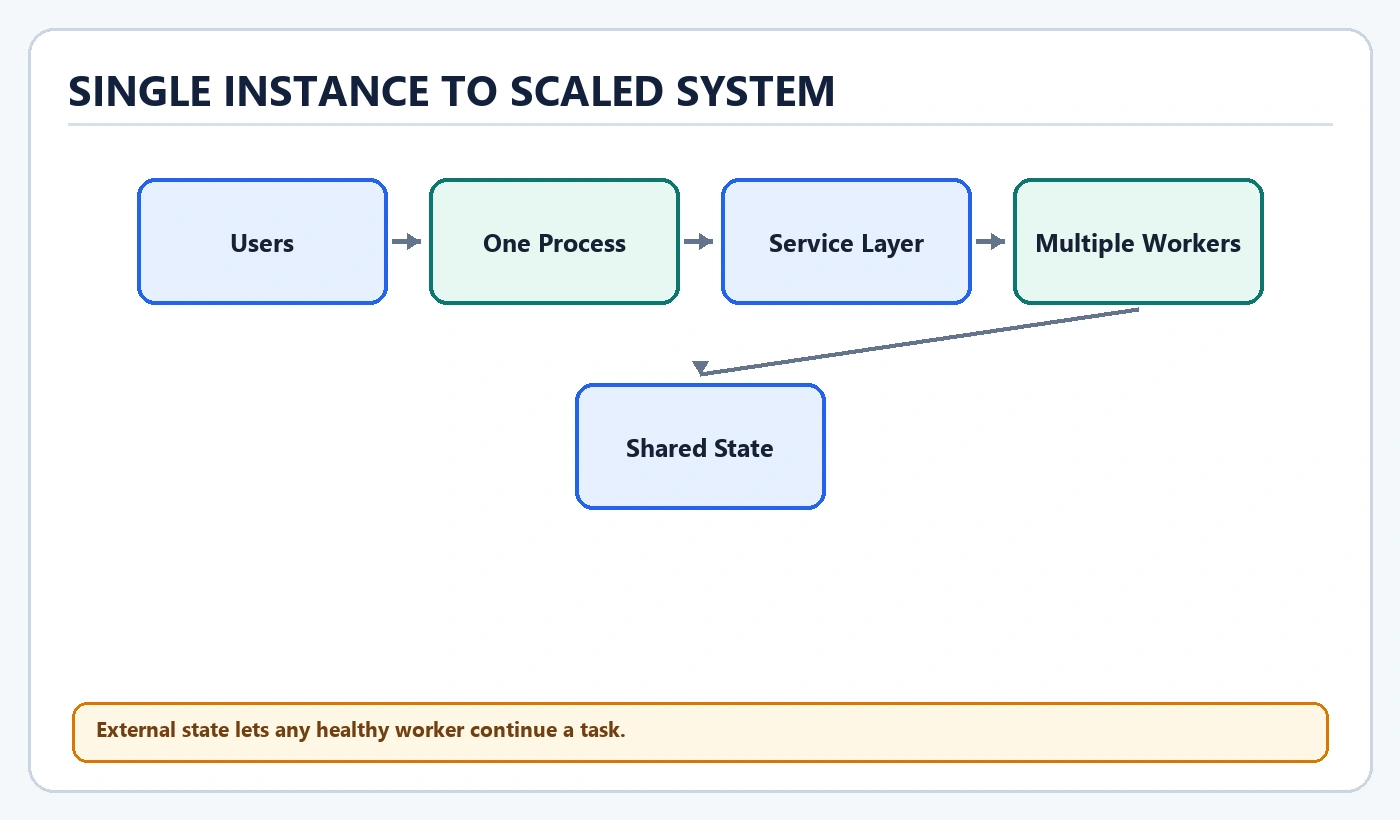
External state lets any healthy worker continue a task.
A concrete example
Replica A starts an account-review task, then the next request reaches Replica B. If critical task state lived only in A's memory, B cannot continue safely and a restart loses the run. A scalable design externalizes durable state, uses operation identities, lets workers claim bounded work, and treats model, tool, database, retrieval, and queue capacity as shared limits.
The example is deliberately vendor-neutral. Exact provider limits, prices, model features, and service guarantees change; the durable design is to discover those values from the selected service, keep them in versioned configuration, and test the behavior that occurs when an assumption stops being true.
How the system works
- Workload, concurrency, and throughput. Trace it as part of the complete task so local improvements do not hide downstream cost or failure.
- Horizontal and vertical scaling. Give it an explicit owner, boundary, and failure result; implicit behavior becomes difficult to test.
- Stateless service replicas. Measure it by workload class because read-only, interactive, background, and side-effecting tasks have different constraints.
- Durable task state. Keep the mechanism deterministic where it enforces identity, authority, durability, or resource limits.
- Workers, queues, and scheduling. Trace it as part of the complete task so local improvements do not hide downstream cost or failure.
- Load distribution. Give it an explicit owner, boundary, and failure result; implicit behavior becomes difficult to test.
- Provider and tool limits. Measure it by workload class because read-only, interactive, background, and side-effecting tasks have different constraints.
- Database and retrieval capacity. Keep the mechanism deterministic where it enforces identity, authority, durability, or resource limits.
- Multi-tenancy and isolation. Trace it as part of the complete task so local improvements do not hide downstream cost or failure.
- Failure domains, telemetry, and cost. Give it an explicit owner, boundary, and failure result; implicit behavior becomes difficult to test.
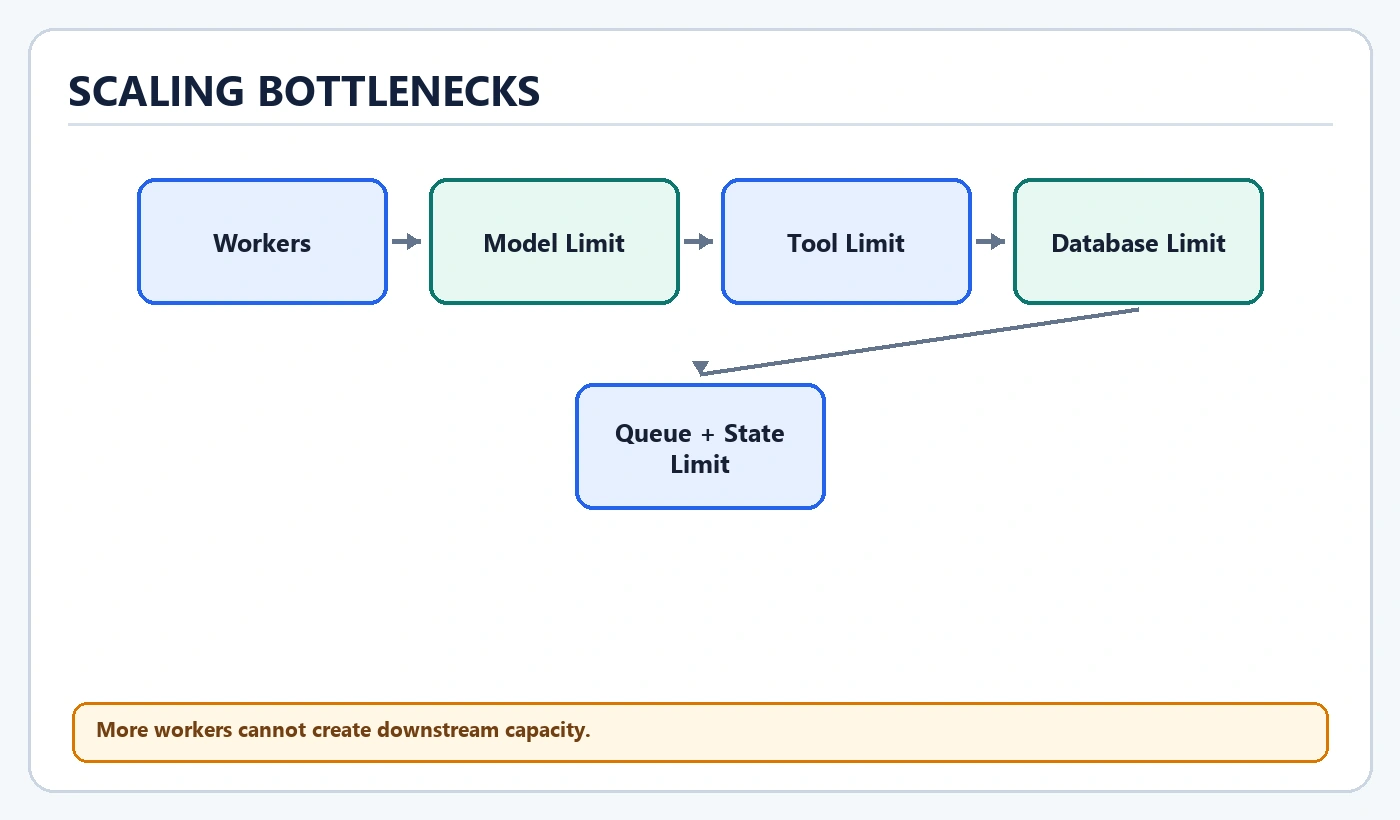
More workers cannot create downstream capacity.
A practical implementation path
1. Measure workload shape and the current bottleneck
Write down the current baseline and the evidence that would disprove the change. For this step, inspect stateless service replicas, watch arrival and completion rate, and explicitly test adding workers beyond provider capacity. Record the assumption, owner, expected result, and safe terminal state so the team can distinguish a genuine improvement from work shifted elsewhere in the system.
2. Keep a single process while it meets reliability and capacity needs
Place this responsibility in the component that can enforce it consistently. For this step, inspect durable task state, watch active tasks and queue depth, and explicitly test process-local critical state. Record the assumption, owner, expected result, and safe terminal state so the team can distinguish a genuine improvement from work shifted elsewhere in the system.
3. Add application replicas with external durable state
Version the decision so a run can be reconstructed after dependencies change. For this step, inspect workers, queues, and scheduling, watch oldest task age, and explicitly test unbounded queues. Record the assumption, owner, expected result, and safe terminal state so the team can distinguish a genuine improvement from work shifted elsewhere in the system.
4. Move slow background work to bounded workers
Exercise the denied, unavailable, stale, duplicate, and unknown-result paths as applicable. For this step, inspect load distribution, watch dependency saturation, and explicitly test scaling every component equally. Record the assumption, owner, expected result, and safe terminal state so the team can distinguish a genuine improvement from work shifted elsewhere in the system.
5. Use a queue when buffering, scheduling, or recovery is required
Use a production-representative trajectory; an empty endpoint test misses accumulated agent behavior. For this step, inspect provider and tool limits, watch success and timeout rate, and explicitly test introducing microservices before ownership requires them. Record the assumption, owner, expected result, and safe terminal state so the team can distinguish a genuine improvement from work shifted elsewhere in the system.
6. Apply per-tenant and per-dependency concurrency limits
Keep identity, permission, and resource limits outside model discretion. For this step, inspect database and retrieval capacity, watch cost and latency by workload class, and explicitly test confusing parallel agents with system capacity. Record the assumption, owner, expected result, and safe terminal state so the team can distinguish a genuine improvement from work shifted elsewhere in the system.
7. Scale consumers only within downstream capacity
Bound the work and define what happens when the bound is exhausted. For this step, inspect multi-tenancy and isolation, watch arrival and completion rate, and explicitly test ignoring noisy tenants. Record the assumption, owner, expected result, and safe terminal state so the team can distinguish a genuine improvement from work shifted elsewhere in the system.
8. Isolate expensive or failure-prone workloads
Attach telemetry to the task and compare the result with the previous version. For this step, inspect failure domains, telemetry, and cost, watch active tasks and queue depth, and explicitly test adding workers beyond provider capacity. Record the assumption, owner, expected result, and safe terminal state so the team can distinguish a genuine improvement from work shifted elsewhere in the system.
9. Load test realistic agent trajectories, not empty endpoints
Roll out gradually when the decision can affect live users or external systems. For this step, inspect workload, concurrency, and throughput, watch oldest task age, and explicitly test process-local critical state. Record the assumption, owner, expected result, and safe terminal state so the team can distinguish a genuine improvement from work shifted elsewhere in the system.
10. Revisit cost and operational complexity at every stage
Remove the mechanism if it adds burden without improving the intended outcome. For this step, inspect horizontal and vertical scaling, watch dependency saturation, and explicitly test unbounded queues. Record the assumption, owner, expected result, and safe terminal state so the team can distinguish a genuine improvement from work shifted elsewhere in the system.
Failure modes and anti-patterns
These mistakes are attractive because they appear to simplify the happy path. They move complexity into incidents, duplicate work, wrong outcomes, or unexplained bills:
- adding workers beyond provider capacity
- process-local critical state
- unbounded queues
- scaling every component equally
- introducing microservices before ownership requires them
- confusing parallel agents with system capacity
- ignoring noisy tenants
Test each failure with the same seriousness as the successful path. Capture whether the system confirmed success, confirmed failure, returned a partial result, entered a degraded mode, or ended with an unknown external outcome. An unknown result must never be silently rewritten as success or treated as definitely safe to repeat.
Commonly confused concepts
| Concept | Meaning | Compared with | Meaning |
|---|---|---|---|
| Scaling | increasing safe workload capacity | Performance optimization | making a given task use fewer resources or less time |
| Concurrency | tasks in progress together | Parallelism | work literally executing simultaneously |
| Stateless runtime | replica holds no required durable session facts | Stateful task | workflow has durable progress and evidence |
| Scaling agents | serving more agent work | Adding agents | introducing more logical roles |
The distinctions matter because each mechanism promises something different. A queue does not create capacity; a timeout does not prove an operation failed; a larger context does not guarantee relevance; and an alternate path does not become safe merely because the primary path is unavailable.
What to measure
- arrival and completion rate
- active tasks and queue depth
- oldest task age
- dependency saturation
- success and timeout rate
- cost and latency by workload class
Segment these signals by task type, deployment version, route, dependency, and tenant where appropriate. Averages alone can hide slow or failing task classes. Prefer cost and latency attached to successful, quality-checked outcomes. Use traces for causal investigation, metrics for trends, logs for discrete evidence, and production evaluations for behavioral quality. Do not invent a universal threshold: derive action levels from the service objective, baseline, consequence, and time available to respond.
When the complexity is unnecessary
A local, read-only experiment with public data and no durable workflow may not need the full machinery described here. For Scaling AI Agent Systems, begin with the simplest observable path that can measure arrival and completion rate. Add complexity when workload, concurrency, and throughput, horizontal and vertical scaling, or the consequences of adding workers beyond provider capacity create a concrete need. Simplicity is valuable only while it preserves the required outcome and makes failure visible.
Builder checklist
- Define the task, success evidence, and terminal failure states.
- Map workload, concurrency, and throughput, horizontal and vertical scaling, and stateless service replicas onto owned components.
- Rehearse adding workers beyond provider capacity and process-local critical state before increasing exposure.
- Bound calls, tokens, retries, elapsed time, queueing, and external side effects.
- Verify important outcomes before reporting completion.
- Compare changes using production-representative evaluations.
- Monitor arrival and completion rate beside active tasks and queue depth.
- Maintain a clear fallback, escalation, or safe-stop path.
My Take
The strongest approach to Scaling AI Agent Systems is to make its boundary measurable before making it clever. My default is to expose workload, concurrency, and throughput, attach it to arrival and completion rate, and preserve a clear response to adding workers beyond provider capacity. That creates a system a team can improve deliberately instead of one that looks efficient only on its happy path.
Continue learning
- [Deploying Ai Agents To Production](/deploying-ai-agents-to-production/)
- [Shared State And Context In Multi Agent Systems](/shared-state-and-context-in-multi-agent-systems/)
- [Rate Limits And Backpressure In Ai Agents](/rate-limits-and-backpressure-in-ai-agents/)
- [Production Monitoring For Ai Agents](/production-monitoring-for-ai-agents/)
Sources
These stable primary references support the standards and distributed-systems concepts used above; no current vendor pricing or product limits are asserted.